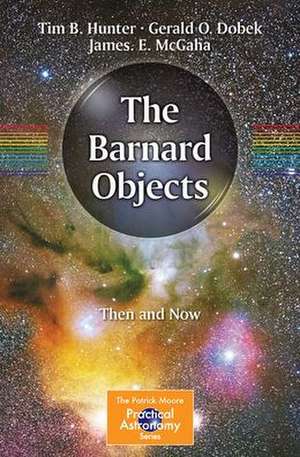
The Barnard Objects: Then and Now: The Patrick Moore Practical Astronomy Series
Autor Tim B. Hunter, Gerald O. Dobek, James E. McGahaen Limba Engleză Paperback – 20 iul 2023
Bazându-ne pe datele furnizate de editura Springer și pe cataloagele astronomice de referință, ne-a atras atenția această ediție din 2023 care reușește să pună în dialog moștenirea istorică a lui E.E. Barnard cu tehnologia contemporană. Apreciem modul în care autorii Tim B. Hunter, Gerald O. Dobek și James E. McGaha au structurat volumul The Barnard Objects: Then and Now nu doar ca pe un catalog, ci ca pe o analiză a progresului științific. Cartea debutează cu o introducere în fizica nebuloaselor și o istorie a cataloagelor astronomice, culminând cu un capitol esențial despre cele 25 de obiecte „dispărute” din listele originale, acum recuperate prin coordonate precise.
Remarcăm progresia logică a capitolelor: de la viața și munca lui Barnard (capitolul 4), la tehnici de observație vizuală (capitolul 5) și, în final, la procesarea imaginilor digitale moderne (capitolul 6). Cititorii familiarizați cu The Caldwell Objects and How to Observe Them de Martin Mobberley vor aprecia abordarea similară, care îmbină rigoarea datelor de catalog cu sfaturi practice pentru amatori, însă volumul de față aduce un plus de profunzime istorică, similară biografiei The Immortal Fire Within, concentrându-se specific pe „nebuloasele întunecate”.
Spre deosebire de lucrări pur vizuale precum Breakthrough!, acest titlu din seria The Patrick Moore Practical Astronomy Series pune un accent deosebit pe tranziția de la plăcile fotografice de acum un secol la senzorii CMOS/CCD de astăzi. Este o resursă care documentează transformarea astrofotografiei dintr-o artă solitară, practicată de „omul care nu dormea niciodată”, într-o disciplină accesibilă oricărui astronom amator dotat cu echipament digital.
Din seria The Patrick Moore Practical Astronomy Series
-
 Preț: 293.27 lei
 -
 Preț: 270.98 lei
 -
 Preț: 277.52 lei
 -
 Preț: 205.97 lei
 -
 Preț: 261.62 lei
 -
 Preț: 198.45 lei
 -
 Preț: 306.34 lei
 -
 Preț: 260.10 lei
 -
 Preț: 218.04 lei
 -
 Preț: 253.36 lei
 -
 Preț: 214.61 lei
 -
 Preț: 317.37 lei
 -
 Preț: 213.03 lei
 -
 Preț: 262.69 lei
 -
 Preț: 419.67 lei
 -
 Preț: 253.68 lei
 -
 Preț: 221.36 lei
 -
 Preț: 314.96 lei
 -
 Preț: 324.65 lei
 -
 Preț: 265.51 lei
 -
 Preț: 174.23 lei
 -
 Preț: 242.50 lei
 -
 Preț: 361.15 lei
 -
 Preț: 198.30 lei
 -
 Preț: 152.91 lei
 -
 Preț: 251.24 lei
 -
 Preț: 198.62 lei
 -
 Preț: 289.34 lei
 -
 Preț: 245.95 lei
 -
 Preț: 207.71 lei
 -
 Preț: 185.35 lei
 -
 Preț: 295.69 lei
 -
 Preț: 314.31 lei
 -
 Preț: 292.61 lei
 -
 Preț: 265.17 lei
 -
 Preț: 199.42 lei
 -
 Preț: 203.03 lei
 -
 Preț: 200.54 lei
 -
 Preț: 293.13 lei
 -
 Preț: 202.74 lei
 -
 Preț: 325.25 lei
 -
 Preț: 234.37 lei
 - 15%
 Preț: 671.63 lei
 -
 Preț: 257.38 lei
 -
 Preț: 270.13 lei
 -
 Preț: 293.18 lei
 -
 Preț: 205.46 lei
 -
 Preț: 314.31 lei
 -
 Preț: 144.54 lei
Preț: 280.23 lei
Carte disponibilă
Livrare economică 13-27 mai
Livrare express 29 aprilie-05 mai pentru 158.41 lei
Specificații
ISBN-10: 3031314840
Pagini: 388
Ilustrații: XL, 343 p. 108 illus., 91 illus. in color.
Dimensiuni: 155 x 235 x 16 mm
Greutate: 0.66 kg
Ediția:2023
Editura: Springer
Colecția The Patrick Moore Practical Astronomy Series
Seria The Patrick Moore Practical Astronomy Series
Locul publicării:Cham, Switzerland
De ce să citești această carte
Această carte este indispensabilă pentru astrofotografii care doresc să captureze nebuloasele întunecate, oferind coordonate actualizate pentru obiectele Barnard, inclusiv pentru cele anterior omise. Cititorul câștigă o înțelegere dublă: contextul istoric al descoperirilor lui E.E. Barnard și instrucțiuni tehnice moderne pentru observare. Este un instrument de lucru precis care transformă o sesiune de observații într-o incursiune în istoria astronomiei.
Despre autor
Autorii volumului sunt experți recunoscuți în comunitatea astronomică. Tim B. Hunter, Gerald O. Dobek și James E. McGaha combină decenii de experiență în observații practice și astrofotografie. Expertiza lor se reflectă în precizia tabelară a obiectelor Barnard și în capacitatea de a explica tranziția tehnologică de la era fotografiei chimice la cea digitală. Contribuția lor în seria „The Patrick Moore Practical Astronomy” consolidează standardele de excelență pentru ghidurile destinate astronomilor amatori și profesioniști deopotrivă.
Descriere scurtă
The chapters in this book are equal parts history and science. It will provide readers with an introduction to nebula science and the incredible discoveries made in this field over the decades; including an overview of popular astronomical catalogues and a detailed look at how astronomical imaging has advanced since Barnard’s time, from early plates to digital imaging and chips. In addition, the book features a comprehensive guide to viewing and imaging these objects yourself. A glossary of astronomical and photographic terms is provided, along with detailed references.And, an updated table displaying the locations of these Barnard Objects; including the missing twenty-five objects from E.E. Barnard’s original catalogue.
Richly researched and illustrated, this fascinating reference will attract astronomers of all skill levels interested in astrophotography and how it has changed over the past hundred years.
Cuprins
Notă biografică
James E. McGaha obtained a BS in management and physics from Georgia Tech University, an MA in management and psychology from Webster University, and a MS in Astronomy and Astrophysics from the University of Arizona. He is currently a retired United States Air Force pilot and is a skeptic lecturer. He is the Director of the Grasslands Observatory (www.3towers.com) and specializes in asteroid and comet astrometry and photometry. He has made over 2900 Minor Planet Electronic Circular (MPEC) publications of near-Earth objects (NEOs) and discovered 63 comets. He identified and performed photometry of optical afterglow of gamma ray burst 030329. He is a contributing author for Skeptical Inquirer magazine and is a scientific and technical consultant to the Committee for Skeptical Inquiry (CSI). He is a Fellow of the Royal Astronomical Society (RASC).
Prof. Gerald Orin Dobek obtained two BS degrees in Mathematics, Trinity College and Ferris State University, a MSc Honours in Astronomy from the University of Western Sydney and a DSc in Astronomy and Astrophysics from James Cook University. Dr. Dobek is currently the Head of Sciences and Department Head of Astronomy at Northwestern Michigan College, where he teaches Astronomy. As a professional astronomer, he researches small amplitude variable stars using his private observatory at his home in Traverse City, Michigan. Jerry also continues to research dark nebulous material in the Milky Way. In 2011, he republished Edward Emerson Barnard’s “A Photographic Atlas of Selected Regions of the Milky Way,” adding updated information and a mosaic of the fifty plates contained within the Atlas. Jerry holds membership in numerous astronomy and science organizations: FRAS, AAS, AAAS, AAVSO, ASP and is a founding member of the IDA.