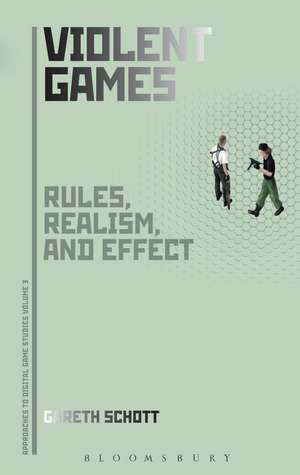
Violent Games: Rules, Realism and Effect: Approaches to Digital Game Studies
Autor Gareth Schotten Limba Engleză Hardback – 28 iul 2016
Drawing on new insights achieved from research located at an intersection between humanities, social and computer sciences, Gareth Schott's addition to the Approaches in Digital Game Studies series interrogates the nature and meaning of the "violence" encountered and experienced by game players. In focusing on the various ways "violence" is mediated by both the rule system and the semiotic layer of games, the aim is to draw out the distinctiveness of games' exploitation of violence or violent themes.
An important if not canonical text in the debates about video games and violence, Violent Games constitutes an essential book for those wishing to make sense of the experience offered by games as technological, aesthetic, and communicational phenomena in the context of issues of media regulation and the classification of game content "as" violence.
Din seria Approaches to Digital Game Studies
- nou
 Preț: 634.74 lei
 -
 Preț: 297.86 lei
 - 33%
 Preț: 218.20 lei
 - 32%
 Preț: 225.05 lei
 - 39%
 Preț: 226.16 lei
 - 14%
 Preț: 267.21 lei
 - 39%
 Preț: 239.43 lei
 - 42%
 Preț: 199.12 lei
 - 26%
 Preț: 213.66 lei
 - 32%
 Preț: 596.09 lei
 - 41%
 Preț: 590.34 lei
 - 41%
 Preț: 591.31 lei
 - 32%
 Preț: 596.25 lei
 - nou
 Preț: 589.73 lei
 - nou
 Preț: 343.09 lei
Preț: 898.18 lei
Preț vechi: 1190.55 lei
-25%
Puncte Express: 1347
Carte tipărită la comandă
Livrare economică 07-21 decembrie
Livrare prin curier în România Termenul estimat este afișat lângă disponibilitate.
Transport gratuit pentru acest produs Plată online sau ramburs, în funcție de opțiunile comenzii.
Retur gratuit în 14 zile Comandă securizată și suport în română.
Specificații
ISBN-13: 9781628925623
ISBN-10: 1628925620
Pagini: 288
Ilustrații: 25 bw illus
Dimensiuni: 146 x 218 x 22 mm
Greutate: 0.48 kg
Editura: Bloomsbury Publishing
Colecția Bloomsbury Academic
Seria Approaches to Digital Game Studies
Locul publicării:New York, United States
ISBN-10: 1628925620
Pagini: 288
Ilustrații: 25 bw illus
Dimensiuni: 146 x 218 x 22 mm
Greutate: 0.48 kg
Editura: Bloomsbury Publishing
Colecția Bloomsbury Academic
Seria Approaches to Digital Game Studies
Locul publicării:New York, United States
V-ar putea interesa
-
 How a Game LivesJacob Geller-20%Preț: 191.62 lei239.53 lei
 -
 Rules of PlayEric Zimmerman-20%Preț: 534.15 lei667.69 lei
 -
 Playing at the World, 2E, Volume 2Jon PetersonPreț: 450.95 lei
 -
 How to Do Things with VideogamesIan Bogost-20%Preț: 112.89 lei141.10 lei
 -
 Vgc: The 2025 Guide to Video GamesMedia LtdPreț: 231.63 lei
 -
 Aesthetics and Video GamesChristopher Bartel-10%Preț: 147.79 lei164.61 lei
 -
 -26%Preț: 68.96 lei93.06 lei
 -
 Board Games as MediaDr. Paul Booth-19%Preț: 179.42 lei220.63 lei
 -
 -32%Preț: 599.99 lei878.76 lei
 -
 Preț: 356.57 lei
 -
 Preț: 330.77 lei
 -
 Everything to Play ForMarijam DidPreț: 130.09 lei
 -
 ViolenceSlavoj Zizek-19%Preț: 69.00 lei85.36 lei
 -
 VideogamesMarie Foulston-36%Preț: 141.29 lei221.19 lei
 -
 Playthrough Poetics: Gameplay as Research MethodMilena Droumeva-20%Preț: 103.87 lei129.84 lei
 -
 Games That Haunt Us: Gothic Game Space as a Living NightmareStephanie Farnsworth-32%Preț: 596.25 lei878.53 lei
Cuprins
Preface
Chapter 1 - Violent Games / Game Violence
Chapter 2 - Violent Media as a Political Conception
Chapter 3 - Games as Artifice
Chapter 4 - Subjective Realism
Chapter 5 - Performative Inquiry,Intent and Awareness
Chapter 6 - The Activation of Violence
Chapter 7 - The Aestheticisation of Violence
Chapter 8 - Undeniable Content and Serious Intent
Chapter 9 - Adopting a Configurative Sensibility
Bibliography
Index
Chapter 1 - Violent Games / Game Violence
Chapter 2 - Violent Media as a Political Conception
Chapter 3 - Games as Artifice
Chapter 4 - Subjective Realism
Chapter 5 - Performative Inquiry,Intent and Awareness
Chapter 6 - The Activation of Violence
Chapter 7 - The Aestheticisation of Violence
Chapter 8 - Undeniable Content and Serious Intent
Chapter 9 - Adopting a Configurative Sensibility
Bibliography
Index
Recenzii
Gareth Schott's examination of the debates surrounding violent video games presents an important and fresh perspective on this contentious issue. Given the moral panic surrounding games, scholars have increasingly been calling for more sociological examinations of the phenomenology of media panics and media research itself. Schott's work represents a cogent effort in this regard that should be required reading of all students and scholars of media effects.
The interrelationships between video games, virtual or simulated aggression, violence and ludic fictionality are among the most complex and controversial in the fields of studies and culture of video games. Based on a thorough examination of existing game research and new evidence, Gareth Schott's book is the most comprehensive and thoughtful reflection yet written on game violence. The reader will not only learn about how violent elements become experienced in the context of video game play, but also to reappraise what we mean by 'violence', to start with. Learned and articulate, Violent Games will open new avenues for thought for both students and scholars, and also provide a solid foundation for the decision making by parents, educators and policy creators alike.
Wonderful read. Schott takes a thoughtful and balanced approach at explaining the complexity around media effects broadly and video game violence specifically, and does a superb job of weaving together scholarship from a variety of expected (communication, game studies/game theory, media psychology, rhetoric) and unexpected (criminology, dramaturgy, film studies, sociology, just to name a few) areas. The result is a volume easily accessible to a variety of different audiences - a touchstone for designers and scholars, a comprehensive reader for a graduate-level seminar on video games, and chapters of the book would be accessible to younger audiences, such as undergraduates. The book blends familiar and unfamiliar scholarship to help better address the "real issues" around the video game violence debate, as the volume puts those issues into focus. The result is a book that marks the past and present of game studies, and offers myriad suggestions for the future of the same.
The interrelationships between video games, virtual or simulated aggression, violence and ludic fictionality are among the most complex and controversial in the fields of studies and culture of video games. Based on a thorough examination of existing game research and new evidence, Gareth Schott's book is the most comprehensive and thoughtful reflection yet written on game violence. The reader will not only learn about how violent elements become experienced in the context of video game play, but also to reappraise what we mean by 'violence', to start with. Learned and articulate, Violent Games will open new avenues for thought for both students and scholars, and also provide a solid foundation for the decision making by parents, educators and policy creators alike.
Wonderful read. Schott takes a thoughtful and balanced approach at explaining the complexity around media effects broadly and video game violence specifically, and does a superb job of weaving together scholarship from a variety of expected (communication, game studies/game theory, media psychology, rhetoric) and unexpected (criminology, dramaturgy, film studies, sociology, just to name a few) areas. The result is a volume easily accessible to a variety of different audiences - a touchstone for designers and scholars, a comprehensive reader for a graduate-level seminar on video games, and chapters of the book would be accessible to younger audiences, such as undergraduates. The book blends familiar and unfamiliar scholarship to help better address the "real issues" around the video game violence debate, as the volume puts those issues into focus. The result is a book that marks the past and present of game studies, and offers myriad suggestions for the future of the same.