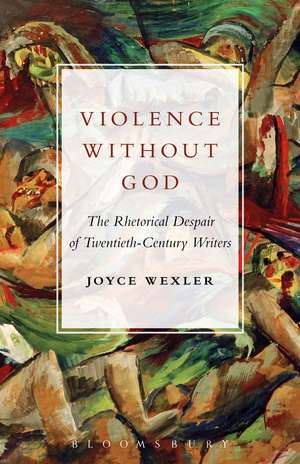
Violence Without God: The Rhetorical Despair of Twentieth-Century Writers
Autor Professor Joyce Wexleren Limba Engleză Paperback – dec 2016
In this major new study, Joyce Wexler argues that this situation produced an aesthetic dilemma that writers solved by inventing new forms. Although Symbolism, Expressionism, Modernism, Magic Realism, and Postmodernism have been criticized for turning away from public events, these forms allowed writers to represent violence without imposing a specific meaning on events or claiming to explain them. Wexler's investigation of the way we think and write about violence takes her across national and period boundaries and into the work of some of the greatest writers of the century, among them Joseph Conrad, T. S. Eliot, D. H. Lawrence, James Joyce, Alfred Döblin, Günter Grass, Gabriel García Márquez, Salman Rushdie, and W. G. Sebald.
Preț: 178.27 lei
Preț vechi: 214.35 lei
-17%
Puncte Express: 267
Carte tipărită la comandă
Livrare economică 18 noiembrie-02 decembrie
Livrare prin curier în România Termenul estimat este afișat lângă disponibilitate.
Transport gratuit de la 400.00 lei Plată online sau ramburs, în funcție de opțiunile comenzii.
Retur gratuit în 14 zile Comandă securizată și suport în română.
Specificații
ISBN-13: 9781501325281
ISBN-10: 1501325280
Pagini: 216
Dimensiuni: 140 x 216 x 23 mm
Greutate: 0.3 kg
Editura: Bloomsbury Publishing
Colecția Bloomsbury Academic
Locul publicării:New York, United States
ISBN-10: 1501325280
Pagini: 216
Dimensiuni: 140 x 216 x 23 mm
Greutate: 0.3 kg
Editura: Bloomsbury Publishing
Colecția Bloomsbury Academic
Locul publicării:New York, United States
V-ar putea interesa
-
 Duino Elegies & the Sonnets to OrpheusRainer Maria Rilke-27%Preț: 79.56 lei109.06 lei
 -
 Letters Between a Father and SonV. S. Naipaul-35%Preț: 78.03 lei119.51 lei
 -
 -30%Preț: 73.96 lei105.74 lei
 -
 DeaEdward Bond-24%Preț: 86.04 lei112.92 lei
 -
 If We Got Some More Cocaine I Could Show You How I Love YouJohn O'Donovan-26%Preț: 84.73 lei114.10 lei
 -
 Home ChatNoël Coward-23%Preț: 86.68 lei113.30 lei
 -
 In Other WordsJhumpa Lahiri-27%Preț: 57.81 lei78.89 lei
 -
 Joy Ride: Lives of the TheatricalsJohn Lahr-29%Preț: 99.63 lei140.10 lei
 -
 A Taste of Honey GCSE Student EditionShelagh Delaney-11%Preț: 86.75 lei97.89 lei
 -
 A Taste of Honey GCSE Student GuideKate Whittaker-13%Preț: 78.43 lei90.32 lei
 -
 This Wide NightChloe Moss-6%Preț: 85.85 lei91.22 lei
 -
 Magic of the RunesSamael Aun WeorPreț: 93.81 lei
Cuprins
Acknowledgments
Introduction: The Problem
1. Symbolism in a Secular Age
2. T. S. Eliot's Expressionist Angst
3. D. H. Lawrence's Women in Love and Men at War
4. Ulysses, the Mythical Method, and Magic Realism
5. The German Route from Ulysses to Magic Realism
6. How to Write about the Holocaust
Epilogue: The End of the Secular Age
Bibliography
Index
Introduction: The Problem
1. Symbolism in a Secular Age
2. T. S. Eliot's Expressionist Angst
3. D. H. Lawrence's Women in Love and Men at War
4. Ulysses, the Mythical Method, and Magic Realism
5. The German Route from Ulysses to Magic Realism
6. How to Write about the Holocaust
Epilogue: The End of the Secular Age
Bibliography
Index
Recenzii
Joyce Wexler makes an important, theoretically informed argument about the many ways in which the experimental indeterminacies of modernist form respond to the social and historical dilemmas of the long twentieth century. She provides a coherent account of an exceptional variety of texts without oversimplifications that ignore or reduce their differences. Students, teachers, and readers of all kinds will find this book an accessible, engaging introduction to modern fiction in particular and to the modern period in general.
Violence Without God pursues the riveting question of the relationship between unthinkable violence and various twentieth-century avant gardes. Working with Charles Taylor's argument that, when secularism is understood as a lack of consensus about what to believe, the uncontainability of violence becomes incomprehensible to modern minds. In tracking that issue, this book uncovers some extraordinary continuities between early modernism, interwar modernism, late modernism, postwar writing, and postcolonialism, while simultaneously delineating how and why their distinctive aesthetic shifts occurred. This book offers an equally impressive intervention in recent developments within modernist studies and global comparativism. Its close comparisons between Anglo and Germanic texts mark a major step in delineating those crucial cross-cultural relationships.
Ambitious, impressive, and provocative . Violence Without God is an important, exciting book that I found myself thinking about for some time after I read it . An exemplar of well-executed, bold scholarship written in lucid, energetic prose that can help us to rethink the intersections between form and history in modern literature. Wexler deftly moves among texts and theories (including trauma theory, new materialist theories, and psychoanalysis) to construct the kind of original argument that offers a new way of thinking about literary history of the past century.
Violence Without God pursues the riveting question of the relationship between unthinkable violence and various twentieth-century avant gardes. Working with Charles Taylor's argument that, when secularism is understood as a lack of consensus about what to believe, the uncontainability of violence becomes incomprehensible to modern minds. In tracking that issue, this book uncovers some extraordinary continuities between early modernism, interwar modernism, late modernism, postwar writing, and postcolonialism, while simultaneously delineating how and why their distinctive aesthetic shifts occurred. This book offers an equally impressive intervention in recent developments within modernist studies and global comparativism. Its close comparisons between Anglo and Germanic texts mark a major step in delineating those crucial cross-cultural relationships.
Ambitious, impressive, and provocative . Violence Without God is an important, exciting book that I found myself thinking about for some time after I read it . An exemplar of well-executed, bold scholarship written in lucid, energetic prose that can help us to rethink the intersections between form and history in modern literature. Wexler deftly moves among texts and theories (including trauma theory, new materialist theories, and psychoanalysis) to construct the kind of original argument that offers a new way of thinking about literary history of the past century.