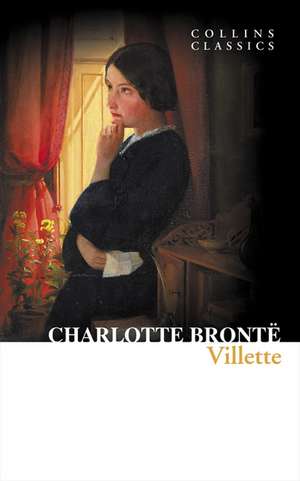
Villette: Collins Classics
Autor Charlotte Brontëen Limba Engleză Paperback – 31 dec 2011
| Toate formatele și edițiile | Preț | Express |
|---|---|---|
| Paperback (8) | 53.86 lei 22-27 zile | +28.79 lei 6-12 zile |
| Oxford University Press – 17 apr 2008 | 53.86 lei 22-27 zile | +28.79 lei 6-12 zile |
| Penguin Books – 28 dec 2004 | 60.51 lei 22-33 zile | +39.79 lei 6-12 zile |
| Random House – 9 oct 2001 | 85.00 lei 3-5 săpt. | |
| BROADVIEW PR – 16 dec 2005 | 187.38 lei 3-5 săpt. | |
| Mint Editions – 30 noi 2020 | 113.51 lei 3-5 săpt. | |
| e-artnow – 24 mai 2023 | 131.25 lei 39-44 zile | |
| Indoeuropeanpublishing.com – 14 ian 2019 | 156.37 lei 6-8 săpt. | |
| ALPHA EDITION – 19 noi 2024 | 173.02 lei 3-5 săpt. | |
| Hardback (2) | 233.02 lei 6-8 săpt. | |
| Indoeuropeanpublishing.com – 15 ian 2019 | 233.02 lei 6-8 săpt. | |
| OUP OXFORD – 14 feb 1985 | 1542.23 lei 43-48 zile |
Din seria Collins Classics
-
 Preț: 24.60 lei
 -
 Preț: 24.60 lei
 -
 Preț: 24.60 lei
 -
 Preț: 24.60 lei
 -
 Preț: 24.60 lei
 -
 Preț: 24.60 lei
 -
 Preț: 24.60 lei
 -
 Preț: 24.60 lei
 -
 Preț: 24.60 lei
 -
 Preț: 24.60 lei
 -
 Preț: 24.60 lei
 -
 Preț: 24.60 lei
 -
 Preț: 24.60 lei
 -
 Preț: 24.60 lei
 -
 Preț: 24.60 lei
 -
 Preț: 24.60 lei
 -
 Preț: 24.60 lei
 -
 Preț: 24.60 lei
 -
 Preț: 24.60 lei
 -
 Preț: 24.60 lei
 -
 Preț: 24.60 lei
 -
 Preț: 24.60 lei
 -
 Preț: 24.60 lei
 -
 Preț: 24.60 lei
 -
 Preț: 24.60 lei
 -
 Preț: 24.60 lei
 -
 Preț: 24.60 lei
 -
 Preț: 24.60 lei
 -
 Preț: 24.60 lei
 -
 Preț: 24.60 lei
 -
 Preț: 24.60 lei
 -
 Preț: 24.60 lei
 -
 Preț: 24.60 lei
 -
 Preț: 24.60 lei
 -
 Preț: 24.60 lei
 -
 Preț: 24.60 lei
 -
 Preț: 24.60 lei
 -
 Preț: 24.60 lei
 -
 Preț: 24.60 lei
 -
 Preț: 24.60 lei
 -
 Preț: 24.60 lei
 -
 Preț: 24.60 lei
 -
 Preț: 24.60 lei
 -
 Preț: 24.60 lei
 -
 Preț: 24.60 lei
 -
 Preț: 24.60 lei
 -
 Preț: 24.60 lei
 -
 Preț: 24.60 lei
 -
 Preț: 24.60 lei
 -
 Preț: 24.60 lei
Preț: 22.38 lei
Preț vechi: 33.41 lei
-33%
Puncte Express: 34
Preț estimativ în valută:
3.96€ • 4.58$ • 3.42£
3.96€ • 4.58$ • 3.42£
Carte indisponibilă temporar
Doresc să fiu notificat când acest titlu va fi disponibil:
Se trimite...
Specificații
ISBN-13: 9780007449415
ISBN-10: 0007449410
Pagini: 192
Dimensiuni: 109 x 36 x 181 mm
Greutate: 0.3 kg
Editura: HarperCollins Publishers
Seria Collins Classics
ISBN-10: 0007449410
Pagini: 192
Dimensiuni: 109 x 36 x 181 mm
Greutate: 0.3 kg
Editura: HarperCollins Publishers
Seria Collins Classics
V-ar putea interesa
-
 Selected DiariesVirginia Woolf-18%Preț: 74.07 lei90.86 lei
 -
 The Fire Next TimeJames Baldwin-30%Preț: 47.20 lei67.07 lei
 -
 Nobody Knows My NameJames Baldwin-21%Preț: 58.99 lei74.65 lei
 -
 The Collected Dorothy ParkerDorothy Parker-18%Preț: 74.25 lei90.96 lei
 -
 Memoirs of a Dutiful DaughterSimone de Beauvoir-19%Preț: 61.29 lei76.05 lei
 -
 The Autobiography of Alice B. ToklasGertrude Stein-27%Preț: 54.65 lei75.07 lei
 -
 Giovanni's RoomJames Baldwin-28%Preț: 53.44 lei74.37 lei
 -
 Simone Weil: An AnthologySimone WeilPreț: 89.22 lei
 -
 A Day in the Life of a Smiling WomanMargaret DrabblePreț: 75.02 lei
 -
 -25%Preț: 67.29 lei89.97 lei
 -
 Selected WritingsAnna Freud-20%Preț: 81.60 lei102.50 lei
 -
 A Gift of LoveMartin Luther King Jr.-21%Preț: 54.08 lei68.12 lei
 -
 The MoonstoneWilkie Collins-17%Preț: 53.52 lei64.25 lei
 -
 Selected LettersCharlotte Brontë-20%Preț: 60.50 lei75.56 lei
 -
 The Pumpkin EaterPenelope MortimerPreț: 74.23 lei
 -
 -40%Preț: 16.31 lei27.12 lei
 -
 Pedagogy of the OppressedPaulo Freire-28%Preț: 53.16 lei74.19 lei
 -
 Notes of a Native SonJames Baldwin-28%Preț: 53.98 lei74.70 lei
 -
 My AntoniaWilla Cather-20%Preț: 54.56 lei68.43 lei
 -
 Tell Me How Long the Train's Been GoneJames Baldwin-26%Preț: 56.32 lei76.11 lei
 -
 Why We Can't WaitMartin Luther King Jr.-21%Preț: 53.88 lei68.02 lei
 -
 A WomanSibilla Aleramo-28%Preț: 53.96 lei74.85 lei
 -
 Lady Sings the BluesBillie Holiday-28%Preț: 53.56 lei74.41 lei
 -
 Great ExpectationsKathy Acker-22%Preț: 52.96 lei67.48 lei
 -
 Black Skin, White MasksFrantz Fanon-28%Preț: 54.28 lei74.89 lei
 -
 Women, Race & ClassAngela Y. Davis-27%Preț: 54.68 lei75.11 lei
 -
 Sister OutsiderAudre Lorde-28%Preț: 53.91 lei74.65 lei
 -
 The WavesVirginia WoolfPreț: 34.58 lei
 -
 ShirleyCharlotte BrontePreț: 37.07 lei
 -
 The ProfessorCharlotte BrontePreț: 34.98 lei
Notă biografică
Much-loved English author Charlotte Bronte published her first semi-autobiographical novel about a governess, Jane Eyre in 1847. Despite her critique of society's treatment of impoverished women, Jane Eyre became an immediate literary classic which she later followed with her novels Shirley and Vilette.
Descriere
Descriere de la o altă ediție sau format:
'I am only just returned to a sense of the real world about me, for I have been reading Villette, a still more wonderful book than Jane Eyre.' George Eliot Lucy Snowe, in flight from an unhappy past, leaves England and finds work as a teacher in Madame Beck's school in 'Villette'. Strongly drawn to the fiery autocratic schoolmaster Monsieur Paul Emanuel, Lucy is compelled by Madame Beck's jealous interference to assert her right to love and be loved. Based in part on Charlotte Brontë's experience in Brussels ten years earlier, Villette (1853) is a cogent and dramatic exploration of a woman's response to the challenge of a constricting social environment. Its deployment of imagery comparable in power to that of Emily Brontë's Wuthering Heights, and its use of comedy–ironic or exuberant–in the service of an ultimately sombre vision, make Villette especially appealing to the modern reader. ABOUT THE SERIES: For over 100 years Oxford World's Classics has made available the widest range of literature from around the globe. Each affordable volume reflects Oxford's commitment to scholarship, providing the most accurate text plus a wealth of other valuable features, including expert introductions by leading authorities, helpful notes to clarify the text, up-to-date bibliographies for further study, and much more.
'I am only just returned to a sense of the real world about me, for I have been reading Villette, a still more wonderful book than Jane Eyre.' George Eliot Lucy Snowe, in flight from an unhappy past, leaves England and finds work as a teacher in Madame Beck's school in 'Villette'. Strongly drawn to the fiery autocratic schoolmaster Monsieur Paul Emanuel, Lucy is compelled by Madame Beck's jealous interference to assert her right to love and be loved. Based in part on Charlotte Brontë's experience in Brussels ten years earlier, Villette (1853) is a cogent and dramatic exploration of a woman's response to the challenge of a constricting social environment. Its deployment of imagery comparable in power to that of Emily Brontë's Wuthering Heights, and its use of comedy–ironic or exuberant–in the service of an ultimately sombre vision, make Villette especially appealing to the modern reader. ABOUT THE SERIES: For over 100 years Oxford World's Classics has made available the widest range of literature from around the globe. Each affordable volume reflects Oxford's commitment to scholarship, providing the most accurate text plus a wealth of other valuable features, including expert introductions by leading authorities, helpful notes to clarify the text, up-to-date bibliographies for further study, and much more.
Recenzii
Charlotte Brontë’s contemporary George Eliot wrote of Villette, “There is something almost preternatural in its power.” The deceptive stillness and security of a girls’ school provide the setting for this 1853 novel, Brontë’s last. Modelled on Brontë’s own experiences as a student and teacher in Brussels, Villette is the sombre but engrossing story of Lucy Snowe, an unmarried Englishwoman making her way in a culture deeply foreign to her. The heroine’s relationships with the fiery professor M. Paul, the cool Englishman Dr. John, and the school’s powerful headmistress, Madame Beck, are described in her compelling and enigmatic first-person narration.
This Broadview edition includes a critical introduction by Kate Lawson and Lynn Shakinovsky. The many contextual documents include contemporary writings on surveillance and espionage, anti-Catholicism, and working women, as well as letters describing Brontë’s own time in Brussels.
“This edition of Villette gives readers the understanding necessary to fully enter what Kate Lawson and Lynn Shakinovsky call its ‘demanding, sometimes punishing narrative mode.’ Their introduction justifies and celebrates the gaps and evasions in the text as the ‘heretic narrative’ of a protagonist who does not always understand herself. The useful appendices—notably on women and love, women and work, and anti-Catholicism—provide the historical material to contextualise the story. The edition admirably demonstrates that this paradoxical narrative—a domestic novel about work, a love story about repression, and a realist text that embraces the supernatural—repays and rewards close examination.” — Maggie Berg, Queen’s University
“Kate Lawson’s edition of Villette is expansive and precise, like the novel it contextualizes and introduces so well. Providing a rich analysis of the complex themes of the novel, the introduction at once acknowledges and limns the text’s resistance to codification and carefully suggests the beautiful patterns in its seeming inconsistencies. The primary materials provide further context for the novel, particularly in regards to the ‘Woman Question.’ Arranged to be in dialogue with each other about this pivotal topic, these materials provide the background necessary for understanding the novel’s involvement with those discussions.” — Gail Turley Houston, University of New Mexico
This Broadview edition includes a critical introduction by Kate Lawson and Lynn Shakinovsky. The many contextual documents include contemporary writings on surveillance and espionage, anti-Catholicism, and working women, as well as letters describing Brontë’s own time in Brussels.
“This edition of Villette gives readers the understanding necessary to fully enter what Kate Lawson and Lynn Shakinovsky call its ‘demanding, sometimes punishing narrative mode.’ Their introduction justifies and celebrates the gaps and evasions in the text as the ‘heretic narrative’ of a protagonist who does not always understand herself. The useful appendices—notably on women and love, women and work, and anti-Catholicism—provide the historical material to contextualise the story. The edition admirably demonstrates that this paradoxical narrative—a domestic novel about work, a love story about repression, and a realist text that embraces the supernatural—repays and rewards close examination.” — Maggie Berg, Queen’s University
“Kate Lawson’s edition of Villette is expansive and precise, like the novel it contextualizes and introduces so well. Providing a rich analysis of the complex themes of the novel, the introduction at once acknowledges and limns the text’s resistance to codification and carefully suggests the beautiful patterns in its seeming inconsistencies. The primary materials provide further context for the novel, particularly in regards to the ‘Woman Question.’ Arranged to be in dialogue with each other about this pivotal topic, these materials provide the background necessary for understanding the novel’s involvement with those discussions.” — Gail Turley Houston, University of New Mexico
Cuprins
Acknowledgements
Introduction
Charlotte Brontë: A Brief Chronology
A Note on the Text
Villette
Appendix A: Brontë and Brussels
Introduction
Charlotte Brontë: A Brief Chronology
A Note on the Text
Villette
Appendix A: Brontë and Brussels
- Letter from Charlotte Brontë to Emily Brontë, 2 September 1843
- Letter from Charlotte Brontë to Constantin Heger, 8 January 1845 (translation)
- Letter from Charlotte Brontë to Constantin Heger, 18 November 1845 (translation)
- Mark 4: 35-41
- Acts 27: 1, 9-16, 18-31, 39-44
- From Sarah Stickney Ellis, The Daughters of England (1842)
- From Dinah Maria Mulock Craik, Olive (1850)
- From Harriet Martineau, Review of Villette. Daily News (3 February 1853)
- From William Makepeace Thackeray, letter to Lucy Baxter (11 March 1853)
- From Sarah Stickney Ellis, The Women of England (1839)
- From Margaret Fuller, Woman in the Nineteenth Century (1845)
- Letter from Charlotte Brontë to Ellen Nussey, 24 June 1851
- From Harriet Taylor Mill, “The Enfranchisement of Women.” Westminster Review, July 1851
- Letter from Charlotte Brontë to Elizabeth Gaskell, 20 September 1851
- From Dinah Maria Mulock Craik, A Woman’s Thoughts About Women (1858)
- The Post Office Espionage Case, 1844-45
- “Opening Letters at the Post Office.” Hansard: House of Lords, 17 June 1844
- “Alleged Post-Office Espionage,” The Times, 25 June 1844
- The Times, 7 August 1844
- The Times, 5 June 1845
- From “Reflections Suggested by the Career of the Late Premier.” Blackwood’s Edinburgh Magazine,January 1847
- From Charlotte Brontë, The Professor (1857)
- From Mary Elizabeth Braddon, Aurora Floyd (1863)
- From Patrick Brontë, “The Maid of Killarney; or Albion and Flora: A Modern Tale; In Which Are Interwoven someCursory Remarks on Religion and Politics” (1818)
- From Maria Monk, Awful Disclosures of Maria Monk, as Exhibited in a Narrative of her Sufferings during a residence of five years as a novice, two as a black nun in the Hotel DieuNunnery at Montreal (1836)
- From Thomas De Quincey, “Maynooth.” Blackwood’s Edinburgh Magazine, May 1845
- From Charles Neaves, “Priests, Women and Families.” Blackwood’s Edinburgh Magazine, May 1845
- “Papal Aggression”
- From Nicholas Wiseman, Archbishop of Westminster. A Pastoral Letter, “From Outside the Flaminian Gate,” 7October 1850
- The Times, 14 October 1850