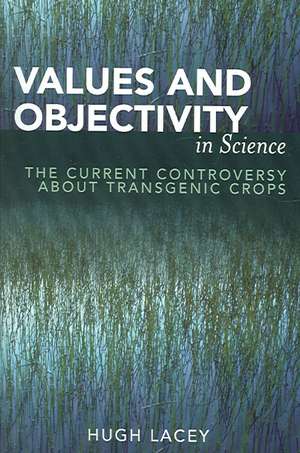
Values and Objectivity in Science: The Current Controversy about Transgenic Crops
Autor Hugh Laceyen Limba Engleză Paperback – 8 iun 2005
Preț: 324.09 lei
Preț vechi: 417.99 lei
-22%
Puncte Express: 486
Carte tipărită la comandă
Livrare economică 28 noiembrie-12 decembrie
Livrare prin curier în România Termenul estimat este afișat lângă disponibilitate.
Transport gratuit de la 400.00 lei Plată online sau ramburs, în funcție de opțiunile comenzii.
Retur gratuit în 14 zile Comandă securizată și suport în română.
Specificații
ISBN-13: 9780739111413
ISBN-10: 0739111418
Pagini: 304
Dimensiuni: 168 x 226 x 23 mm
Greutate: 0.45 kg
Ediția:New.
Editura: Bloomsbury Publishing
Colecția Lexington Books
Locul publicării:New York, United States
ISBN-10: 0739111418
Pagini: 304
Dimensiuni: 168 x 226 x 23 mm
Greutate: 0.45 kg
Ediția:New.
Editura: Bloomsbury Publishing
Colecția Lexington Books
Locul publicării:New York, United States
V-ar putea interesa
-
 Only a TheoryKenneth R. MillerPreț: 146.52 lei
 -
 Emergence: From Chaos to OrderJohn H. Holland-16%Preț: 166.67 lei199.49 lei
 -
 The Essential TuringB. Jack. Copeland-9%Preț: 255.91 lei280.24 lei
 -
 -18%Preț: 343.20 lei419.95 lei
 -
 -28%Preț: 357.49 lei494.52 lei
 -
 -12%Preț: 275.55 lei314.40 lei
 -
 The Demon-Haunted WorldCarl SaganPreț: 124.08 lei
 -
 The Quark And The Jaguar: Adventures in the Simple and the ComplexMurray Gell-Mann-26%Preț: 79.42 lei107.77 lei
 -
 The Cambridge Companion to the Philosophy of BiologyMichael RusePreț: 337.64 lei
 -
 The Turning PointFritjof CapraPreț: 157.38 lei
 -
 -45%Preț: 130.87 lei236.37 lei
 -
 The Evolutionary MindRalph AbrahamPreț: 103.71 lei
 -
 A Sense of the MysteriousAlan LightmanPreț: 108.03 lei
 -
 The Quantum and the LotusMatthieu RicardPreț: 105.16 lei
 -
 Critique of Intelligent DesignJohn Bellamy FosterPreț: 123.79 lei
 -
 Against MethodPaul FeyerabendPreț: 137.75 lei
Cuprins
Chapter 1 Introduction
Part 2 Part I: The Interplay of Science and Values
Chapter 3 How the Sciences Are and Are Not Value Free
Chapter 4 Objectivity and Serving Human Well-Being
Chapter 5 The Distinction Between Cognitive and Social Values
Chapter 6 Incommensurability and "Multicultural Science"
Chapter 7 The Social Location of Scientific Practices
Part 8 Part II: Current Controversy About Transgenic Crops
Chapter 9 The Controversy ABout Transgenics: Structure and Opposing Interests
Chapter 10 Strategies for Research in Agricultural Science
Chapter 11 Benefits of Using Transgenics
Chapter 12 Environmental Risks of the Development and Use of Transgenics
Chapter 13 Alternative ("Better") Forms of Farming
Part 14 Prolegomenon to Empirical Investigation of Future Social Possibilities
Chapter 15 The Socio-Cultural Location of Alternatives to Transgenics
Part 2 Part I: The Interplay of Science and Values
Chapter 3 How the Sciences Are and Are Not Value Free
Chapter 4 Objectivity and Serving Human Well-Being
Chapter 5 The Distinction Between Cognitive and Social Values
Chapter 6 Incommensurability and "Multicultural Science"
Chapter 7 The Social Location of Scientific Practices
Part 8 Part II: Current Controversy About Transgenic Crops
Chapter 9 The Controversy ABout Transgenics: Structure and Opposing Interests
Chapter 10 Strategies for Research in Agricultural Science
Chapter 11 Benefits of Using Transgenics
Chapter 12 Environmental Risks of the Development and Use of Transgenics
Chapter 13 Alternative ("Better") Forms of Farming
Part 14 Prolegomenon to Empirical Investigation of Future Social Possibilities
Chapter 15 The Socio-Cultural Location of Alternatives to Transgenics
Recenzii
This book successfully combines an original account of values and objectivity in science with an application to the case of transgenic crops. It brings careful analysis to a politically charged set of issues, and shows through this case study how philosophy of science has global import.
Hugh Lacey is one of our most careful thinkers about the interrelations of social values and scientific inquiry. Values and Objectivity in Science updates his philosophical account of these relations and then applies them to illuminating a series of issues in contemporary agricultural science. It is a timely and welcome volume, indeed.
Hugh Lacey places his thoughtful and well-researched observations on the controversy that has surrounded the development of agricultural biotechnology within a new philosophical interpretation of objectivity and values in science. The result is a "must read" for anyone with a serious interest in transgenic crops, including working scientists, science administrators, regulators and scholars of this debate. His approach is also an important contribution to science studies (and especially the philosophy of science) that demonstrates how lack of attention to the philosophical dimensions of scientific inquiry and science policy can blossom into full blown public debate.
This book manifests long and serious engagement with the pressing issue of identifying the impact of social values on the pursuit of science, and then it provides informed arguments for separating legitimate and useful impacts from illegitimate and ideological ones. Its treatment of debates about multicultural science is especially sophisticated.
Hugh Lacey's new book should be required reading for anyone interested in questions of values (or ethics) and their role in science. His discussion of research strategies also brings new insights concerning the nature and practice of science itself. The second part on transgenic agriculture is a brilliant and exemplary case study.
Hugh Lacey is one of our most careful thinkers about the interrelations of social values and scientific inquiry. Values and Objectivity in Science updates his philosophical account of these relations and then applies them to illuminating a series of issues in contemporary agricultural science. It is a timely and welcome volume, indeed.
Hugh Lacey places his thoughtful and well-researched observations on the controversy that has surrounded the development of agricultural biotechnology within a new philosophical interpretation of objectivity and values in science. The result is a "must read" for anyone with a serious interest in transgenic crops, including working scientists, science administrators, regulators and scholars of this debate. His approach is also an important contribution to science studies (and especially the philosophy of science) that demonstrates how lack of attention to the philosophical dimensions of scientific inquiry and science policy can blossom into full blown public debate.
This book manifests long and serious engagement with the pressing issue of identifying the impact of social values on the pursuit of science, and then it provides informed arguments for separating legitimate and useful impacts from illegitimate and ideological ones. Its treatment of debates about multicultural science is especially sophisticated.
Hugh Lacey's new book should be required reading for anyone interested in questions of values (or ethics) and their role in science. His discussion of research strategies also brings new insights concerning the nature and practice of science itself. The second part on transgenic agriculture is a brilliant and exemplary case study.