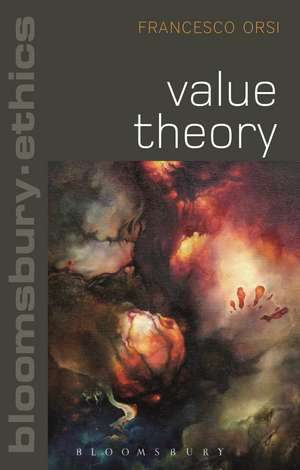
Value Theory: Bloomsbury Ethics
Autor Francesco Orsi Prof Thom Brooksen Limba Engleză Hardback – 29 ian 2015
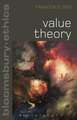
Orsi provides a systematic survey of both classic texts including Plato, Aristotle, Kant, Moore and Ross and an array of contemporary theorists. The reader is guided through the moral maze of value theory with everyday examples and thought experiments. Rare stamps, Napoleon's hat, evil demons, and Kant's good will are all considered in order to probe our intuitions, question our own and philosophers' assumptions about value, and, ultimately, understand better what we want to say when we talk about value.

Preț: 612.18 lei
Preț vechi: 809.81 lei
-24%
Puncte Express: 918
Carte tipărită la comandă
Livrare economică 23 noiembrie-07 decembrie
Livrare prin curier în România Termenul estimat este afișat lângă disponibilitate.
Transport gratuit pentru acest produs Plată online sau ramburs, în funcție de opțiunile comenzii.
Retur gratuit în 14 zile Comandă securizată și suport în română.
Specificații
ISBN-13: 9781472530882
ISBN-10: 1472530888
Pagini: 184
Dimensiuni: 138 x 216 x 14 mm
Greutate: 0.39 kg
Editura: Bloomsbury Publishing
Colecția Bloomsbury Academic
Seria Bloomsbury Ethics
Locul publicării:London, United Kingdom
ISBN-10: 1472530888
Pagini: 184
Dimensiuni: 138 x 216 x 14 mm
Greutate: 0.39 kg
Editura: Bloomsbury Publishing
Colecția Bloomsbury Academic
Seria Bloomsbury Ethics
Locul publicării:London, United Kingdom
V-ar putea interesa
-
 Philosophers Take On the WorldDavid Edmonds-18%Preț: 95.75 lei116.56 lei
 -
 Tetralogue: I'm Right, You're WrongTimothy Williamson-21%Preț: 55.66 lei70.23 lei
 -
 The Evidential Argument from EvilDaniel Howard–snyderPreț: 208.24 lei
 -
 One World Now: The Ethics of GlobalizationPeter SingerPreț: 114.39 lei
 -
 Human DignityPeter BieriPreț: 108.78 lei
 -
 Business Ethics CSchwartz-8%Preț: 639.19 lei694.77 lei
 -
 Moral Matters: A Philosophy of HomecomingMark Dooley-11%Preț: 307.98 lei346.82 lei
 -
 The Bloomsbury Companion to EthicsDr Christian B. Miller-14%Preț: 281.47 lei326.83 lei
 -
 Preț: 435.58 lei
 -
 Liquid EvilZygmunt BaumanPreț: 174.13 lei
 -
 Endeavor for Renewal: Droplets of Wisdom from the HeartFethullah GülenPreț: 81.20 lei
 -
 Preț: 297.36 lei
 -
 After VirtueProfessor Alasdair MacIntyre-14%Preț: 169.56 lei197.15 lei
 -
 On ForgivenessRichard HollowayPreț: 69.31 lei
 -
 -15%Preț: 136.65 lei161.31 lei
Cuprins
1. Value and Normativity
1.1 Introduction
1.2 Which Evaluations?
1.3 The Idea of Value Theory
1.4 Value and Normativity
1.5 Overview
1.6 Meta-ethical Neutrality
1.7 Value Theory: The Questions
2. Meet the Values: Intrinsic, Final & Co.
2.1 Introduction
2.2 Final and Unconditional Value: Some Philosophical Examples
2.3 Intrinsic Value and Final Value
2.4 The Reduction to Facts
2.5 Intrinsic and Conditional Value
2.6 Elimination of Extrinsic Value?
2.7 Summary
3. The Challenge against Absolute Value
3.1 Introduction
3.2 Geach and Attributive Goodness
3.3 Foot and the Virtues
3.4 Thomson and Goodness in a Way
3.5 Zimmerman's Ethical Goodness
3.6 A Better Reply: Absolute Value and Fitting Attitudes
3.7 Summary
4. Personal Value
4.1 Introduction
4.2 Moore on Good and Good For
4.3 Good For and Fitting Attitudes
4.4 Moore Strikes Back?
4.5 Agent-relative Value
4.6 Impersonal/Personal and Agent-neutral/Agent-relative
4.7 Summary
5. The Chemistry of Value
5.1 Introduction
5.2 Supervenience and Other Relations
5.3 Organic Unities
5.4 Alternatives to Organic Unities: Virtual Value
5.5 Alternatives to Organic Unities: Conditional Value
5.6 Holism and Particularism
5.7 Summary
6. Value Relations
6.1 Introduction
6.2 The Trichotomy Thesis and Incomparability
6.3 A Fitting Attitude Argument for Incomparability
6.4 Against Incomparability: Epistemic Limitations
6.5 Against Incomparability: Parity
6.6 Parity and Choice
6.7 Parity and Incomparability
6.8 Summary
7. How Do I Favour Thee?
7.1 Introduction
7.2 Three Dimensions of Favouring
7.3 Responses to Value: Maximizing
7.4 Two Concepts of Intrinsic Value?
7.5 Summary
8. Value and the Wrong Kind of Reasons
8.1 Introduction
8.2 The Fitting Attitude Account and its Rivals
8.3 The Wrong Kind of Reasons Problem
8.4 The Structure of the Problem and an Initial Response
8.5 Reasons for What?
8.6 Characteristic Concerns and Shared Reasons
8.7 Circular Path: No-Priority
8.8 Summary
1.1 Introduction
1.2 Which Evaluations?
1.3 The Idea of Value Theory
1.4 Value and Normativity
1.5 Overview
1.6 Meta-ethical Neutrality
1.7 Value Theory: The Questions
2. Meet the Values: Intrinsic, Final & Co.
2.1 Introduction
2.2 Final and Unconditional Value: Some Philosophical Examples
2.3 Intrinsic Value and Final Value
2.4 The Reduction to Facts
2.5 Intrinsic and Conditional Value
2.6 Elimination of Extrinsic Value?
2.7 Summary
3. The Challenge against Absolute Value
3.1 Introduction
3.2 Geach and Attributive Goodness
3.3 Foot and the Virtues
3.4 Thomson and Goodness in a Way
3.5 Zimmerman's Ethical Goodness
3.6 A Better Reply: Absolute Value and Fitting Attitudes
3.7 Summary
4. Personal Value
4.1 Introduction
4.2 Moore on Good and Good For
4.3 Good For and Fitting Attitudes
4.4 Moore Strikes Back?
4.5 Agent-relative Value
4.6 Impersonal/Personal and Agent-neutral/Agent-relative
4.7 Summary
5. The Chemistry of Value
5.1 Introduction
5.2 Supervenience and Other Relations
5.3 Organic Unities
5.4 Alternatives to Organic Unities: Virtual Value
5.5 Alternatives to Organic Unities: Conditional Value
5.6 Holism and Particularism
5.7 Summary
6. Value Relations
6.1 Introduction
6.2 The Trichotomy Thesis and Incomparability
6.3 A Fitting Attitude Argument for Incomparability
6.4 Against Incomparability: Epistemic Limitations
6.5 Against Incomparability: Parity
6.6 Parity and Choice
6.7 Parity and Incomparability
6.8 Summary
7. How Do I Favour Thee?
7.1 Introduction
7.2 Three Dimensions of Favouring
7.3 Responses to Value: Maximizing
7.4 Two Concepts of Intrinsic Value?
7.5 Summary
8. Value and the Wrong Kind of Reasons
8.1 Introduction
8.2 The Fitting Attitude Account and its Rivals
8.3 The Wrong Kind of Reasons Problem
8.4 The Structure of the Problem and an Initial Response
8.5 Reasons for What?
8.6 Characteristic Concerns and Shared Reasons
8.7 Circular Path: No-Priority
8.8 Summary
Recenzii
[Orsi] manages to be both clear and accessible as he navigates the many distinctions and relations that have come to populate the field. ... [A] welcome addition to the literature and a useful resource.
Orsi provides a detailed but succinct exploration of every axis of value theory, with special attention to the fitting attitude theory. Clearly written and tightly argued, this book is a thorough guide to the shape of value that also advances current debates in creative and engaging ways.
Francesco Orsi's Value Theory is the first thorough overview of all the main distinctions and debates in the rich philosophical tradition of investigating the evaluative realm. It is also historically informed, clear, balanced, and well-argued overall.
Orsi's book lucidly explores core conceptual questions at the very fore of value theory. The focus is on the much-discussed fitting-attitude analysis of value, and Orsi serves as an excellent and attentive guide, as the reader explores the advantages as well as the more serious rocks and shoals inherent in this approach. Not only is the book a great introduction to this pattern of analysis, it provides a distinguished contribution to contemporary value theory.
Orsi provides a detailed but succinct exploration of every axis of value theory, with special attention to the fitting attitude theory. Clearly written and tightly argued, this book is a thorough guide to the shape of value that also advances current debates in creative and engaging ways.
Francesco Orsi's Value Theory is the first thorough overview of all the main distinctions and debates in the rich philosophical tradition of investigating the evaluative realm. It is also historically informed, clear, balanced, and well-argued overall.
Orsi's book lucidly explores core conceptual questions at the very fore of value theory. The focus is on the much-discussed fitting-attitude analysis of value, and Orsi serves as an excellent and attentive guide, as the reader explores the advantages as well as the more serious rocks and shoals inherent in this approach. Not only is the book a great introduction to this pattern of analysis, it provides a distinguished contribution to contemporary value theory.