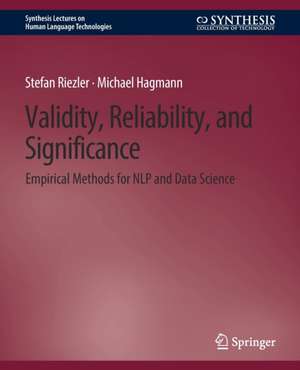
Validity, Reliability, and Significance: Empirical Methods for NLP and Data Science: Synthesis Lectures on Human Language Technologies
Autor Stefan Riezler, Michael Hagmannen Limba Engleză Paperback – 3 dec 2021
Notăm cu interes apariția celei de-a doua ediții a volumului Validity, Reliability, and Significance, o resursă metodologică esențială pentru cercetătorii din NLP și Data Science care doresc să treacă dincolo de simplele metrici de performanță. Metodologia propusă de Stefan Riezler și Michael Hagmann se ancorează în utilizarea modelelor probabilistice interpretabile, precum modelele aditive generalizate (GAM) și modelele liniare cu efecte mixte (LMEM). Această abordare permite nu doar măsurarea succesului unui algoritm, ci și înțelegerea cauzelor profunde ale variațiilor de performanță, identificând trăsăturile circulare care pot compromite procesul de învățare.
Structura cărții este riguros segmentată pentru a acoperi cele trei întrebări fundamentale ale științelor empirice. Secțiunea dedicată validității analizează dacă modelul măsoară într-adevăr fenomenul vizat, în timp ce capitolul despre fiabilitate utilizează descompunerea varianței prin parametrii de efecte aleatorii ai LMEM pentru a verifica consistența rezultatelor. Finalul volumului este dedicat testelor de semnificație bazate pe raportul de verosimilitate, oferind o metodă naturală de a include variațiile meta-parametrilor în testarea ipotezelor.
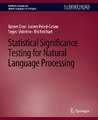
Cititorul care a aplicat ideile din Statistical Significance Testing for Natural Language Processing de Rotem Dror va găsi aici o extensie teoretică și practică valoroasă, trecând de la testele de semnificație clasice la o abordare bazată pe modelare statistică avansată. Spre deosebire de manualele introductive, acest titlu din seria Synthesis Lectures on Human Language Technologies oferă un exemplu practic detaliat de analiză a reproductibilității inferențiale, susținut de cod R, ceea ce facilitează aplicarea imediată a tehnicilor în proiecte de cercetare sau producție.
Din seria Synthesis Lectures on Human Language Technologies
- 20%
 Preț: 286.80 lei
 - 20%
 Preț: 281.22 lei
 - 20%
 Preț: 285.34 lei
 - 20%
 Preț: 229.53 lei
 - 20%
 Preț: 220.29 lei
 - 20%
 Preț: 272.60 lei
 - 20%
 Preț: 219.51 lei
 - 20%
 Preț: 464.40 lei
 - 20%
 Preț: 217.50 lei
 - 20%
 Preț: 417.94 lei
 - 20%
 Preț: 359.31 lei
 - 20%
 Preț: 390.71 lei
 - 20%
 Preț: 226.54 lei
 - 20%
 Preț: 461.64 lei
 - 20%
 Preț: 220.04 lei
 - 20%
 Preț: 324.38 lei
 - 20%
 Preț: 219.80 lei
 - 20%
 Preț: 218.53 lei
 - 20%
 Preț: 167.49 lei
 - 20%
 Preț: 411.24 lei
 - 20%
 Preț: 360.11 lei
 - 20%
 Preț: 218.53 lei
 - 20%
 Preț: 263.64 lei
 - 20%
 Preț: 261.64 lei
 - 20%
 Preț: 520.07 lei
 - 20%
 Preț: 218.53 lei
 - 20%
 Preț: 289.34 lei
 - 20%
 Preț: 342.26 lei
 - 20%
 Preț: 215.38 lei
 - 20%
 Preț: 428.42 lei
 - 20%
 Preț: 219.51 lei
 - 20%
 Preț: 343.50 lei
 - 15%
 Preț: 561.42 lei
 - 20%
 Preț: 215.99 lei
 - 20%
 Preț: 220.04 lei
 - 20%
 Preț: 386.77 lei
 - 20%
 Preț: 225.89 lei
 - 20%
 Preț: 483.65 lei
 - 20%
 Preț: 227.45 lei
 - 20%
 Preț: 320.59 lei
 - 20%
 Preț: 317.57 lei
 - 20%
 Preț: 290.12 lei
 - 20%
 Preț: 220.04 lei
 - 20%
 Preț: 369.94 lei
 - 20%
 Preț: 421.38 lei
 - 20%
 Preț: 315.77 lei
 - 20%
 Preț: 266.46 lei
Preț: 342.96 lei
Preț vechi: 428.69 lei
-20%
Carte disponibilă
Livrare economică 07-21 noiembrie
Specificații
ISBN-10: 3031010558
Pagini: 147
Ilustrații: XVII, 147 p.
Dimensiuni: 191 x 235 mm
Greutate: 0.3 kg
Editura: Springer International Publishing
Colecția Springer
Seria Synthesis Lectures on Human Language Technologies
Locul publicării:Cham, Switzerland
V-ar putea interesa
-
 Just Enough Data Science and Machine LearningMark LevenePreț: 342.01 lei
 -
 Veridical Data ScienceBin Yu-20%Preț: 553.31 lei691.64 lei
 -
 Statistical Rethinking: A Bayesian Course with Examples in R and STANRichard McElreath-20%Preț: 713.42 lei891.77 lei
 -
 The Elements of Statistical LearningTrevor Hastie-20%Preț: 546.54 lei683.17 lei
 -
 -39%Preț: 394.79 lei646.62 lei
 -
 Preț: 267.88 lei
 -
 -9%Preț: 1388.37 lei1525.67 lei
 -
 Preț: 204.99 lei
 -
 Nonparametric Hypothesis TestingStefano Bonnini-19%Preț: 498.79 lei615.78 lei
 -
 Data Analytics & Visualization All-in-One For DummiesJack A. HymanPreț: 307.59 lei
 -
 Data Science Essentials for DummiesLillian Pierson-20%Preț: 76.56 lei95.69 lei
 -
 Statistical Analysis with Python For DummiesJoseph SchmullerPreț: 197.44 lei
 -
 Measurement and Evaluation in Human PerformanceDale P Mood-14%Preț: 707.38 lei822.53 lei
 -
 -8%Preț: 436.19 lei474.11 lei
 -
 LLMs in ActionImmanuel Trummer-20%Preț: 219.46 lei274.33 lei
 -
 -20%Preț: 249.08 lei311.36 lei
 -
 Materials Data ScienceStefan Sandfeld-15%Preț: 591.20 lei695.53 lei
 -
 Statistics for ScientistsUmberto Michelucci-20%Preț: 275.88 lei344.84 lei
 -
 Stochastic Models, Statistics and Their ApplicationsAnsgar Steland-20%Preț: 1175.30 lei1469.13 lei
De ce să citești această carte
Recomandăm această carte profesioniștilor din inteligența artificială și lingvistică computațională care au nevoie de un cadru matematic riguros pentru validarea modelelor. Cititorul câștigă instrumente concrete pentru a distinge între rezultatele datorate șansei și performanța reală a algoritmilor. Este un ghid practic ce transformă evaluarea empirică dintr-o bifare de metrici într-un proces analitic profund, sprijinit de exemple în R și modele statistice moderne.
Despre autor
Stefan Riezler este un cercetător recunoscut în domeniul procesării limbajului natural și al învățării automate, cu un interes deosebit pentru metodele empirice și evaluarea statistică a sistemelor de calcul. Michael Hagmann contribuie cu expertiză în domeniul statisticii aplicate, colaborând la dezvoltarea unor metodologii care aduc rigoarea matematică în contextul modern al științei datelor. Împreună, autorii oferă o perspectivă interdisciplinară, combinând informatica cu statistica avansată pentru a îmbunătăți standardele de raportare și replicabilitate în cercetarea de profil.