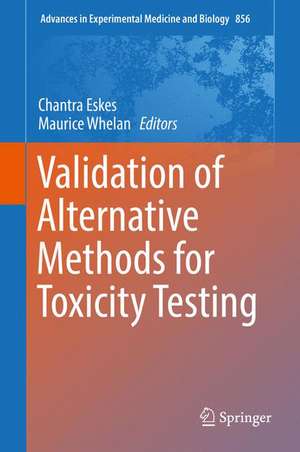
Validation of Alternative Methods for Toxicity Testing: Advances in Experimental Medicine and Biology, cartea 856
Editat de Chantra Eskes, Maurice Whelanen Limba Engleză Hardback – 5 oct 2016
Observăm că, deși inovațiile tehnologice în biotehnologie au avansat rapid, literatura academică a prezentat mult timp o lacună în ceea ce privește protocoalele riguroase de validare necesare pentru ca metodele alternative să fie acceptate de autoritățile de reglementare. Validation of Alternative Methods for Toxicity Testing vine să completeze exact acest gol, oferind un cadru metodologic pentru tranziția de la experimentele tradiționale pe animale către soluții in vitro și in silico. Remarcăm structura binară a volumului: prima parte analizează succesul metodelor deja acceptate, în timp ce a doua secțiune explorează adaptarea principiilor de validare la noile tehnologii, precum sistemele transcriptomice și modelele derivate din celule stem. Apreciem includerea unor capitole dedicate dispozitivelor human-on-a-chip, elemente care indică o progresie clară a conținutului de la fundamentele OECD către frontierele cercetării actuale. Comparabil cu Alternatives to Animal Testing în rigurozitate, acest volum editat de Chantra Eskes și Maurice Whelan este însă actualizat pentru era toxicologiei bazate pe căi de răspuns biologic și a metodelor computaționale avansate. Această lucrare reprezintă o evoluție firească față de contribuțiile anterioare ale editorilor, precum Alternatives for Dermal Toxicity Testing, extinzând sfera de aplicare de la testarea dermică la o viziune sistemică asupra siguranței chimice și farmaceutice. Prin analiza detaliată a studiilor multi-centrice și a dovezilor din toxicologie, volumul reușește să pună în dialog nevoile industriei cu rigoarea academică și cerințele guvernamentale.
Din seria Advances in Experimental Medicine and Biology
- 30%
 Preț: 715.95 lei
 - 5%
 Preț: 1070.60 lei
 - 5%
 Preț: 688.64 lei
 - 5%
 Preț: 1382.79 lei
 - 5%
 Preț: 689.53 lei
 - 5%
 Preț: 1243.69 lei
 - 5%
 Preț: 1125.05 lei
 - 5%
 Preț: 1243.97 lei
 - 5%
 Preț: 1119.42 lei
 - 5%
 Preț: 1058.97 lei
 - 18%
 Preț: 1079.97 lei
 - 5%
 Preț: 1379.77 lei
 - 5%
 Preț: 1118.41 lei
 - 18%
 Preț: 920.45 lei
 - 18%
 Preț: 1187.64 lei
 - 5%
 Preț: 1183.68 lei
 - 5%
 Preț: 1242.06 lei
 - 5%
 Preț: 1059.31 lei
 - 18%
 Preț: 1088.78 lei
 - 5%
 Preț: 1125.25 lei
 - 5%
 Preț: 1363.28 lei
 - 5%
 Preț: 1254.87 lei
 - 18%
 Preț: 1362.49 lei
 - 18%
 Preț: 1357.94 lei
 - 18%
 Preț: 1194.92 lei
 - 5%
 Preț: 1555.64 lei
 - 5%
 Preț: 1260.90 lei
 - 18%
 Preț: 1087.57 lei
 - 5%
 Preț: 1054.94 lei
 - 24%
 Preț: 923.80 lei
 - 15%
 Preț: 625.77 lei
 - 5%
 Preț: 1054.94 lei
 - 18%
 Preț: 909.08 lei
 - 18%
 Preț: 915.13 lei
 - 5%
 Preț: 1113.82 lei
 - 5%
 Preț: 696.54 lei
 - 18%
 Preț: 1341.26 lei
 - 5%
 Preț: 1049.67 lei
 - 18%
 Preț: 2436.13 lei
 - 18%
 Preț: 1335.19 lei
 - 5%
 Preț: 696.45 lei
 - 5%
 Preț: 1060.22 lei
 - 5%
 Preț: 696.54 lei
 - 18%
 Preț: 962.90 lei
 - 5%
 Preț: 1263.12 lei
 - 5%
 Preț: 701.25 lei
 - 18%
 Preț: 1185.81 lei
Preț: 1076.62 lei
Preț vechi: 1312.95 lei
-18%
Carte tipărită la comandă
Livrare economică 28 mai-11 iunie
Specificații
ISBN-10: 3319338242
Pagini: 341
Ilustrații: XX, 407 p. 44 illus., 40 illus. in color.
Dimensiuni: 155 x 235 x 24 mm
Greutate: 0.77 kg
Ediția:1st ed. 2016
Editura: Springer International Publishing
Colecția Springer
Seria Advances in Experimental Medicine and Biology
Locul publicării:Cham, Switzerland
V-ar putea interesa
-
 -15%Preț: 510.42 lei600.50 lei
 -
 High-Throughput Analysis in the Pharmaceutical IndustryPerry G. Wang-15%Preț: 522.91 lei615.18 lei
 -
 Laboratory Auditing for Quality and Regulatory ComplianceDonald C. Singer-15%Preț: 517.19 lei608.47 lei
 -
 -15%Preț: 509.61 lei599.54 lei
 -
 Biotransformations and BioprocessesMukesh Doble-15%Preț: 509.25 lei599.11 lei
 -
 Pharmaceutical Product Development: In Vitro-In Vivo CorrelationChilukuri Dakshina Murthy-15%Preț: 499.52 lei587.68 lei
 -
 -15%Preț: 470.48 lei553.51 lei
 -
 -15%Preț: 592.09 lei696.57 lei
 -
 Biocalorimetry: Foundations and Contemporary ApproachesMargarida BastosPreț: 468.73 lei
 -
 Computer-Aided Design of Antimicrobial Lipopeptides as Prospective Drug CandidatesJujjvarapu Satya Eswari-5%Preț: 1508.82 lei1588.23 lei
 -
 -18%Preț: 860.12 lei1048.92 lei
 -
 Preț: 357.10 lei
 -
 The Lilac BowMaurice WhelanPreț: 82.37 lei
 -
 Excalibur's ReturnMaurice WhelanPreț: 82.02 lei
 -
 A Season and a TimeMaurice WhelanPreț: 70.26 lei
 -
 Spirit EyesMaurice WhelanPreț: 79.33 lei
 -
 Preț: 140.68 lei
 -
 Alternatives for Dermal Toxicity TestingChantra Eskes-5%Preț: 867.54 lei913.20 lei
 -
 Nanophytomedicine: Concept to ClinicSarwar Beg-18%Preț: 910.58 lei1110.47 lei
 -
 -18%Preț: 1072.69 lei1308.16 lei
 -
 Probiotic Research in TherapeuticsParneet Kaur Deol-20%Preț: 617.98 lei772.47 lei
 -
 -18%Preț: 1071.18 lei1306.33 lei
 -
 -18%Preț: 964.71 lei1176.48 lei
 -
 -18%Preț: 1175.05 lei1432.98 lei
 -
 Perspectives in Pharmacy PracticeAnantha Naik Nagappa-18%Preț: 1340.85 lei1635.19 lei
De ce să citești această carte
Recomandăm această lucrare profesioniștilor din toxicologie și autorităților de reglementare care au nevoie de un ghid tehnic despre cum pot fi validate noile tehnologii (bioreactoare, celule stem, modele computaționale). Cititorul câștigă o înțelegere profundă a procesului prin care o metodă alternativă devine standard internațional, un avantaj competitiv esențial în cercetarea academică și industrială modernă, unde reducerea testării pe animale este o prioritate etică și legislativă.
Despre autor
Chantra Eskes și Maurice Whelan sunt experți recunoscuți internațional în domeniul metodelor alternative de testare. Chantra Eskes a contribuit semnificativ la dezvoltarea strategiilor de testare in vitro, fiind implicată anterior în lucrări de referință precum Alternatives for Dermal Toxicity Testing. Maurice Whelan deține un rol central în cadrul laboratoarelor de referință ale Uniunii Europene pentru alternative la testarea pe animale (EURL ECVAM). Expertiza lor combinată asigură o perspectivă echilibrată între cercetarea fundamentală și implementarea practică a noilor metodologii în politici de siguranță chimică la nivel global.
Descriere scurtă
Validation of Alternative Methods for Toxicity Testing is divided into two sections, in the first, practical insights are given on the state-of-the-art and on approaches that have resulted in successfully validated and accepted alternative methods. The second section focuses on the evolution of validation principles and practice that are necessary to ensure fit-for-purpose validation that has the greatest impact on international regulatory acceptance of alternative methods. In this context validation needs to keep pace with the considerable scientific advancements being made in toxicology, the availability of sophisticated tools and techniques that can be applied in a variety of ways, and the increasing societal and regulatory demands for better safety assessment.
This book will be a useful resource for scientists in the field of toxicology, both from industry and academia, developing new test methods, strategies or techniques, as well as Governmental and regulatory authorities interested in understanding the principles and practicalities of validation of alternative methods for toxicity testing.
Cuprins
Notă biografică
With Engineering and MsC degrees in food sciences followed by a PhD in in vitro neurotoxicity, Dr. Eskes has over 20 years of experience in the development, optimization, validation, peer-review and regulatory acceptance of alternative methods to animal toxicity testing. Her activities have contributed to the formal validation and regulatory acceptance of several test methods and to the development of a number of official international test guidelines.
Dr. Eskes is a Nominated Expert for the Organisation for Economic Co-operation and Development (OECD), the President of the European Society of In Vitro Toxicology (ESTIV), and the Executive Secretary of the Animal Cell Technology Industrial Platform on the production of biopharmaceuticals (ACTIP). She is the founder and manager of SeCAM, a company offering independent consultation and services regarding alternative methods for scientific, regulatory, and industrial requirements. She is also editor, author, and co-author of a number of scientific monographs, articles, and book chapters and acts as reviewer for several journals in the field of in vitro toxicology.
Maurice Whelan
Prof. Maurice Whelan is head of the Systems Toxicology Unit of the Institute for Health and Consumer Protection (IHCP) of the European Commission's Joint Research Centre (JRC), based in Ispra, Italy. He also leads the European Union Reference Laboratory for Alternatives to Animal Testing (EURL ECVAM) of the JRC, established under EU Directive 2010/63 on the protection of animals used for scientific purposes to build on the 20 years of activities of ECVAM, the European Centre for the Validation of Alternative Methods. His areas of expertise include the development, validation and promotion of alternative approaches to animal testing both for regulatory safety assessment of chemicals (inc. nanomaterials) and for applications in biomedical research. Whelan isthe EU co-chair of the OECD Advisory Group on Molecular Screening and Toxicogenomics that is responsible for the OECD programme on Adverse Outcome Pathways, and he is a member of the Steering Committee of the European Partnership for Alternative Approaches to Animal Testing (EPAA). He also currently holds an external appointment of visiting Professor of Bioengineering at the University of Liverpool (UK).