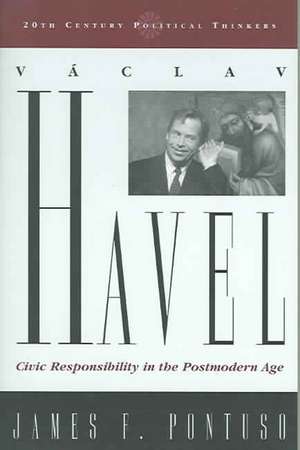
Vaclav Havel: Civic Responsibility in the Postmodern Age: 20th Century Political Thinkers
Autor James F. Pontusoen Limba Engleză Paperback – 19 aug 2004
In the first book to bring together Havel's life and work, James Pontuso examines the Czech president's political philosophy. Pontuso argues that Havel's life as a dissident and political leader, his political writings, and his plays are part of a whole and must be understood as intimately connected to one another. In this engaging work, Pontuso skillfully explores these connections and explains Havel's prescriptions for political life.
Din seria 20th Century Political Thinkers
- 31%
 Preț: 337.07 lei
 - 32%
 Preț: 721.91 lei
 - 26%
 Preț: 347.34 lei
 - 20%
 Preț: 309.09 lei
 - 25%
 Preț: 338.72 lei
 - 25%
 Preț: 263.71 lei
 - 25%
 Preț: 352.70 lei
 - 25%
 Preț: 264.19 lei
 - 20%
 Preț: 307.96 lei
 - 24%
 Preț: 307.03 lei
 - 25%
 Preț: 349.00 lei
 - 33%
 Preț: 356.15 lei
 - 28%
 Preț: 338.34 lei
 - 30%
 Preț: 325.76 lei
 - 16%
 Preț: 209.06 lei
Preț: 175.34 lei
Preț vechi: 403.58 lei
-57%
Puncte Express: 263
Carte disponibilă
Livrare economică 22 mai-03 iunie
Livrare express 02-08 mai pentru 308.33 lei
Specificații
ISBN-13: 9780742522565
ISBN-10: 0742522563
Pagini: 175
Dimensiuni: 146 x 226 x 14 mm
Greutate: 0.29 kg
Editura: Bloomsbury Publishing
Colecția Rowman & Littlefield
Seria 20th Century Political Thinkers
Locul publicării:New York, United States
ISBN-10: 0742522563
Pagini: 175
Dimensiuni: 146 x 226 x 14 mm
Greutate: 0.29 kg
Editura: Bloomsbury Publishing
Colecția Rowman & Littlefield
Seria 20th Century Political Thinkers
Locul publicării:New York, United States
Cuprins
Chapter 1 Preface
Chapter 2 A Life like a Work of Art
Chapter 3 A Hesitant Philosopher
Chapter 4 A Dissident in an "Unnatural" World
Chapter 5 An Ironic Playwright
Chapter 6 Free Markets and Civil Society: Citizen in the Global Economy
Chapter 7 An "Untactical" President
Chapter 8 Index
Chapter 9 About the Author
Chapter 2 A Life like a Work of Art
Chapter 3 A Hesitant Philosopher
Chapter 4 A Dissident in an "Unnatural" World
Chapter 5 An Ironic Playwright
Chapter 6 Free Markets and Civil Society: Citizen in the Global Economy
Chapter 7 An "Untactical" President
Chapter 8 Index
Chapter 9 About the Author
Recenzii
James Pontuso shows his remarkable mastery of the many nuances and complexities of Václav Havel´s life and work under the communist and post-communist social and political conditions. His thought-provoking book is important for all those who are interested in basic human values and transformation politics.
It is not hard to write a lively book about Václav Havel, but James Pontuso has done much more than that. Pontuso shows us how and why a poet and a playwright became a politician and a president at the hinge in history when central Europe emerged from its communist coma. There is more life in this story than just its lively central character.
I meet very few people, Czechs and foreigners included, that know the latest history of the Czech Republic as well as Dr. Pontuso. And even fewer that have been able to put it in a broader context. I have not read a book on Václav Havel with such a pleasure as this one. Pontuso shows that studying the topic with both diligence and sympathy is worth it!
Pontuso portrays Vaclav Havel not just as 'one of the most articulate political leaders of his generation,' but as a statesman who in his deeds and thoughts approximates the Platonic ideal of a Philosopher-King. This book is a must for philosophers, literary critics, and all students of post-communist transitions.
[This] is the best book-length treatment of Havel's oeuvre (an integration of the writings and the political activity) that I know of.
In this intellectual biography, Havel emerges as a kind of matrioshka doll: a politician inside a dissident, inside a playwright, inside a philosopher. That makes the outer shell commanding, and Pontuso gives full vent to an exploration of the Czech leader's moral philosophy and philosophy of fundamental meaning, weaving throughout his debt to and dissent from Martin Heidegger.
Pontuso deserves praise for showing how Havel corrects and breaks with his intellectual influences (primarily Martin Heidegger), mounts a powerful defense of common sense against existentialism and postmodernism, and addresses perennial themes from the canon of political philosophy. Pontuso does a masterful job explicating Havel's philosophy, but he also highlights how mush faith Havel places in culture and moral rhetoric as opposed to political institutions and party politics.
It is not hard to write a lively book about Václav Havel, but James Pontuso has done much more than that. Pontuso shows us how and why a poet and a playwright became a politician and a president at the hinge in history when central Europe emerged from its communist coma. There is more life in this story than just its lively central character.
I meet very few people, Czechs and foreigners included, that know the latest history of the Czech Republic as well as Dr. Pontuso. And even fewer that have been able to put it in a broader context. I have not read a book on Václav Havel with such a pleasure as this one. Pontuso shows that studying the topic with both diligence and sympathy is worth it!
Pontuso portrays Vaclav Havel not just as 'one of the most articulate political leaders of his generation,' but as a statesman who in his deeds and thoughts approximates the Platonic ideal of a Philosopher-King. This book is a must for philosophers, literary critics, and all students of post-communist transitions.
[This] is the best book-length treatment of Havel's oeuvre (an integration of the writings and the political activity) that I know of.
In this intellectual biography, Havel emerges as a kind of matrioshka doll: a politician inside a dissident, inside a playwright, inside a philosopher. That makes the outer shell commanding, and Pontuso gives full vent to an exploration of the Czech leader's moral philosophy and philosophy of fundamental meaning, weaving throughout his debt to and dissent from Martin Heidegger.
Pontuso deserves praise for showing how Havel corrects and breaks with his intellectual influences (primarily Martin Heidegger), mounts a powerful defense of common sense against existentialism and postmodernism, and addresses perennial themes from the canon of political philosophy. Pontuso does a masterful job explicating Havel's philosophy, but he also highlights how mush faith Havel places in culture and moral rhetoric as opposed to political institutions and party politics.