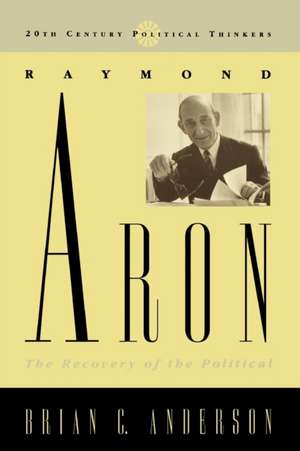
Raymond Aron: The Recovery of the Political: 20th Century Political Thinkers
Autor Brian C. Andersonen Limba Engleză Paperback – 22 ian 1998
Din seria 20th Century Political Thinkers
- 56%
 Preț: 182.96 lei
 - 30%
 Preț: 354.61 lei
 - 32%
 Preț: 747.09 lei
 - 26%
 Preț: 347.34 lei
 - 19%
 Preț: 324.09 lei
 - 24%
 Preț: 351.97 lei
 - 24%
 Preț: 276.88 lei
 - 25%
 Preț: 352.70 lei
 - 20%
 Preț: 320.20 lei
 - 23%
 Preț: 322.03 lei
 - 24%
 Preț: 366.08 lei
 - 33%
 Preț: 368.50 lei
 - 27%
 Preț: 355.32 lei
 - 29%
 Preț: 341.71 lei
 - 14%
 Preț: 219.06 lei
Preț: 277.28 lei
Preț vechi: 361.50 lei
-23%
Puncte Express: 416
Carte tipărită la comandă
Livrare economică 20 noiembrie-04 decembrie
Livrare prin curier în România Termenul estimat este afișat lângă disponibilitate.
Transport gratuit de la 400.00 lei Plată online sau ramburs, în funcție de opțiunile comenzii.
Retur gratuit în 14 zile Comandă securizată și suport în română.
Specificații
ISBN-13: 9780847687589
ISBN-10: 0847687589
Pagini: 224
Dimensiuni: 150 x 226 x 16 mm
Greutate: 0.32 kg
Ediția:New.
Editura: Bloomsbury Publishing
Colecția Rowman & Littlefield
Seria 20th Century Political Thinkers
Locul publicării:New York, United States
ISBN-10: 0847687589
Pagini: 224
Dimensiuni: 150 x 226 x 16 mm
Greutate: 0.32 kg
Ediția:New.
Editura: Bloomsbury Publishing
Colecția Rowman & Littlefield
Seria 20th Century Political Thinkers
Locul publicării:New York, United States
V-ar putea interesa
-
 The Case for Working with Your HandsMatthew CrawfordPreț: 84.99 lei
 -
 Political Philosophy: A Very Short IntroductionDavid Miller-20%Preț: 56.94 lei71.12 lei
 -
 Political ThoughtMichael Rosen-11%Preț: 373.09 lei417.89 lei
 -
 Perspectives on Thomas HobbesG. A. J. Rogers-29%Preț: 350.58 lei490.48 lei
 -
 Social JusticeDavid Miller-20%Preț: 304.15 lei381.35 lei
 -
 Rationality and CommitmentFabienne Peter-31%Preț: 777.02 lei1125.51 lei
 -
 The Economy of Esteem: An Essay on Civil and Political SocietyGeoffrey Brennan-28%Preț: 381.86 lei530.51 lei
 -
 The Quality of FreedomMatthew H. Kramer-22%Preț: 420.12 lei537.47 lei
 -
 Political ObligationsGeorge Klosko-28%Preț: 360.38 lei501.64 lei
 -
 Theatre and EthicsNicholas Ridout-28%Preț: 49.56 lei68.45 lei
 -
 AnarchismKropotkin-18%Preț: 85.26 lei104.25 lei
 -
 Preț: 38.44 lei
 -
 From Physics to PhilosophyJeremy ButterfieldPreț: 343.20 lei
 -
 Amartya SenChristopher MorrisPreț: 297.66 lei
 -
 Politics: Key Concepts in PhilosophyDr Iain MacKenzie-11%Preț: 156.65 lei176.70 lei
Recenzii
Anderson makes a good case for Aron's subtlety and intelligence. . . and deserves high praise for explicating and elucidating [Aron's] message with impressive analysis and textual fidelity.
Writing with great clarity of style from a stance of interpretive charity, Anderson helps us to sort out Aron's enormous oeuvre. There is much more to recommend in this densely packed, lucid volume. Anderson's effort to bring the attention of our political theorists back to Aron is worthy of our thanks.
A compelling examination of Aron's contributions to political theory and practice.
Brian Anderson's insightful book on Raymond Aron deserves a wide audience. According to Anderson, modern liberal theory lacks an understanding of politics, but a corrective is to be found in Aron's 'conservative liberalism.' An exceptional analysis, and much needed.
One of the great contributions of Brian Anderson's book is to highlight the role of political reason-related to Aristotle's practical wisdom-in the work of Aron. A splendid book, of elegance and distinction.
Brian Anderson's elegant book wonderfully captures Aron's recovery of the political as an independent realm of thought and action. One of its great strengths is the way it places Aron's work in fruitful dialogue with other important twentieth-century political thinkers such as Isaiah Berlin, F. A. Hayek, John Rawls, and Leo Strauss. Anderson shows that if political theorists wish to take politics seriously, they must fully confront the work of Aron.
In his excellent analysis of Aron's many writings, Anderson (American Enterprise Institute) succeeds in showing their deep, ever reflective political character and in explaining how they qualify as conservatively liberal. The book should be required reading for all interested in modern political and social thought.
As an account of the political thought of Raymond Aron, this study has much to recommend it . . . [Anderson's] aims are acheived with elegance and insight.
Brian C. Anderson attempts to rescue Aron fron relative obscurity by suggesting that what he has to say about modern politics is grounded in a sophisticated understanding of prctical reason. One of the prominent themes of the book is that modern liberal theories have become divorced from the practical concerns and realities of politics through abstract theorizing, which fails to engage with practical politics and lived concerns.Anderson has covered all of these aspects of Aron's work with admirable clarity and has convincingly established the case for understanding Aron's overall intelligibility in terms of political reason. A particular strength of the book is the treatment of Aron's critique of ideology in which the conecpt of a secular religion provides the driving force. The book is to be commended both for the author's lucidity and the strength of the case he makes for taking Aron much more seriously as a social and political analyst.
[an] engaging and well-structured book . . .
Writing with great clarity of style from a stance of interpretive charity, Anderson helps us to sort out Aron's enormous oeuvre. There is much more to recommend in this densely packed, lucid volume. Anderson's effort to bring the attention of our political theorists back to Aron is worthy of our thanks.
A compelling examination of Aron's contributions to political theory and practice.
Brian Anderson's insightful book on Raymond Aron deserves a wide audience. According to Anderson, modern liberal theory lacks an understanding of politics, but a corrective is to be found in Aron's 'conservative liberalism.' An exceptional analysis, and much needed.
One of the great contributions of Brian Anderson's book is to highlight the role of political reason-related to Aristotle's practical wisdom-in the work of Aron. A splendid book, of elegance and distinction.
Brian Anderson's elegant book wonderfully captures Aron's recovery of the political as an independent realm of thought and action. One of its great strengths is the way it places Aron's work in fruitful dialogue with other important twentieth-century political thinkers such as Isaiah Berlin, F. A. Hayek, John Rawls, and Leo Strauss. Anderson shows that if political theorists wish to take politics seriously, they must fully confront the work of Aron.
In his excellent analysis of Aron's many writings, Anderson (American Enterprise Institute) succeeds in showing their deep, ever reflective political character and in explaining how they qualify as conservatively liberal. The book should be required reading for all interested in modern political and social thought.
As an account of the political thought of Raymond Aron, this study has much to recommend it . . . [Anderson's] aims are acheived with elegance and insight.
Brian C. Anderson attempts to rescue Aron fron relative obscurity by suggesting that what he has to say about modern politics is grounded in a sophisticated understanding of prctical reason. One of the prominent themes of the book is that modern liberal theories have become divorced from the practical concerns and realities of politics through abstract theorizing, which fails to engage with practical politics and lived concerns.Anderson has covered all of these aspects of Aron's work with admirable clarity and has convincingly established the case for understanding Aron's overall intelligibility in terms of political reason. A particular strength of the book is the treatment of Aron's critique of ideology in which the conecpt of a secular religion provides the driving force. The book is to be commended both for the author's lucidity and the strength of the case he makes for taking Aron much more seriously as a social and political analyst.
[an] engaging and well-structured book . . .