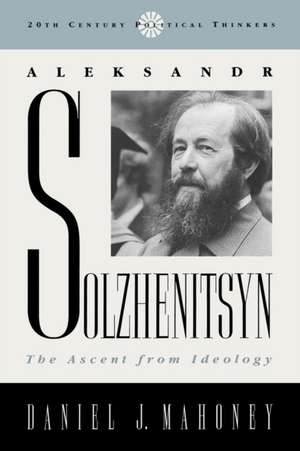
Aleksandr Solzhenitsyn: The Ascent from Ideology: 20th Century Political Thinkers
Autor Daniel J. Mahoneyen Limba Engleză Paperback – 30 iul 2001
Din seria 20th Century Political Thinkers
- 56%
 Preț: 182.96 lei
 - 30%
 Preț: 354.61 lei
 - 32%
 Preț: 747.09 lei
 - 26%
 Preț: 347.34 lei
 - 19%
 Preț: 324.09 lei
 - 24%
 Preț: 351.97 lei
 - 25%
 Preț: 352.70 lei
 - 23%
 Preț: 277.28 lei
 - 20%
 Preț: 320.20 lei
 - 23%
 Preț: 322.03 lei
 - 24%
 Preț: 366.08 lei
 - 33%
 Preț: 368.50 lei
 - 27%
 Preț: 355.32 lei
 - 29%
 Preț: 341.71 lei
 - 14%
 Preț: 219.06 lei
Preț: 276.88 lei
Preț vechi: 362.59 lei
-24%
Puncte Express: 415
Carte tipărită la comandă
Livrare economică 20 noiembrie-04 decembrie
Livrare prin curier în România Termenul estimat este afișat lângă disponibilitate.
Transport gratuit de la 400.00 lei Plată online sau ramburs, în funcție de opțiunile comenzii.
Retur gratuit în 14 zile Comandă securizată și suport în română.
Specificații
ISBN-13: 9780742521131
ISBN-10: 0742521133
Pagini: 200
Dimensiuni: 148 x 226 x 14 mm
Greutate: 0.3 kg
Ediția:0200
Editura: Bloomsbury Publishing
Colecția Rowman & Littlefield
Seria 20th Century Political Thinkers
Locul publicării:New York, United States
ISBN-10: 0742521133
Pagini: 200
Dimensiuni: 148 x 226 x 14 mm
Greutate: 0.3 kg
Ediția:0200
Editura: Bloomsbury Publishing
Colecția Rowman & Littlefield
Seria 20th Century Political Thinkers
Locul publicării:New York, United States
V-ar putea interesa
-
 The Communist ManifestoKarl Marx-26%Preț: 48.13 lei65.27 lei
 -
 Trouble in ParadiseSlavoj Zizek-31%Preț: 62.77 lei91.44 lei
 -
 Chinese Foreign Policy: Theory and PracticeThomas W. Robinson-32%Preț: 686.17 lei1011.05 lei
 -
 Karl Marx: Selected WritingsKarl Marx-57%Preț: 421.16 lei987.72 lei
 -
 Communism in India: Events, Processes and IdeologiesBidyut Chakrabarty-35%Preț: 628.32 lei961.40 lei
 -
 Willing Slaves Of CapitalFrederic LordonPreț: 147.26 lei
 -
 Utopia or BustBenjamin KunkelPreț: 136.80 lei
 -
 -11%Preț: 78.45 lei88.53 lei
 -
 The Communist HypothesisAlain BadiouPreț: 163.95 lei
 -
 First Measures of the Coming InsurrectionEric Hazan-23%Preț: 93.47 lei121.76 lei
 -
 Preț: 158.77 lei
 -
 Fear of MirrorsTariq AliPreț: 164.31 lei
 -
 Late MarxismFredric JamesonPreț: 115.76 lei
 -
 The Prophet OutcastIsaac DeutscherPreț: 288.34 lei
 -
 -18%Preț: 152.54 lei185.65 lei
Cuprins
Chapter 1 Introductory Note: Taking Solzhenitsyn Seriously
Chapter 2 The One True Progress: Solzhenitsyn's Alternative to Modern Liberalism
Chapter 3 The Experience of Totalitarianism and the Recovery of Nature
Chapter 4 True and False Liberalism: Stolypin and His Enemies in August 1914
Chapter 5 The Ascent from Modernity:"Repentance and Self-Limitation in the Life of Nations"
Chapter 6 The Physiognomy of Liberty: Solzhenitsyn's "Tocquevillian" Defense of Local Self-Government
Chapter 7 Concluding Reflection: The Soul between Politics and Eternity
Chapter 2 The One True Progress: Solzhenitsyn's Alternative to Modern Liberalism
Chapter 3 The Experience of Totalitarianism and the Recovery of Nature
Chapter 4 True and False Liberalism: Stolypin and His Enemies in August 1914
Chapter 5 The Ascent from Modernity:"Repentance and Self-Limitation in the Life of Nations"
Chapter 6 The Physiognomy of Liberty: Solzhenitsyn's "Tocquevillian" Defense of Local Self-Government
Chapter 7 Concluding Reflection: The Soul between Politics and Eternity
Recenzii
In the natural progression of the ripening of Solzhenitsyn criticism, what has been needed is a book by a political theorist who is at home in the vocabulary of political philosophy and fully familiar with the categories and concepts of that field. Daniel Mahoney fills this niche and his study advances Solzhenitsyn criticism not by small or even medium sized increments, but by a quantum leap forward. Mahoney's book will stand as the book on Solzhenitsyn's politics, precisely because it does not treat politics as a self-contained and free-standing entity, i.e. it does not tear the politics out of the overarching moral vision. This book is simply superb.
Everything Daniel Mahoney writes is worth reading and this book, in particular, shows how Solzhenitsyn's vision is even more relevant today than it was in the dark days of the Soviet Occupation.
Excellent new book.
Mahoney reintroduces Solzhenitsyn as a political thinker who deserves to be included in the ranks of Raymond Aron, Jacques Maritain, Martin Buber, and John Dewey, among others.
Through its penetrating and comprehensive assessment of Solzhenitsyn's significance, Professor Mahoney's book is a lesson in human greatness as well as a powerful contribution to our understanding of modern tyranny.
In an age of uninhibited materialism and crass popular culture, where the demands of the fast-paced 'information age' make us so busy we can entirely forget the spiritual realm, Mahoney's book on Solzhenitsyn is a refreshment for the soul. It reminds us that the most important possession of our time on earth is our character, and our character cannot be properly tended unless we allow it to pursue its longing for the true and eternal.
Even before Aleksandr Solzhenitsyn confessed that in his years of exile in the United States he had not taken up our habit of 'chatting at filling stations,' Americans had decided to disdain him. He was some sort of autocrat or authoritarian, a theocrat, a self-ordained prophet, not to mention an ingrate who had unkind things to say about America and other western nations. If Daniel Mahoney's book does not cause us to rethink our opinions about Solzhenitsyn, it's hard to imagine what could. Mahoney's open-minded and manifestly intelligent analysis of a wide array of his writings shows Solzhenitsyn to be an ardent, albeit measured and reasoned defender of constitutionalism and democratic freedom. He is also, as Mahoney puts it, 'a postmodern foundationalist,' a thoughtful man who did not begin a Christian, but whose experience and reflections on human nature-his 'anthropological conclusions'-led him to its embrace. Not ignorance of the West, of its politics and way of life and of its philosophic underpinnings, but precisely a profound understanding of these enables Mahoney's Solzhenitsyn to speak to the mind and heart of every human being.
Solzhenitsyn's literary genius as a chronicler of the totalitarian past is universally recognized. Daniel Mahoney persuasively suggests that the great Russian witness and writer is also a serious political philosopher with important things to say about the democratic future.
Mahoney offers a splendid and always reliable analysis of the political, philosophical, and moral dimensions of Solzhenitsyn's writings which demonstrates that contrary to widespread journalistic assumptions, Solzhenitsyn is deeply indebted to a long line of classic thinkers going all the way back to Plato and Aristotle.
Mahoney provides the most fair-minded and attractive account of Solzhenitsyn's political thought to date.
Mahoney understands Solzhenitsyn as very few do, and he orients the great writer for us all. This is a book that should destroy the myth of Solzhenitsyn as an autocrat, a theocrat, a right-winger, etc. And it is as exquisitely written as it is conceived. A real pearl of a volume.
Mahoney has written the book about the politics of Aleksandr Solzhenitsyn.
This very remarkable and most timely book differs from others on Solzhenitsyn by highlighting his 'critique of ideology' and his 'recovery of the 'natural world.' Mahoney's exceptionally penetrating, wonderfully judcious, and always accessible analysis is on the cutting edge of thought today.
Solzhenitsyn presents quite a challenge to anyone attempting a comprehensive assessment of his thought. Daniel Mahoney meets the challenge squarely in his excellent new book.
A much-needed meditation on the limit of politics, through a study of the writings of Solzhenitsyn.
By allowing Solzhenitsyn to speak above the din of those who dismiss him, Mahoney has given us a great gift. His interpretations of Solzhenitsyn's speeches, essays, and books are especially incisive in recognizing Solzhenitsyn's significane for political philosophy, and political philosophy's postmodern task of grappling with ideological evil.
Everything Daniel Mahoney writes is worth reading and this book, in particular, shows how Solzhenitsyn's vision is even more relevant today than it was in the dark days of the Soviet Occupation.
Excellent new book.
Mahoney reintroduces Solzhenitsyn as a political thinker who deserves to be included in the ranks of Raymond Aron, Jacques Maritain, Martin Buber, and John Dewey, among others.
Through its penetrating and comprehensive assessment of Solzhenitsyn's significance, Professor Mahoney's book is a lesson in human greatness as well as a powerful contribution to our understanding of modern tyranny.
In an age of uninhibited materialism and crass popular culture, where the demands of the fast-paced 'information age' make us so busy we can entirely forget the spiritual realm, Mahoney's book on Solzhenitsyn is a refreshment for the soul. It reminds us that the most important possession of our time on earth is our character, and our character cannot be properly tended unless we allow it to pursue its longing for the true and eternal.
Even before Aleksandr Solzhenitsyn confessed that in his years of exile in the United States he had not taken up our habit of 'chatting at filling stations,' Americans had decided to disdain him. He was some sort of autocrat or authoritarian, a theocrat, a self-ordained prophet, not to mention an ingrate who had unkind things to say about America and other western nations. If Daniel Mahoney's book does not cause us to rethink our opinions about Solzhenitsyn, it's hard to imagine what could. Mahoney's open-minded and manifestly intelligent analysis of a wide array of his writings shows Solzhenitsyn to be an ardent, albeit measured and reasoned defender of constitutionalism and democratic freedom. He is also, as Mahoney puts it, 'a postmodern foundationalist,' a thoughtful man who did not begin a Christian, but whose experience and reflections on human nature-his 'anthropological conclusions'-led him to its embrace. Not ignorance of the West, of its politics and way of life and of its philosophic underpinnings, but precisely a profound understanding of these enables Mahoney's Solzhenitsyn to speak to the mind and heart of every human being.
Solzhenitsyn's literary genius as a chronicler of the totalitarian past is universally recognized. Daniel Mahoney persuasively suggests that the great Russian witness and writer is also a serious political philosopher with important things to say about the democratic future.
Mahoney offers a splendid and always reliable analysis of the political, philosophical, and moral dimensions of Solzhenitsyn's writings which demonstrates that contrary to widespread journalistic assumptions, Solzhenitsyn is deeply indebted to a long line of classic thinkers going all the way back to Plato and Aristotle.
Mahoney provides the most fair-minded and attractive account of Solzhenitsyn's political thought to date.
Mahoney understands Solzhenitsyn as very few do, and he orients the great writer for us all. This is a book that should destroy the myth of Solzhenitsyn as an autocrat, a theocrat, a right-winger, etc. And it is as exquisitely written as it is conceived. A real pearl of a volume.
Mahoney has written the book about the politics of Aleksandr Solzhenitsyn.
This very remarkable and most timely book differs from others on Solzhenitsyn by highlighting his 'critique of ideology' and his 'recovery of the 'natural world.' Mahoney's exceptionally penetrating, wonderfully judcious, and always accessible analysis is on the cutting edge of thought today.
Solzhenitsyn presents quite a challenge to anyone attempting a comprehensive assessment of his thought. Daniel Mahoney meets the challenge squarely in his excellent new book.
A much-needed meditation on the limit of politics, through a study of the writings of Solzhenitsyn.
By allowing Solzhenitsyn to speak above the din of those who dismiss him, Mahoney has given us a great gift. His interpretations of Solzhenitsyn's speeches, essays, and books are especially incisive in recognizing Solzhenitsyn's significane for political philosophy, and political philosophy's postmodern task of grappling with ideological evil.