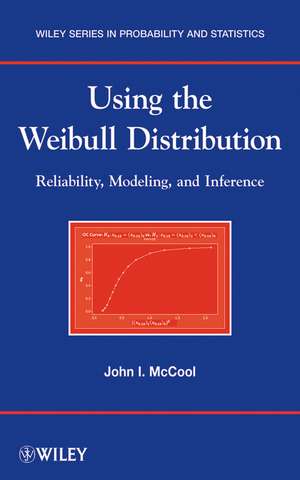
Using the Weibull Distribution
Autor John I McCoolen Limba Engleză Hardback – 13 aug 2012
Destinată studenților din ultimii ani de licență, masteranzilor și practicienilor din ingineria fiabilității, Using the Weibull Distribution oferă instrumentele necesare pentru a transforma datele brute în decizii fundamentate statistic. Considerăm că volumul semnat de John I McCool reușește să acopere un vid informațional important, oferind o prezentare de sine stătătoare a fundamentelor probabilistice, fără a neglija complexitatea tehnicilor de extragere a informațiilor din datele de teren. Textul se distinge prin rigoarea cu care tratează inferența exactă în regresia Weibull și analiza modelelor cu trei parametri, subiecte adesea simplificate în alte lucrări. Merită menționat că autorul nu se limitează la teorie, ci integrează exemple din lumea reală care vizează optimizarea garanțiilor și strategiile de înlocuire a componentelor (block replacement). Din punct de vedere metodologic, volumul este susținut de resurse software proprii și module Mathcad, facilitând aplicarea imediată a simulărilor descrise. În contextul literaturii de specialitate, această lucrare completează perspectiva oferită de Weibull Models de D N Prabhakar Murthy. În timp ce volumul lui Murthy funcționează ca o enciclopedie ce integrează fațetele dispersate ale modelelor Weibull, Using the Weibull Distribution se concentrează pe latura aplicativă și inferențială, oferind un ghid pas cu pas pentru implementarea metodologiei. De asemenea, față de Applied Reliability, care pune accent pe utilizarea software-ului statistic generalist, lucrarea de față propune soluții dedicate și algoritmi specifici pentru cazurile în care distribuția normală este inadecvată. Putem afirma că echilibrul dintre fundamentele matematice și aplicațiile în controlul calității face din acest manual o resursă esențială pentru orice specialist în analiza riscului.
Preț: 797.48 lei
Preț vechi: 876.36 lei
-9%
Carte tipărită la comandă
Livrare economică 01-15 decembrie
Specificații
ISBN-10: 1118217985
Pagini: 366
Dimensiuni: 161 x 240 x 24 mm
Greutate: 0.61 kg
Ediția:New.
Editura: Wiley
Locul publicării:Hoboken, United States
V-ar putea interesa
-
 -9%Preț: 890.62 lei978.70 lei
 -
 -27%Preț: 857.64 lei1174.86 lei
 -
 Mathematicians Fleeing from Nazi GermanyReinhard Siegmund-Schultze-19%Preț: 545.96 lei674.04 lei
 -
 Major Revision Facts in MathematicsB. N. Kumar-28%Preț: 251.94 lei348.01 lei
 -
 Classical Galois TheoryNewman-8%Preț: 536.55 lei583.21 lei
 -
 Understanding Business ResearchBart L Weathington-5%Preț: 995.04 lei1047.41 lei
 -
 Preț: 294.96 lei
 -
 -8%Preț: 425.40 lei462.39 lei
 -
 Bayesian Introduction 4ePeter M. LeePreț: 427.78 lei
 -
 Case Studies in Bayesian Statistical Modelling and AnalysisClair L Alston-19%Preț: 568.51 lei701.86 lei
 -
 Introduction to String Field TheoryWarren SiegelPreț: 211.78 lei
 -
 Mathe mit dem Känguru 1Monika NoackPreț: 114.61 lei
 -
 Algorithmische GraphentheorieVolker Turau-8%Preț: 534.92 lei581.43 lei
 -
 Mathematik ist wirklich überallNorbert HerrmannPreț: 175.98 lei
 -
 -8%Preț: 572.29 lei622.06 lei
 -
 Diffusion Processes with ReflectionSebastian AndresPreț: 370.25 lei
 -
 Computer algebra in coding theory and cryptanalysisStanislav Bulygin-8%Preț: 460.34 lei500.37 lei
 -
 p-groups of maximal classHeiko Dietrich-8%Preț: 460.11 lei500.11 lei
 -
 Numerical simulation of granular flowSebastian Schmidt-8%Preț: 472.74 lei513.84 lei
 -
 Random walks, disconnection and random interlacementsDavid Windisch-8%Preț: 518.90 lei564.02 lei
 -
 Energy-based model of condensing on metric spacesMostafa ZahriPreț: 369.27 lei
 -
 Numino. Das universelle RechenspielKai VollmarPreț: 85.18 lei
Public țintă
As a book for courses on applied statistics and reliablility engineering at the upper–undergraduate and graduate levels; as a reference for statisticians, engineers, business analysts, operation research professionals, and risk analysts who gather and interpret data that follows the Weibull distributionDe ce să citești această carte
Această carte este esențială pentru inginerii și analiștii de date care au nevoie de o metodologie precisă pentru modelarea fiabilității. Cititorul câștigă acces la tehnici avansate de diferențiere între distribuțiile Weibull și lognormale, susținute de exerciții practice și suport software. Este o investiție valoroasă pentru cei care doresc să stăpânească inferența statistică aplicată în inginerie și afaceri, acolo unde precizia predicțiilor privind durata de viață a produselor este critică.
Despre autor
John I McCool este un expert recunoscut în domeniul statisticii aplicate și al ingineriei fiabilității. Cu o carieră dedicată cercetării și educației, McCool s-a specializat în utilizarea distribuției Weibull pentru rezolvarea problemelor complexe de inginerie și analiză a datelor de supraviețuire. Experiența sa vastă se reflectă în abordarea pragmatică a textului, autorul dezvoltând propriile soluții software și module de calcul pentru a facilita înțelegerea conceptelor teoretice. Contribuțiile sale în literatura de specialitate, publicată la edituri de prestigiu precum Wiley, sunt puncte de referință pentru comunitatea academică și profesională.
Descriere scurtă
Notă biografică
Cuprins
Preface xiii
1. Probability 1
1.1 Sample Spaces and Events 2
1.2 Mutually Exclusive Events 2
1.3 Venn Diagrams 3
1.4 Unions of Events and Joint Probability 4
1.5 Conditional Probability 6
1.6 Independence 8
1.7 Partitions and the Law of Total Probability 9
1.8 Reliability 12
1.9 Series Systems 12
1.10 Parallel Systems 13
1.11 Complex Systems 15
1.12 Crosslinked Systems 16
1.13 Reliability Importance 19
References 20
Exercises 21
2. Discrete and Continuous Random Variables 23
2.1 Probability Distributions 24
2.2 Functions of a Random Variable 26
2.3 Jointly Distributed Discrete Random Variables 28
2.4 Conditional Expectation 32
2.5 The Binomial Distribution 34
2.6 The Poisson Distribution 39
2.7 The Geometric Distribution 41
2.8 Continuous Random Variables 42
2.9 Jointly Distributed Continuous Random Variables 51
2.10 Simulating Samples from Continuous Distributions 52
2.11 The Normal Distribution 54
2.12 Distribution of the Sample Mean 60
2.13 The Lognormal Distribution 66
2.14 Simple Linear Regression 67
References 69
Exercises 69
3. Properties of the Weibull Distribution 73
3.1 The Weibull Cumulative Distribution Function (CDF) Percentiles Moments and Hazard Function 73
3.2 The Minima of Weibull Samples 82
3.3 Transformations 83
3.4 The Conditional Weibull Distribution 86
3.5 Quantiles for Order Statistics of a Weibull Sample 89
3.6 Simulating Weibull Samples 92
References 94
Exercises 95
4. Weibull Probability Models 97
4.1 System Reliability 97
4.2 Weibull Mixtures 103
4.3 P(Y < X) 105
4.4 Radial Error 108
4.5 Pro Rata Warranty 110
4.6 Optimum Age Replacement 112
4.7 Renewal Theory 119
4.8 Optimum Bidding 123
4.9 Optimum Burn-In 124
4.10 Spare Parts Provisioning 126
References 127
Exercises 128
5. Estimation in Single Samples 130
5.1 Point and Interval Estimation 130
5.2 Censoring 130
5.3 Estimation Methods 132
5.4 Graphical Estimation of Weibull Parameters 136
5.5 Maximum Likelihood Estimation 145
5.6 ML Estimation for the Weibull Distribution 154
References 177
Exercises 179
6. Sample Size Selection Hypothesis Testing and Goodness of Fit 180
6.1 Precision Measure for Maximum Likelihood (ML) Estimates 180
6.2 Interval Estimates from Menon's Method of Estimation 182
6.3 Hypothesis Testing-Single Samples 184
6.4 Operating Characteristic (OC) Curves for One-Sided Tests of the Weibull Shape Parameter 188
6.5 OC Curves for One-Sided Tests on a Weibull Percentile 191
6.6 Goodness of Fit 195
6.7 Lognormal versus Weibull 204
References 210
Exercises 212
7. The Program Pivotal.exe 213
7.1 Relationship among Quantiles 216
7.2 Series Systems 217
7.3 Confidence Limits on Reliability 218
7.4 Using Pivotal.exe for OC Curve Calculations 221
7.5 Prediction Intervals 224
7.6 Sudden Death Tests 226
7.7 Design of Optimal Sudden Death Tests 230
References 233
Exercises 234
8. Inference from Multiple Samples 235
8.1 Multiple Weibull Samples 235
8.2 Testing the Homogeneity of Shape Parameters 236
8.3 Estimating the Common Shape Parameter 238
8.4 Interval Estimation of a Percentile 244
8.5 Testing Whether the Scale Parameters Are Equal 249
8.6 Multiple Comparison Tests for Differences in Scale Parameters 257
8.7 An Alternative Multiple Comparison Test for Percentiles 259
8.8 The Program Multi-Weibull.exe 261
8.9 Inference on P (Y < X) 266
References 274
Exercises 274
9. Weibull Regression 276
9.1 The Power Law Model 276
9.2 ML Estimation 278
9.3 Example 279
9.4 Pivotal Functions 280
9.5 Confidence Intervals 281
9.6 Testing the Power Law Model 281
9.7 Monte Carlo Results 282
9.8 Example Concluded 285
9.9 Approximating u* at Other Stress Levels 287
9.10 Precision 289
9.11 Stress Levels in Different Proportions Than Tabulated 289
9.12 Discussion 291
9.13 The Disk Operating System (DOS) Program REGEST 291
References 296
Exercises 296
10. The Three-Parameter Weibull Distribution 298
10.1 The Model 298
10.2 Estimation and Inference for the Weibull Location Parameter 300
10.3 Testing the Two- versus Three-Parameter Weibull Distribution 301
10.4 Power of the Test 302
10.5 Interval Estimation 302
10.6 Input and Output Screens of LOCEST.exe 307
10.7 The Program LocationPivotal.exe 309
10.8 Simulated Example 311
References 311
Exercises 312
11 Factorial Experiments with Weibull Response 313
11.1 Introduction 313
11.2 The Multiplicative Model 314
11.3 Data 317
11.4 Estimation 317
11.5 Test for the Appropriate Model 319
11.6 Monte Carlo Results 320
11.7 The DOS Program TWOWAY 320
11.8 Illustration of the Influence of Factor Effects on the Shape Parameter Estimates 320
11.9 Numerical Examples 327
References 331
Exercises 332
Index 333