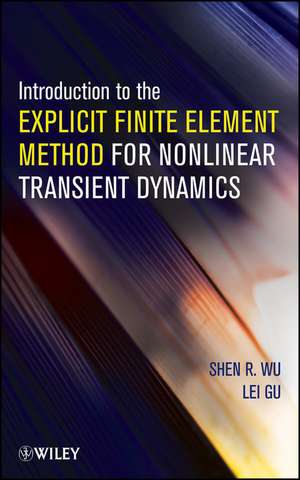
Introduction to the Explicit Finite Element Method for Nonlinear Transient Dynamics
Autor Shen R Wu, Lei Guen Limba Engleză Hardback – 19 sep 2012
As numerical technology continues to grow and evolve with industrial applications, understanding the explicit finite element method has become increasingly important, particularly in the areas of crashworthiness, metal forming, and impact engineering. Introduction to the Explicit Finite Element Method for Nonlinear Transient Dynamics is the first book to address specifically what is now accepted as the most successful numerical tool for nonlinear transient dynamics. The book aids readers in mastering the explicit finite element method and programming code without requiring extensive background knowledge of the general finite element.
The authors present topics relating to the variational principle, numerical procedure, mechanical formulation, and fundamental achievements of the convergence theory. In addition, key topics and techniques are provided in four clearly organized sections:
- Fundamentals explores a framework of the explicit finite element method for nonlinear transient dynamics and highlights achievements related to the convergence theory
- Element Technology discusses four-node, three-node, eight-node, and two-node element theories
- Material Models outlines models of plasticity and other nonlinear materials as well as the mechanics model of ductile damage
- Contact and Constraint Conditions covers subjects related to three-dimensional surface contact, with examples solved analytically, as well as discussions on kinematic constraint conditions
Introduction to the Explicit Finite Element Method for Nonlinear Transient Dynamics is an ideal book for both engineers who require more theoretical discussions and for theoreticians searching for interesting and challenging research topics. The book also serves as an excellent resource for courses on applied mathematics, applied mechanics, and numerical methods at the graduate level.
Preț: 885.15 lei
Preț vechi: 972.69 lei
-9%
Puncte Express: 1328
Carte tipărită la comandă
Livrare economică 18 noiembrie-02 decembrie
Livrare prin curier în România Termenul estimat este afișat lângă disponibilitate.
Transport gratuit pentru acest produs Plată online sau ramburs, în funcție de opțiunile comenzii.
Retur gratuit în 14 zile Comandă securizată și suport în română.
Specificații
ISBN-13: 9780470572375
ISBN-10: 047057237X
Pagini: 352
Dimensiuni: 161 x 240 x 23 mm
Greutate: 0.7 kg
Editura: Wiley
Locul publicării:Hoboken, United States
ISBN-10: 047057237X
Pagini: 352
Dimensiuni: 161 x 240 x 23 mm
Greutate: 0.7 kg
Editura: Wiley
Locul publicării:Hoboken, United States
V-ar putea interesa
-
 Fundamental ProbabilityPaolella-9%Preț: 976.23 lei1072.78 lei
 -
 Modeling and SimulationStanislaw Raczynski-8%Preț: 652.55 lei709.29 lei
 -
 Linear Models for Unbalanced DataShayle R Searle-23%Preț: 883.06 lei1146.83 lei
 -
 Exploring Data Tables PHoaglin-9%Preț: 899.27 lei988.21 lei
 -
 -9%Preț: 899.71 lei988.69 lei
 -
 -20%Preț: 1023.29 lei1279.11 lei
 -
 Measurement Error Models PFuller-9%Preț: 861.96 lei947.21 lei
 -
 -19%Preț: 105.58 lei130.68 lei
 -
 Zariski, O: Commutative Algebra Volume IIOscar Zariski-25%Preț: 160.52 lei215.42 lei
 -
 Mathematics and ComputationAvi WigdersonPreț: 426.94 lei
 -
 Perspective and Projective GeometryAnnalisa Crannell-14%Preț: 423.94 lei492.95 lei
 -
 -19%Preț: 512.42 lei632.62 lei
 -
 Flight Dynamics and Control of Aero and Space VehiclesRama K. Yedavalli-27%Preț: 741.02 lei1015.11 lei
 -
 Preț: 518.61 lei
 -
 Engineering OptimizationSingiresu S. Rao-27%Preț: 948.34 lei1299.10 lei
 -
 -9%Preț: 571.74 lei628.28 lei
 -
 Banach Algebras and ApplicationsMahmoud Filali-23%Preț: 891.76 lei1158.14 lei
Public țintă
Reference book for engineers who require more theoretical discussions and for theoreticians who need explore research topics about the explicit finite element method; coursebook for graduates in areas such as applied mathematics and numerical methods and other related manufacturing and engineering fields.Cuprins
Preface xv
Part I Fundamentals 1
1 Introduction 3
1.1 Era of Simulation and Computer Aided Engineering 3
1.2 Preliminaries 6
2 Framework of Explicit Finite Element Method for Nonlinear Transient Dynamics 11
2.1 Transient Structural Dynamics 11
2.2 Variational Principles for Transient Dynamics 13
2.3 Finite Element Equations and the Explicit Procedures 15
2.4 Main Features of the Explicit Finite Element Method 21
2.5 Assessment of Explicit Finite Element Method 24
Part II Element Technology 37
3 Four-Node Shell Element (Reissner-Mindlin Plate Theory) 39
3.1 Fundamentals of Plates and Shells 40
3.2 Linear Theory of R-M Plate 47
3.3 Interpolation for Four-node R-M Plate Element 52
3.4 Reduced Integration and Selective Reduced Integration 56
3.5 Perturbation Hourglass Control-Belytschko-Tsay Element 60
3.6 Physical Hourglass Control-Belytschko-Leviathan (QPH) Element 71
3.7 Shear Projection Method-Bathe-Dvorkin Element 76
3.8 Assessment of Four-node R-M Plate Element 80
4 Three-Node Shell Element (Reissner-Mindlin Plate Theory) 88
4.1 Fundamentals of a Three-node C0 Element 89
4.2 Decomposition Method for C0 Triangular Element with One-point Integration 92
4.3 Discrete Kirchhoff Triangular Element 97
4.4 Assessment of Three-node R-M Plate Element 102
5 Eight-Node Solid Element 107
5.1 Trilinear Interpolation for the Eight-node Hexahedron Element 107
5.2 Locking Issues of the Eight-node Solid Element 111
5.3 One-point Reduced Integration and the Perturbed Hourglass Control 113
5.4 Assumed Strain Method and Selective/Reduced Integration 115
5.5 Assumed Deviatoric Strain 118
5.6 An Enhanced Assumed Strain Method 118
5.7 Taylor Expansion of Assumed Strain about the Element Center 120
5.8 Evaluation of Eight-node Solid Element 123
6 Two-Node Element 128
6.1 Truss and Rod Element 128
6.2 Timoshenko Beam Element 129
6.3 Spring Element 131
6.4 Spot Weld Element 134
Part III Material Models 139
7 Material Model of Plasticity 141
7.1 Fundamentals of Plasticity 142
7.2 Constitutive Equations 153
7.3 Software Implementation 159
7.4 Evaluation of Shell Elements with Plastic Deformation 169
8 Continuum Mechanics Model of Ductile Damage 175
8.1 Concept of Damage Mechanics 175
8.2 Gurson's Model 177
8.3 Chow's Isotropic Model of Continuum Damage Mechanics 180
8.4 Chow's Anisotropic Model of Continuum Damage Mechanics 189
9 Models of Nonlinear Materials 192
9.1 Viscoelasticity 192
9.2 Polymer and Engineering Plastics 197
9.3 Rubber 200
9.4 Foam 203
9.5 Honeycomb 209
9.6 Laminated Glazing 214
Part IV Contact and Constraint Conditions 219
10 Three-Dimensional Surface Contact 221
10.1 Examples of Contact Problems 221
10.2 Description of Contact Conditions 233
10.3 Variational Principle for the Dynamic Contact Problem 243
10.4 Penalty Method and the Regularization of Variational Inequality 252
11 Numerical Procedures for Three-Dimensional Surface Contact 261
11.1 A Contact Algorithm with Slave Node Searching Master Segment 262
11.3 Method of Contact Territory and Defense Node 273
11.4 Pinball Contact Algorithm 277
11.5 Edge (Line Segment) Contact 279
11.6 Evaluation of Contact Algorithm with Penalty Method 282
12 Kinematic Constraint Conditions 289
12.1 Rigid Wall 289
12.2 Rigid Body 296
12.3 Explicit Finite Element Procedure with Constraint Conditions 298
12.4 Application Examples with Constraint Conditions 300
References 305
Index 325
Part I Fundamentals 1
1 Introduction 3
1.1 Era of Simulation and Computer Aided Engineering 3
1.2 Preliminaries 6
2 Framework of Explicit Finite Element Method for Nonlinear Transient Dynamics 11
2.1 Transient Structural Dynamics 11
2.2 Variational Principles for Transient Dynamics 13
2.3 Finite Element Equations and the Explicit Procedures 15
2.4 Main Features of the Explicit Finite Element Method 21
2.5 Assessment of Explicit Finite Element Method 24
Part II Element Technology 37
3 Four-Node Shell Element (Reissner-Mindlin Plate Theory) 39
3.1 Fundamentals of Plates and Shells 40
3.2 Linear Theory of R-M Plate 47
3.3 Interpolation for Four-node R-M Plate Element 52
3.4 Reduced Integration and Selective Reduced Integration 56
3.5 Perturbation Hourglass Control-Belytschko-Tsay Element 60
3.6 Physical Hourglass Control-Belytschko-Leviathan (QPH) Element 71
3.7 Shear Projection Method-Bathe-Dvorkin Element 76
3.8 Assessment of Four-node R-M Plate Element 80
4 Three-Node Shell Element (Reissner-Mindlin Plate Theory) 88
4.1 Fundamentals of a Three-node C0 Element 89
4.2 Decomposition Method for C0 Triangular Element with One-point Integration 92
4.3 Discrete Kirchhoff Triangular Element 97
4.4 Assessment of Three-node R-M Plate Element 102
5 Eight-Node Solid Element 107
5.1 Trilinear Interpolation for the Eight-node Hexahedron Element 107
5.2 Locking Issues of the Eight-node Solid Element 111
5.3 One-point Reduced Integration and the Perturbed Hourglass Control 113
5.4 Assumed Strain Method and Selective/Reduced Integration 115
5.5 Assumed Deviatoric Strain 118
5.6 An Enhanced Assumed Strain Method 118
5.7 Taylor Expansion of Assumed Strain about the Element Center 120
5.8 Evaluation of Eight-node Solid Element 123
6 Two-Node Element 128
6.1 Truss and Rod Element 128
6.2 Timoshenko Beam Element 129
6.3 Spring Element 131
6.4 Spot Weld Element 134
Part III Material Models 139
7 Material Model of Plasticity 141
7.1 Fundamentals of Plasticity 142
7.2 Constitutive Equations 153
7.3 Software Implementation 159
7.4 Evaluation of Shell Elements with Plastic Deformation 169
8 Continuum Mechanics Model of Ductile Damage 175
8.1 Concept of Damage Mechanics 175
8.2 Gurson's Model 177
8.3 Chow's Isotropic Model of Continuum Damage Mechanics 180
8.4 Chow's Anisotropic Model of Continuum Damage Mechanics 189
9 Models of Nonlinear Materials 192
9.1 Viscoelasticity 192
9.2 Polymer and Engineering Plastics 197
9.3 Rubber 200
9.4 Foam 203
9.5 Honeycomb 209
9.6 Laminated Glazing 214
Part IV Contact and Constraint Conditions 219
10 Three-Dimensional Surface Contact 221
10.1 Examples of Contact Problems 221
10.2 Description of Contact Conditions 233
10.3 Variational Principle for the Dynamic Contact Problem 243
10.4 Penalty Method and the Regularization of Variational Inequality 252
11 Numerical Procedures for Three-Dimensional Surface Contact 261
11.1 A Contact Algorithm with Slave Node Searching Master Segment 262
11.3 Method of Contact Territory and Defense Node 273
11.4 Pinball Contact Algorithm 277
11.5 Edge (Line Segment) Contact 279
11.6 Evaluation of Contact Algorithm with Penalty Method 282
12 Kinematic Constraint Conditions 289
12.1 Rigid Wall 289
12.2 Rigid Body 296
12.3 Explicit Finite Element Procedure with Constraint Conditions 298
12.4 Application Examples with Constraint Conditions 300
References 305
Index 325