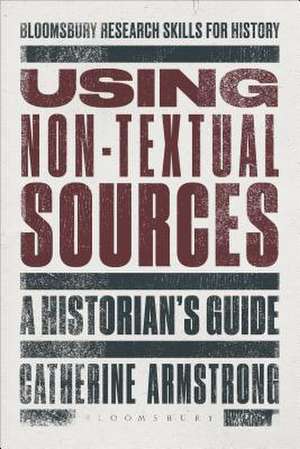
Using Non-Textual Sources: A Historian's Guide: Bloomsbury Research Skills for History
Autor Dr Catherine Armstrongen Limba Engleză Hardback – 16 dec 2015
| Toate formatele și edițiile | Preț | Express |
|---|---|---|
| Paperback (1) | 182.53 lei 6-8 săpt. | |
| Bloomsbury Publishing – 16 dec 2015 | 182.53 lei 6-8 săpt. | |
| Hardback (1) | 613.95 lei 6-8 săpt. | |
| Bloomsbury Publishing – 16 dec 2015 | 613.95 lei 6-8 săpt. |
Preț: 613.95 lei
Preț vechi: 826.55 lei
-26% Nou
Puncte Express: 921
Preț estimativ în valută:
108.64€ • 127.39$ • 95.41£
108.64€ • 127.39$ • 95.41£
Carte tipărită la comandă
Livrare economică 05-19 februarie 26
Preluare comenzi: 021 569.72.76
Specificații
ISBN-13: 9781472505835
ISBN-10: 1472505832
Pagini: 160
Ilustrații: 20 bw illus
Dimensiuni: 156 x 234 x 11 mm
Greutate: 0.4 kg
Editura: Bloomsbury Publishing
Colecția Bloomsbury Academic
Seria Bloomsbury Research Skills for History
Locul publicării:London, United Kingdom
ISBN-10: 1472505832
Pagini: 160
Ilustrații: 20 bw illus
Dimensiuni: 156 x 234 x 11 mm
Greutate: 0.4 kg
Editura: Bloomsbury Publishing
Colecția Bloomsbury Academic
Seria Bloomsbury Research Skills for History
Locul publicării:London, United Kingdom
V-ar putea interesa
-
 Letter To An Unknown SoldierKate PullingerPreț: 107.26 lei
 -
 An Ordinary Man: The True Story Behind Hotel RwandaPaul Rusesabagina-29%Preț: 71.89 lei101.42 lei
 -
 Red AzaleaAnchee Min-28%Preț: 49.65 lei68.64 lei
 -
 Preț: 196.15 lei
 -
 Preț: 64.01 lei
 -
 Exorcising HitlerFrederick TaylorPreț: 143.28 lei
 -
 My Own StoryEmmeline Pankhurst-19%Preț: 45.33 lei55.86 lei
 -
 The Vanishing Map: A Journey from LA to Tokyo to the Heart of EuropeDr Stephen Barber-39%Preț: 253.70 lei416.57 lei
Caracteristici
Provides practical advice for university history students on the range of non-textual sources they'll encounter
Notă biografică
Catherine Armstrong is Lecturer in American History at Loughborough University, UK.
Cuprins
Introduction \ 1. Borrowing from Other Disciplines \ 2. Reading Images \ 3. Audio/Film Sources \ 4. Material Culture and Historic Places \ 5. Practical Applications \ Postscript \ Glossary \ Further Reading \ Index
Recenzii
Armstrong's work is an excellent point of entry into material for the analysis of non-textual sources. Written by an enthusiastic historian, it will be of great use to students, but can also serve as an inspiration to other researchers.
Students eager to find a fresh way to study history should read this book. Written in a clear, accessible style, it applies essential cultural theory to a dazzling array of examples from many continents and periods, from pottery and portraits to films and interviews. One of Catherine Armstrong's outstanding qualities as a historian is that far from talking down to her readers she encourages them to join her on an exciting and surprising voyage of historical discovery. As such, this is both a useful handbook and an extended essay, fizzing with interest and enthusiasm, that one can read with pleasure from start to finish.
Armstrong's Using Non-Texual Sources is an ambitious, concise, clearly structured and lucidly written introduction to the use of visual, aural, and material sources for the writing of history. Based upon a broad and deep knowledge of the relevant interdisciplinary literatures, there is no comparable textbook available for undergraduate historical methods courses. Its intended audience will find a persuasive argument for why they should look beyond textual sources as well as a detailed guide to best-practices in their analysis of film, paintings, cartoons, music, film, and artefacts.
Students eager to find a fresh way to study history should read this book. Written in a clear, accessible style, it applies essential cultural theory to a dazzling array of examples from many continents and periods, from pottery and portraits to films and interviews. One of Catherine Armstrong's outstanding qualities as a historian is that far from talking down to her readers she encourages them to join her on an exciting and surprising voyage of historical discovery. As such, this is both a useful handbook and an extended essay, fizzing with interest and enthusiasm, that one can read with pleasure from start to finish.
Armstrong's Using Non-Texual Sources is an ambitious, concise, clearly structured and lucidly written introduction to the use of visual, aural, and material sources for the writing of history. Based upon a broad and deep knowledge of the relevant interdisciplinary literatures, there is no comparable textbook available for undergraduate historical methods courses. Its intended audience will find a persuasive argument for why they should look beyond textual sources as well as a detailed guide to best-practices in their analysis of film, paintings, cartoons, music, film, and artefacts.