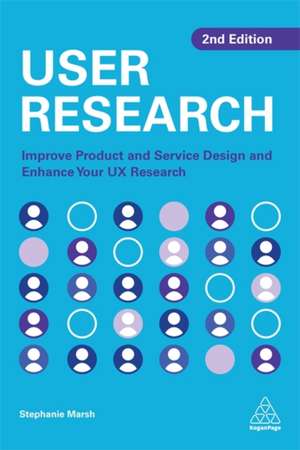
User Research
Autor Stephanie Marshen Limba Engleză Paperback – 22 feb 2022
Remarcăm de la primele pagini că această lucrare nu se mulțumește doar să descrie concepte abstracte, ci oferă protocoale clare pentru metode esențiale precum card sorting, testarea A/B sau sondajele de opinie. Într-o piață unde multe produse eșuează pentru că omit nevoile reale ale publicului, Stephanie Marsh propune un sistem riguros de înțelegere a comportamentului uman. Această a doua ediție a volumului User Research – Improve Product and Service Design and Enhance Your UX Research extinde perspectiva asupra domeniului, introducând capitole vitale despre infrastructura de cercetare și modul în care echipele pot integra eficient multiple metodologii simultan. Credem că valoarea acestui ghid rezidă în echilibrul dintre teorie și execuție: fiecare tehnică este prezentată cu avantajele și dezavantajele sale, oferind cititorului instrumentele necesare pentru a decide ce metodă se potrivește contextului său specific. Fanii volumului Understanding Your Users de Kathy Baxter vor recunoaște aceeași atenție la detaliile practice de implementare, aplicată aici într-un context modern de Research Operations. Stilul este unul aplicat, specific editurii Kogan Page, transformând cercetarea dintr-o etapă opțională într-un pilon central al strategiei de business. Merită menționat că autoarea analizează nu doar colectarea datelor, ci și procesul delicat de comunicare a rezultatelor către factorii de decizie, asigurându-se că munca de cercetare produce schimbări reale în designul serviciilor.
Preț: 266.37 lei
Preț vechi: 332.96 lei
-20%
Carte tipărită la comandă
Livrare economică 21 decembrie 26 - 04 ianuarie 27
Specificații
ISBN-10: 1398603570
Pagini: 344
Dimensiuni: 156 x 234 x 22 mm
Greutate: 0.78 kg
Ediția:2. Auflage
Editura: Kogan Page
V-ar putea interesa
-
 Sketching User Experiences: The WorkbookSaul Greenberg-16%Preț: 124.55 lei149.00 lei
-
 -39%Preț: 273.70 lei450.65 lei
-
 Business Research MethodsEmma Bell-18%Preț: 480.46 lei582.47 lei
-
 -39%Preț: 485.75 lei798.37 lei
-
 -8%Preț: 443.64 lei482.22 lei
-
 Preț: 207.88 lei
-
 User Experience DesignSatyam Kantamneni-20%Preț: 171.74 lei214.67 lei
-
 User Experience ResearchMarty Gage-20%Preț: 176.58 lei220.72 lei
-
 The Practice of Market ResearchYvonne McGivern-13%Preț: 518.89 lei596.43 lei
-
 Research Methods for Business StudentsMark Saunders-19%Preț: 601.66 lei742.79 lei
-
 User Experience Design: A Practical IntroductionGavin Allanwood-12%Preț: 186.40 lei211.77 lei
-
 -29%Preț: 369.61 lei522.82 lei
-
 Research MethodsBob Matthews-13%Preț: 492.88 lei566.53 lei
-
 Product Research RulesC Todd LombardoPreț: 319.78 lei
-
 Visual Methods for Digital Research - An IntroductionGabriele ColomboPreț: 141.04 lei
-
 Business Research Methods 5eBoris Blumberg-26%Preț: 374.19 lei502.50 lei
-
 Universal Methods of Design, Expanded and RevisedBruce Hanington-20%Preț: 164.26 lei205.92 lei
-
 Research Methods in InformationAlison Jane Pickard-19%Preț: 566.08 lei698.87 lei
-
 -19%Preț: 167.87 lei206.99 lei
De ce să citești această carte
Pentru profesioniștii care vor să depășească intuiția și să bazeze deciziile de design pe dovezi concrete. Cititorul câștigă un set complet de instrumente practice pentru a înțelege motivațiile utilizatorilor, învățând nu doar cum să colecteze date prin metode variate, ci și cum să gestioneze logistica complexă a unui departament de cercetare modern.
Descriere
Many businesses are based on creating desirable experiences, products and services for users. However, companies often fail to consider the end user - the consumer - in their planning and development processes. How can marketing practitioners effectively understand their customers and create products and services that work for them? This book has the answers.
User experience research, also known as UX research, focuses on understanding user behaviours, needs and motivations through a range of observational techniques, task analysis and other methodologies. User Research is a practical guide that shows readers how to use the vast array of user research methods available. Written by one of the UK's leading UX research professionals, readers can benefit from in-depth knowledge that explores the fundamentals of user research.
Covering all the key research methods including face-to-face user testing, card sorting, surveys, A/B testing and many more, the book gives expert insight into the nuances, advantages and disadvantages of each, while also providing guidance on how to interpret, analyze and share the data once it has been obtained. Now in its second edition, User Research provides a new chapter on research operations and infrastructure as well as new material on combining user research methodologies.
Cuprins
Chapter - 01: Introduction - Why is user research so important?; Section - ONE: The fundamentals - What good research looks like; Chapter - 02: Planning, objectives and legalities in user research; Chapter - 03: Best practice in user research - Who, what, why and how; Chapter - 04: Managing user research logistics - Agencies, facilities and contracts; Section - TWO: Selecting and using user research methods; Chapter - 05: Usability testing - Observing people doing things; Chapter - 06: Content testing - What do people think your content means?; Chapter - 07: Card sorting - Understanding how people group and relate things; Chapter - 08: Surveys - How to gauge a widespread user response; Chapter - 09: User interviews - Understanding people's experience through talking to them; Chapter - 10: Diary studies - How to capture user research data over time; Chapter - 11: Information architecture validation - Does the structure of your information work for your users?; Chapter - 12: Ethnography - Observing how people behave in the real world; Chapter - 13: Contextual inquiry - Interviewing people in their own environment; Chapter - 14: A/B Testing - A technique to compare different options; Chapter - 15: Getting the best out of stakeholder workshops; Chapter - 16: Guerrilla research - Running fast-paced research in the real world; Chapter - 17: How to combine user research methodologies; Section - THREE: Analyzing and presenting your data; Chapter - 18: Content analysis - A method of coding and making sense of your qualitative data; Chapter - 19: Affinity diagramming - Understand your data through identifying its themes; Chapter - 20: Prioritizing issues and user needs - What's important and what to work on next; Chapter - 21: Making recommendations - How to make your research findings actionable; Chapter - 22: Creating executive summaries and detailed reports to present results; Chapter - 23: Using video playback to present your research results; Chapter - 24: Using personas to communicate user characteristics and behaviours; Chapter - 25: Using mental models to visualize how users think and identify opportunities; Chapter - 26: Using journey and experience maps to visualize user research data; Chapter - 27: Using scenarios and storyboards to represent the user journey; Chapter - 28: Using infographics to translate numerical and statistical data; Chapter - 29: How to recommend changes to visual, interaction and information design; Chapter - 30: Conclusion