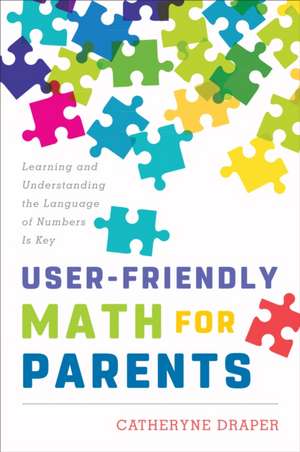
User-Friendly Math for Parents: Learning and Understanding the Language of Numbers Is Key: Rowman & Littlefield Publishers
Autor Catheryne Draperen Limba Engleză Paperback – 8 iun 2017
Din seria Rowman & Littlefield Publishers
-
 Preț: 113.89 lei
 - 13%
 Preț: 155.38 lei
 -
 Preț: 109.93 lei
 - 20%
 Preț: 370.93 lei
 - 19%
 Preț: 323.76 lei
 - 25%
 Preț: 228.52 lei
 - 19%
 Preț: 328.78 lei
 - 20%
 Preț: 314.77 lei
 - 20%
 Preț: 191.09 lei
 - 30%
 Preț: 703.64 lei
 - 19%
 Preț: 332.36 lei
 - 31%
 Preț: 351.69 lei
 - 15%
 Preț: 127.13 lei
 - 22%
 Preț: 328.37 lei
 - 19%
 Preț: 324.21 lei
 - 30%
 Preț: 355.24 lei
 - 23%
 Preț: 258.39 lei
 - 25%
 Preț: 344.18 lei
 - 23%
 Preț: 282.77 lei
 - 16%
 Preț: 109.26 lei
 - 31%
 Preț: 351.50 lei
 - 22%
 Preț: 331.09 lei
 - 32%
 Preț: 373.39 lei
 - 34%
 Preț: 842.33 lei
 - 19%
 Preț: 314.30 lei
 - 23%
 Preț: 363.28 lei
 - 21%
 Preț: 128.84 lei
 - 30%
 Preț: 774.75 lei
 - 23%
 Preț: 278.65 lei
 - 22%
 Preț: 266.38 lei
 - 19%
 Preț: 344.02 lei
 - 32%
 Preț: 594.45 lei
 - 31%
 Preț: 566.85 lei
 - 22%
 Preț: 367.22 lei
 - 19%
 Preț: 322.03 lei
 - 16%
 Preț: 148.06 lei
 - 21%
 Preț: 369.53 lei
 - 19%
 Preț: 323.37 lei
 -
 Preț: 402.96 lei
 - 30%
 Preț: 424.70 lei
 - 24%
 Preț: 255.02 lei
 - 24%
 Preț: 275.28 lei
 - 14%
 Preț: 152.49 lei
 - 30%
 Preț: 847.72 lei
 - 19%
 Preț: 316.66 lei
 - 23%
 Preț: 283.57 lei
 - 29%
 Preț: 727.24 lei
 - 23%
 Preț: 262.16 lei
 - 19%
 Preț: 343.92 lei
Preț: 263.04 lei
Preț vechi: 343.47 lei
-23%
Puncte Express: 395
Carte tipărită la comandă
Livrare economică 01-15 decembrie
Livrare prin curier în România Termenul estimat este afișat lângă disponibilitate.
Transport gratuit de la 400.00 lei Plată online sau ramburs, în funcție de opțiunile comenzii.
Retur gratuit în 14 zile Comandă securizată și suport în română.
Specificații
ISBN-13: 9781475834208
ISBN-10: 1475834209
Pagini: 183
Ilustrații: 3 b/w photos; 97 graphs
Dimensiuni: 174 x 252 x 12 mm
Greutate: 0.32 kg
Editura: Bloomsbury Publishing
Colecția Rowman & Littlefield
Seria Rowman & Littlefield Publishers
Locul publicării:New York, United States
ISBN-10: 1475834209
Pagini: 183
Ilustrații: 3 b/w photos; 97 graphs
Dimensiuni: 174 x 252 x 12 mm
Greutate: 0.32 kg
Editura: Bloomsbury Publishing
Colecția Rowman & Littlefield
Seria Rowman & Littlefield Publishers
Locul publicării:New York, United States
V-ar putea interesa
-
 Organized Innovation: A Blueprint for Renewing America's ProsperitySteven C. Currall-19%Preț: 367.47 lei454.91 lei
 -
 -12%Preț: 282.37 lei322.55 lei
 -
 School Choice Tradeoffs: Liberty, Equity, and DiversityR. Kenneth GodwinPreț: 263.13 lei
 -
 Preț: 300.77 lei
 -
 Preț: 276.51 lei
 -
 -15%Preț: 434.78 lei511.50 lei
 -
 Preț: 369.64 lei
 -
 Speaking UpAnne Proffitt DuprePreț: 203.88 lei
 -
 Creating Multicultural Change on CampusRaechele L PopePreț: 292.12 lei
 -
 Preț: 189.57 lei
Descriere
User-Friendly Numbers in Math for Parents shares stories of students' reasoning, thinking, and sometimes misunderstandings about numbers - stories that provide the opportunity to see math differently. Most of the students are visual-spatial, creative, daydreamers who may miss the details in math, a characteristic of visual-spatial learners. Through these stories, parents will see mathematics through their child's eyes, both the clarity and the confusion. Armed with this new sight, and therefore insight, parents will be able to talk differently with their child about the number language of math. By seeing numbers through "new eyes," children and parents can take control of the math language and therefore, the mathematics.
This book focuses more on the "why" reasons behind math number relationships, explained in plain English and with images that show number relationships. By including more images and fewer formulas, readers - especially the visual spatial learners - have a better chance of understanding how number organizers apply to different number types. Recognizing connections among number formats significantly reduces the impatience, frustration, and heartache around homework.
This book focuses more on the "why" reasons behind math number relationships, explained in plain English and with images that show number relationships. By including more images and fewer formulas, readers - especially the visual spatial learners - have a better chance of understanding how number organizers apply to different number types. Recognizing connections among number formats significantly reduces the impatience, frustration, and heartache around homework.
Cuprins
Preface
Foreword
Introduction
Part I: Definition
1. Getting a Grip on Number Sense
Number Freedom
Flexibility Through Composition and Decomposition of Numbers
How Counting Can Make or Break Number Sense
Ducks, Gauss, and George
Keep in Mind
2. The Map of Number Symbol Territory
The Shapes of Reading Numbers
Is Subitizing About Another Shape to Recognize?
Alphabet of Letters and Alphabet of Digits
Writing Numbers and Reading Symbolism
Keep in Mind
3. An Evolution of Number and Naming Rights
Counting (Natural), and Whole Numbers
Integers and Other Positive and Negative Absurd Numbers
Rational Numbers Include Fractions and Other Number Comparisons
Politics of Rational and Unutterable Irrational Numbers
Infinity, Googol, and Other Very Large Ideas
Keep in Mind
Part II: Organization
4. Classify First
Three Is Not Red
Classification as an Essential Skill
Different Classifications Lead to Increased Flexibility
Keep in Mind
5. Whence Came Place Value?
Digits Continue to be the Alphabet for Numbers
Some Cautionary Tales About Learning Place Value
Classifying by Size for Place Value
Transitioning to Place Value Record-Keeping
Charles' Overlays
Decimals Continue the Same Organization, Just Smaller
Keep in Mind
6. The Number Line Brings Numbers to Order
First, Last, and In Between - The Nature of Order
Repetition of Pattern in Sequential Order
A Place for Everything
Keep in Mind
Part III: Relationships and Patterns
7. Pattern Ancestors
Repeating Patterns
Growing Patterns
Ancestors of Figurate Numbers and Other Growing Patterns
Patterns Inside EquivalencesExpressing Ancestral Rules as Algebra Relationships
Keep in Mind
8. Balance of Relationships and Patterns
Flexibility Within Balance
Balance in Fraction Equivalences
Decimal Numbers Are Connections to the Other Side
Finding Patterns With ViewfindersKeep in Mind
9. Number Personalities
Even and Odd Numbers
Prime and Composite Numbers
Positive and Negative Integers
Numbers Can Have Multiple Number Personalities
Keep in Mind
Part IV: Connections
10. Place Value LegaciesExponents and Logarithms
Location Matters
Reciprocals: A Location and an Inverse
Who Moved My Decimal?
Keep in Mind
11. Ratio: The Comparison Effect
Predicaments Around Understanding Fraction as a Ratio Notation
Ratio Pairs Can Make Proportions
Percentage: A Location and a Rate
Keep in Mind
12. More Order From the Number Line
Number Lines Are Everywhere
Coordinate Axes
More Coordinate Connections
Keep in Mind
Conclusion: What Parents Can Do
Ask Questions
Advocate for Number Sense
Find Your Math Voice
Keep in Mind
Glossary
References
About the Author
Foreword
Introduction
Part I: Definition
1. Getting a Grip on Number Sense
Number Freedom
Flexibility Through Composition and Decomposition of Numbers
How Counting Can Make or Break Number Sense
Ducks, Gauss, and George
Keep in Mind
2. The Map of Number Symbol Territory
The Shapes of Reading Numbers
Is Subitizing About Another Shape to Recognize?
Alphabet of Letters and Alphabet of Digits
Writing Numbers and Reading Symbolism
Keep in Mind
3. An Evolution of Number and Naming Rights
Counting (Natural), and Whole Numbers
Integers and Other Positive and Negative Absurd Numbers
Rational Numbers Include Fractions and Other Number Comparisons
Politics of Rational and Unutterable Irrational Numbers
Infinity, Googol, and Other Very Large Ideas
Keep in Mind
Part II: Organization
4. Classify First
Three Is Not Red
Classification as an Essential Skill
Different Classifications Lead to Increased Flexibility
Keep in Mind
5. Whence Came Place Value?
Digits Continue to be the Alphabet for Numbers
Some Cautionary Tales About Learning Place Value
Classifying by Size for Place Value
Transitioning to Place Value Record-Keeping
Charles' Overlays
Decimals Continue the Same Organization, Just Smaller
Keep in Mind
6. The Number Line Brings Numbers to Order
First, Last, and In Between - The Nature of Order
Repetition of Pattern in Sequential Order
A Place for Everything
Keep in Mind
Part III: Relationships and Patterns
7. Pattern Ancestors
Repeating Patterns
Growing Patterns
Ancestors of Figurate Numbers and Other Growing Patterns
Patterns Inside EquivalencesExpressing Ancestral Rules as Algebra Relationships
Keep in Mind
8. Balance of Relationships and Patterns
Flexibility Within Balance
Balance in Fraction Equivalences
Decimal Numbers Are Connections to the Other Side
Finding Patterns With ViewfindersKeep in Mind
9. Number Personalities
Even and Odd Numbers
Prime and Composite Numbers
Positive and Negative Integers
Numbers Can Have Multiple Number Personalities
Keep in Mind
Part IV: Connections
10. Place Value LegaciesExponents and Logarithms
Location Matters
Reciprocals: A Location and an Inverse
Who Moved My Decimal?
Keep in Mind
11. Ratio: The Comparison Effect
Predicaments Around Understanding Fraction as a Ratio Notation
Ratio Pairs Can Make Proportions
Percentage: A Location and a Rate
Keep in Mind
12. More Order From the Number Line
Number Lines Are Everywhere
Coordinate Axes
More Coordinate Connections
Keep in Mind
Conclusion: What Parents Can Do
Ask Questions
Advocate for Number Sense
Find Your Math Voice
Keep in Mind
Glossary
References
About the Author
Recenzii
For the past 25 years, Cathy Draper and I have engaged in many fascinating conversations
focused on teaching and learning math. Two things are clear to me. Cathy has a deep
understanding of conceptual and practical math. Cathy, unlike many educators, knows that
each human brain assimilates and processes in its own unique way. I have witnessed her
analysis and diagnosis of each "student", and applauded as she found the unique prescriptive
approach needed to help them understand and learn in their own way. She takes math from the
linear left-brain to the visual, conceptual right brain and develops an approach that successfully
integrates the two into a whole-brain approach. Sharing her lifetime of math experience with us
is her gift to the world.
Catheryne Draper makes math homework less of a chore and more of a game. She succeeds at this by saying use visuals and use the imagination. The highlight for me was the chapter on Becca's Pattern Ancestors. The two children in my life, at ages four and six, began using "Silly Bands" to form groupings and create patterns. Years later, they both now understand sequences, and they are working on factoring and quadratic expressions. Catheryne demonstrates through out her book that math can be learned by using visuals and a child's imagination and that there isn't just one method for teaching but to use the method that is most effective for your child.
focused on teaching and learning math. Two things are clear to me. Cathy has a deep
understanding of conceptual and practical math. Cathy, unlike many educators, knows that
each human brain assimilates and processes in its own unique way. I have witnessed her
analysis and diagnosis of each "student", and applauded as she found the unique prescriptive
approach needed to help them understand and learn in their own way. She takes math from the
linear left-brain to the visual, conceptual right brain and develops an approach that successfully
integrates the two into a whole-brain approach. Sharing her lifetime of math experience with us
is her gift to the world.
Catheryne Draper makes math homework less of a chore and more of a game. She succeeds at this by saying use visuals and use the imagination. The highlight for me was the chapter on Becca's Pattern Ancestors. The two children in my life, at ages four and six, began using "Silly Bands" to form groupings and create patterns. Years later, they both now understand sequences, and they are working on factoring and quadratic expressions. Catheryne demonstrates through out her book that math can be learned by using visuals and a child's imagination and that there isn't just one method for teaching but to use the method that is most effective for your child.