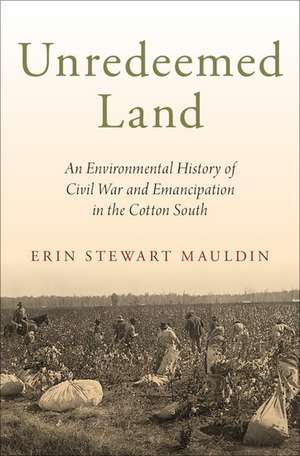
Unredeemed Land: An Environmental History of Civil War and Emancipation in the Cotton South
Autor Erin Stewart Mauldinen Limba Engleză Hardback – 29 noi 2018
Găsim în Unredeemed Land o resursă academică esențială pentru studenții și cercetătorii istoriei americane, oferind o perspectivă indispensabilă pentru înțelegerea transformărilor structurale postbelice solicitate în examenele de istorie economică și socială. Volumul semnat de Erin Stewart Mauldin nu este doar o cronică a conflictului militar, ci o analiză riguroasă a modului în care ecologia a dictat succesul sau eșecul reconstrucției economice în Sudul bumbacului.
Apreciem modul în care autoarea reîncadrează „King Cotton” nu doar ca un sistem politic, ci ca o tehnică de utilizare a terenurilor care depindea de soluri proaspete și sclavie. Ne-a atras atenția argumentul central: Războiul Civil a accelerat schimbările ecologice, forțând trecerea la o agricultură intensivă care a epuizat resursele naturale și a blocat foștii sclavi și micii fermieri într-un cerc vicios al datoriilor. Stilul narativ este unul echilibrat; deși subiectul este unul tehnic, Mauldin reușește să însuflețească textul prin utilizarea jurnalelor epocii, oferind o dimensiune umană datelor despre eroziunea solului și randamentul culturilor.
Această lucrare acoperă aceeași arie tematică precum Scars on the Land de David Silkenat, însă se diferențiază printr-o abordare mult mai axată pe mecanismele economice ale tranziției către capitalism și pe moștenirea ecologică pe termen lung a emancipării. Dacă One Kind of Freedom de Roger L. Ransom se concentrează pe instituțiile economice post-sclavie, Unredeemed Land adaugă variabila critică a mediului înconjurător ca factor decizional. În contextul operei sale, această carte reprezintă o aplicare specifică și aprofundată a principiilor generale din A Companion to Global Environmental History, demonstrând cum forțele globale și locale se intersectează la nivelul solului.
Preț: 423.20 lei
Preț vechi: 538.51 lei
-21%
Carte tipărită la comandă
Livrare economică 11-16 iunie
Specificații
ISBN-10: 0190865172
Pagini: 256
Ilustrații: 17 hts
Dimensiuni: 236 x 157 x 25 mm
Greutate: 0.6 kg
Editura: Oxford University Press
Colecția OUP USA
Locul publicării:New York, United States
V-ar putea interesa
-
 -10%Preț: 729.56 lei812.31 lei
 -
 -21%Preț: 304.93 lei385.08 lei
 -
 -26%Preț: 190.84 lei257.69 lei
 -
 Panda Nation: The Construction and Conservation of China's Modern IconE. Elena Songster-26%Preț: 172.07 lei233.49 lei
 -
 Rivers of the Sultan: The Tigris and Euphrates in the Ottoman EmpireFaisal H. HusainPreț: 249.26 lei
 -
 Habitat Ecology and AnalysisJoseph A. Veech-12%Preț: 340.44 lei387.03 lei
 -
 Reassembling the Social: BestsellerBruno Latour-14%Preț: 245.61 lei284.25 lei
 -
 Rivers and Society: Landscapes, Governance and LivelihoodsMalcolm CooperPreț: 429.15 lei
 -
 Preț: 463.27 lei
 -
 Preț: 383.05 lei
 -
 Riverlands of the Anthropocene: Walking Our Waterways as Places of BecomingMargaret SomervillePreț: 406.58 lei
 -
 The Dawn of EverythingDavid GraeberPreț: 227.73 lei
 -
 Global Political EcologyRichard Peet-15%Preț: 405.82 lei477.43 lei
 -
 -15%Preț: 411.58 lei484.20 lei
 -
 Symbiotic PlanetLynn MargulisPreț: 93.33 lei
 -
 Facing GaiaBruno LatourPreț: 161.87 lei
 -
 Dust: The Archive and Cultural HistoryCarolyn Kay SteedmanPreț: 298.47 lei
 -
 Water Ethics: A Values Approach to Solving the Water CrisisDavid GroenfeldtPreț: 405.76 lei
 -
 -14%Preț: 783.22 lei910.71 lei
 -
 The Anthropology of the FutureRebecca BryantPreț: 232.16 lei
 -
 Practical Field EcologyC. Philip WheaterPreț: 444.29 lei
 -
 In the Name of the Great WorkDoubravka Ol¿áková-23%Preț: 723.78 lei939.97 lei
 -
 Managing Northern Europe's ForestsK. Jan Oosthoek-23%Preț: 800.27 lei1039.30 lei
 -
 -23%Preț: 720.29 lei935.44 lei
 -
 -23%Preț: 803.91 lei1044.03 lei
De ce să citești această carte
Recomandăm această carte istoricilor și celor interesați de ecologie politică. Cititorul va înțelege de ce emanciparea nu a adus imediat prosperitate economică, explorând legătura dintre degradarea pământului și sistemul de arendă. Este o lectură clară, care explică de ce geografia și biologia sunt la fel de importante ca strategiile militare în definirea destinului unei regiuni după război.
Despre autor
Erin Stewart Mauldin este o specialistă recunoscută în istoria mediului, fiind implicată în proiecte de anvergură precum A Companion to Global Environmental History. Expertiza sa se concentrează pe intersecția dintre schimbările ecologice și transformările socio-economice din Statele Unite ale Americii în secolul al XIX-lea. Prin activitatea sa academică, Mauldin a adus contribuții semnificative în istoriografia Războiului Civil, fiind apreciată pentru capacitatea de a sintetiza date științifice despre sol și agricultură cu relatări istorice subiective, oferind astfel o viziune multidisciplinară asupra trecutului american.
Descriere
Recenzii
In Unredeemed Land, Mauldin has written a thoughtful and engaging examination of southern environmental history stretching from the antebellum era through the Civil War and into Reconstruction. Unredeemed Land illuminates a frequently neglected area of study. Mauldin also demonstrates that policies promoting environmental protection need not be limited to affluent nations operating under strong economic conditions. Denizens who ignore sustainable environmental practices do so at their peril.
Erin Stewart Mauldin has written a succinct and insightful analysis of southern agriculture that explodes old myths and offers new explanations by taking an environmentally holistic view of the subject...This brief but incisive book will be of interest to anyone who wants to understand how the Old South attempted to become the New South, with all the attendant challenges and setbacks of such a fundamental adjustment. It adroitly explains why such a transition was wrought with failures and limitations.
Unredeemed Land is a welcome intervention in Civil War and Reconstruction historiography, demonstrating the critical role of environmental fragility in rural Southern life ... an impressive piece of scholarship
In Unredeemed Land, Mauldin has written a thoughtful and engaging examination of southern environmental history stretching from the antebellum era through the Civil War and into Reconstruction. So many histories of the era focus on political, military, and socioeconomic events, and rightly so. Yet in reading these sweeping histories, there is a tendency to think that ordinary citizens reflected on the monumental issues of the daywhen, in fact, most people worried far more about earning a living and feeding their families. Byexamin[ing] the factors that affected the day-to-day lives of farmers,Unredeemed Landilluminates a frequently neglected area of study. Mauldin also demonstrates that policies promoting environmental protection need not be limited to affluent nations operating under strong economic conditions.
Unredeemed Land adds an important new chapter to the expanding historiography of southern environmental history. Mauldin's work goes far in helping to explain why southern farmers and planters would have embraced a postwar system of intensive cotton production that proved to be so detrimental to the land and its people ... [The book] serves as an important introduction to the American Civil War's devastating ecological legacy.
Mauldin should be applauded for the amount of primary research she did. By utilizing a number of letters and journals, she provides a human element to the story of economic and environmental change. Mauldin also deserves credit for writing a highly readable book about a complex subject. Even when dealing with subjects such as ecology and socioeconomic factors of the time period, the writing and sources make for a fascinating read.
[Amidst] the sesquicentennial of the Civil War ... Mauldin still found fresh soil to till ... in considering the impact of the war on land usage. ... She does a commendable job humanizing a potentially dry topic; her prose is lively, and she combines personalized accounts and moving journal entries with obligatory census data and government records. ... Essential.