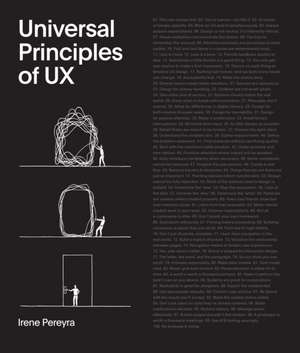
Universal Principles of UX: Rockport Universal
Autor Irene Pereyraen Limba Engleză Hardback – 9 mar 2023
ACTUALIZAREA: Față de versiunea portabilă a autoarei, The Pocket Universal Principles of UX, acest volum extinde analiza de la simple elemente vizuale la o abordare enciclopedică, oferind contextul teoretic și practic necesar pentru a înțelege complexitatea experienței utilizatorului. Reținem că Irene Pereyra trece dincolo de estetică, poziționând designul ca un act etic și strategic. Structura cărții este riguroasă: primele capitole, „Consider” și „Empathize”, ghidează cititorul de la fundamentele psihologice — precum efectul de poziție serială sau memoria vizuală — către empatia profundă necesară pentru a proiecta soluții accesibile. Putem afirma că progresia conținutului reflectă fluxul de lucru real al unui designer: de la înțelegerea limitărilor cognitive umane la implementarea de feedback rapid și gestionarea fricțiunii în interfață. Complementar lui 101 UX Principles de Will Grant, care oferă o listă rapidă de bune practici, volumul de față acoperă zona de intersecție dintre designul industrial, psihologie și responsabilitate socială, explicând de ce anumite principii funcționează. Recomandăm acest manual pentru modul în care tratează designul pentru grupuri specifice, precum copiii sau seniorii, subliniind că nu există un „UX atemporal”, ci doar adaptare continuă la contextul tehnologic și uman.







Preț: 172.95 lei
Preț vechi: 221.19 lei
-22%
Carte disponibilă
Livrare economică 27 octombrie-10 noiembrie
Livrare express 13-17 octombrie pentru 109.78 lei
Specificații
ISBN-10: 0760378045
Pagini: 224
Ilustrații: 100+ photos
Dimensiuni: 220 x 256 x 22 mm
Greutate: 1.02 kg
Editura: Quarto Publishing Group USA, Inc.
Colecția Rockport Universal
Seria Rockport Universal
V-ar putea interesa
-
 Sketching User Experiences: The WorkbookSaul Greenberg-18%Preț: 120.36 lei146.40 lei
 -
 -40%Preț: 268.36 lei450.08 lei
 -
 100 Things Every Designer Needs to Know About PeopleSusan WeinschenkPreț: 202.53 lei
 -
 Web Style Guide, 4th Edition: Foundations of User Experience DesignPatrick J. Lynch-20%Preț: 205.63 lei257.03 lei
 -
 Don't Make Me ThinkSteve Krug-20%Preț: 224.39 lei280.49 lei
 -
 -40%Preț: 471.55 lei787.42 lei
 -
 The Design of Everyday ThingsDon NormanPreț: 121.66 lei
 -
 The Pocket Universal Principles of UXIrene Pereyra-20%Preț: 79.13 lei98.81 lei
 -
 Universal Principles of Storytelling for DesignersLyle H. Sandler-22%Preț: 169.36 lei217.34 lei
 -
 Universal Methods of Ethical DesignColin Gray-17%Preț: 192.67 lei232.12 lei
 -
 Natoli, J: Think FirstJoe Natoli-20%Preț: 109.02 lei136.29 lei
 -
 User FriendlyCliff KuangPreț: 117.47 lei
 -
 User Experience Design: A Practical IntroductionGavin Allanwood-7%Preț: 179.72 lei192.43 lei
 -
 Storytelling in DesignAnna Dahlstrom-20%Preț: 258.09 lei322.61 lei
 -
 -36%Preț: 154.45 lei242.67 lei
 -
 The Pocket Universal Principles of DesignWilliam Lidwell-17%Preț: 72.84 lei88.07 lei
 -
 Rethinking Users: The Design Guide to User Ecosystem ThinkingBenjamin J. Chesluk-27%Preț: 165.85 lei227.02 lei
De ce să citești această carte
Recomandăm această carte designerilor care doresc să treacă de la execuție vizuală la strategie bazată pe principii universale. Cititorul câștigă o bază solidă de cunoștințe interdisciplinare, învățând să aplice concepte de psihologie și etică pentru a crea interfețe incluzive. Este un instrument esențial pentru oricine vrea să înțeleagă legătura directă dintre estetica unui produs și percepția uzabilității acestuia.
Cuprins
Chapter 1: Consider
- The user comes first.
- You're human-act like it.
- UI makes or breaks usability.
- Work on UX and UI simultaneously.
- Always surpass expectations.
- Design is not neutral, it's inherently ethical.
- Visual metaphors communicate the fastest.
- The bias to remember the unusual.
- Attractive products are perceived as more usable.
- First and last items in a series are remembered most.
- Less is more.
- Less is a bore.
- Provide feedback quickly or else.
- Sometimes a little friction is a good thing.
- You only get one chance to make a first impression.
- There's no such thing as timeless UX design.
- Nothing lasts forever, and we both know hearts can change.
- Accessibility first.
- Make the choice easy.
- Diverse teams create better solutions.
- Devices are ubiquitous.
- Design for clumsy handling.
- Children are not small adults.
- Take extra care of seniors.
- Systems should match the real world.
- Know when to break with convention.
- Persuade, don't coerce.
- Allow for differences in digital literacy.
- Design for both novices & power users.
- Design for learnability.
- Design for passive attention.
- Make it unobtrusive.
- Avoid forced interruptions.
- Make notifications valuable.
- Minimize form input.
- As little design as possible.
- Rebel! Rules are meant to be broken.
- Choose the right client.
- Understand the problem first.
- Gather requirements.
- Define the problem statement.
- Find shortcuts without sacrificing quality.
- Start with the minimum viable product.
- Under-promise and over-deliver.
- Only introduce complexity when necessary.
- Some complexity cannot be reduced.
- Assume worst case scenario.
- Create a user flow.
- Remove barriers & obstacles.
- Things that are not there are just as important.
- Pointing devices inform functionality.
- Design cannot be fully objective.
- Most of the science used in design is bull.
- Determine the 'how'.
- Map the ecosystem.
- Look at the data.
- Uncover the 'why'.
- Determine the 'what'.
- Personas are useless unless created properly.
- Keep your friends close but your enemies closer.
- Learn from bad examples.
- Make mental models work in your favor.
- Uncover expectations.
- Not all e-commerce is alike.
- Most usability issues can be spotted a mile ahead.
- Brainstorm efficiently.
- Priming before presenting.
- Building consensus is easier than you think.
- From low to high fidelity.
- Don't just illustrate, annotate.
- Learn from navigation in the real world.
- Build a logical structure.
- Visualize the relationship between pages.
- Navigation makes or breaks user experience.
- Yes, side doors matter.
- The letter, the word, and the paragraph.
- Maintain consistent branding.
- So you think you can scroll.
- Animate responsibly.
- Make data lovable.
- Dark mode rises.
- Never give total control.
- Personalization is either hit or miss.
- A word is worth a thousand pictures.
- Make it perform the best it can on any device.
- Pattern library, style guide, or design system-choose one.
- Don't let design systems kill creativity.
- Expect the unexpected.
- An audible system status is awkward.
- Don't ask for unnecessary things.
- Manage errors effectively.
- Be liberal with the inputs you accept.
- Confirm user actions.
- Broken pages shouldn't feel broken.
- Fill the gap our imagination can't bridge.
- Metric-based design is silly.
- Don't grade your own homework.
- Prioritize attention where impact will be greatest.
- Stay involved in the project post launch.
- Re-evaluate & revise.
About the Author
Index