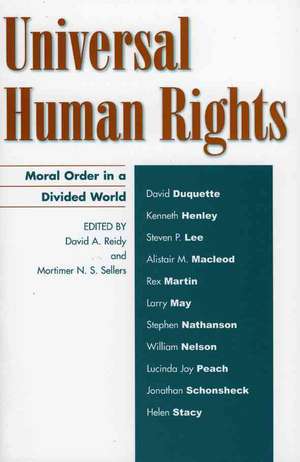
Universal Human Rights: Moral Order in a Divided World: Philosophy and the Global Context
Editat de David A. Reidy, Mortimer N. S. Sellers Contribuţii de Larry May, Kenneth Henley, Alistair Macleod, Rex Martin, David Duquette, Lucinda Peach, Helen Stacy, William Nelson, Suzy Kim, Stephen Nathanson, Jonathan Schonshecken Limba Engleză Paperback – 21 iul 2005

Preț: 318.43 lei
Preț vechi: 398.37 lei
-20%
Puncte Express: 478
Carte tipărită la comandă
Livrare economică 26 noiembrie-10 decembrie
Livrare prin curier în România Termenul estimat este afișat lângă disponibilitate.
Transport gratuit de la 400.00 lei Plată online sau ramburs, în funcție de opțiunile comenzii.
Retur gratuit în 14 zile Comandă securizată și suport în română.
Specificații
ISBN-13: 9780742548619
ISBN-10: 0742548619
Pagini: 238
Dimensiuni: 169 x 227 x 14 mm
Greutate: 0.32 kg
Editura: Bloomsbury Publishing
Colecția Rowman & Littlefield
Seria Philosophy and the Global Context
Locul publicării:New York, United States
ISBN-10: 0742548619
Pagini: 238
Dimensiuni: 169 x 227 x 14 mm
Greutate: 0.32 kg
Editura: Bloomsbury Publishing
Colecția Rowman & Littlefield
Seria Philosophy and the Global Context
Locul publicării:New York, United States
Cuprins
Chapter 1 Introduction
Part 2 Part I:The Nature of Human Rights
Chapter 3 The Structure of Arguments for Human Rights
Chapter 4 Human Rights: Constitutional and International
Chapter 5 Universalism and Relativism in Human Rights
Part 6 Part II:The Particular in Universal Human Rights
Chapter 7 Are Women Human? Feminist Reflections on "Women's Rights as Human Rights"
Chapter 8 Human Rights and the Ethic of Listening
Chapter 9 Rights Against Institutions: What Governments Should and Can Do
Part 10 Part III:Enforcing Universal Human Rights
Chapter 11 Human Rights and Humanitarian Intervention
Chapter 12 Genocide and Political Responsibility
Chapter 13 Human Rights and the Rule of Law: Sovereignty and the International Criminal Court
Part 14 Rights in Extremis
Chapter 15 Is Terrorism Ever Morally Permissible? An Inquiry into the Right to Life
Chapter 16 Thwarting Suicide Terrorists: The Locus of Moral Constraints and the (Ir)Relevance of "Human Rights"
Part 2 Part I:The Nature of Human Rights
Chapter 3 The Structure of Arguments for Human Rights
Chapter 4 Human Rights: Constitutional and International
Chapter 5 Universalism and Relativism in Human Rights
Part 6 Part II:The Particular in Universal Human Rights
Chapter 7 Are Women Human? Feminist Reflections on "Women's Rights as Human Rights"
Chapter 8 Human Rights and the Ethic of Listening
Chapter 9 Rights Against Institutions: What Governments Should and Can Do
Part 10 Part III:Enforcing Universal Human Rights
Chapter 11 Human Rights and Humanitarian Intervention
Chapter 12 Genocide and Political Responsibility
Chapter 13 Human Rights and the Rule of Law: Sovereignty and the International Criminal Court
Part 14 Rights in Extremis
Chapter 15 Is Terrorism Ever Morally Permissible? An Inquiry into the Right to Life
Chapter 16 Thwarting Suicide Terrorists: The Locus of Moral Constraints and the (Ir)Relevance of "Human Rights"
Recenzii
Although human rights discourse is becoming the recognized lingua franca of international relations, differences of justification, interpretation, application and enforcement abound. This set of original essays throws fresh light on these differences while clearly exemplifying the greater importance of the basic similarities that all parties to the debate share.
Nine philosophers and two legal scholars contribute articles to this volume, and severla contribute significantly to this discussion.
This impressive and timely volume brings together some of the most hotly-debated issues in the philosophical discourse on human rights and offers new ways of thinking about them. The essays raise all the hard questions on the theory and practice of human rights, providing wide-ranging and sharply contested arguments. The book is a must for anyone interested in the normative and institutional issues of human rights and their global dimensions.
Nine philosophers and two legal scholars contribute articles to this volume, and severla contribute significantly to this discussion.
This impressive and timely volume brings together some of the most hotly-debated issues in the philosophical discourse on human rights and offers new ways of thinking about them. The essays raise all the hard questions on the theory and practice of human rights, providing wide-ranging and sharply contested arguments. The book is a must for anyone interested in the normative and institutional issues of human rights and their global dimensions.