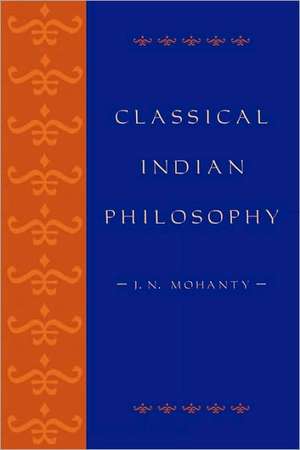
Classical Indian Philosophy: An Introductory Text: Philosophy and the Global Context
Autor J. N. Mohantyen Limba Engleză Paperback – 2000




Preț: 276.66 lei
Preț vechi: 361.13 lei
-23%
Puncte Express: 415
Carte tipărită la comandă
Livrare economică 30 noiembrie-14 decembrie
Livrare prin curier în România Termenul estimat este afișat lângă disponibilitate.
Transport gratuit de la 400.00 lei Plată online sau ramburs, în funcție de opțiunile comenzii.
Retur gratuit în 14 zile Comandă securizată și suport în română.
Specificații
ISBN-13: 9780847689330
ISBN-10: 0847689336
Pagini: 192
Dimensiuni: 149 x 227 x 11 mm
Greutate: 0.29 kg
Ediția:0191
Editura: Bloomsbury Publishing
Colecția Rowman & Littlefield
Seria Philosophy and the Global Context
Locul publicării:New York, United States
ISBN-10: 0847689336
Pagini: 192
Dimensiuni: 149 x 227 x 11 mm
Greutate: 0.29 kg
Ediția:0191
Editura: Bloomsbury Publishing
Colecția Rowman & Littlefield
Seria Philosophy and the Global Context
Locul publicării:New York, United States
V-ar putea interesa
-
 The Art of WarSun Tzu-19%Preț: 75.89 lei93.40 lei
 -
 Indian Philosophy: A Very Short IntroductionSue Hamilton-19%Preț: 57.35 lei71.23 lei
 -
 -20%Preț: 398.37 lei496.21 lei
 -
 Introducing BuddhismCharles S. PrebishPreț: 408.60 lei
 -
 Chinese PhilosophyHaiming WenPreț: 208.40 lei
 -
 Preț: 85.29 lei
 -
 Pilgrims to OpennessShambhavi SarasvatiPreț: 100.83 lei
 -
 Essence of the UpanishadsEknath EaswaranPreț: 101.63 lei
 -
 Secret Teachings of PadmasambhavaPadmasambhava-33%Preț: 93.92 lei139.23 lei
 -
 The Diamond in Your PocketGangajiPreț: 117.03 lei
 -
 A Search In Secret IndiaPaul Brunton-43%Preț: 77.90 lei136.27 lei
 -
 Degrees of Excellence: A Fatimid Treatise on Leadership in IslamArzina R. Lalani-22%Preț: 350.58 lei452.28 lei
 -
 Freedom from the KnownJ. Krishnamurti-32%Preț: 61.90 lei91.58 lei
 -
 Creativity and Taoism: A Study of Chinese Philosophy, Art and PoetryChung-yuan Chang-20%Preț: 131.05 lei163.53 lei
Cuprins
Chapter 1 Preface
Chapter 2 1. Indian Philosophy: A Historical Overview
Part 3 I Theory of Knowledge (Pramana Sastra)
Chapter 4 2. Theory of Knowledge (Pramana-Theory)
Part 5 II. Metaphysics (Prameya Sastra)
Chapter 6 3. The Categories (Pdarthas)
Chapter 7 4. The Self(Atman)
Chapter 8 5. Central Metaphysical Issues
Part 9 IIIPhilosophy of Politics, Law and Morals (Dharma sastras)
Chapter 10 6.State, Society and Law
Chapter 11 7.Moral Philosophy
Part 12 IV Religion and Art
Chapter 13 8.Philosophy of Religion
Chapter 14 9. Aesthetics orRasasastra
Part 15 VBeyond the Pramana-Prameya Distinction
Chapter 16 10. Beyond the Pramana-Prameya Distinction
Chapter 17 Appendices
Chapter 18 Bibliography
Chapter 19 Index
Chapter 20 About the Author
Chapter 2 1. Indian Philosophy: A Historical Overview
Part 3 I Theory of Knowledge (Pramana Sastra)
Chapter 4 2. Theory of Knowledge (Pramana-Theory)
Part 5 II. Metaphysics (Prameya Sastra)
Chapter 6 3. The Categories (Pdarthas)
Chapter 7 4. The Self(Atman)
Chapter 8 5. Central Metaphysical Issues
Part 9 IIIPhilosophy of Politics, Law and Morals (Dharma sastras)
Chapter 10 6.State, Society and Law
Chapter 11 7.Moral Philosophy
Part 12 IV Religion and Art
Chapter 13 8.Philosophy of Religion
Chapter 14 9. Aesthetics orRasasastra
Part 15 VBeyond the Pramana-Prameya Distinction
Chapter 16 10. Beyond the Pramana-Prameya Distinction
Chapter 17 Appendices
Chapter 18 Bibliography
Chapter 19 Index
Chapter 20 About the Author
Recenzii
Mohanty uses his extensive and deep subject knowledge to produce another valuable work. The design of the present book is thoughtful, presenting several charts on specific topics. This extraordinally concise and well-written work is highly recommended for both graduate and upper-division undergraduate students.
On every page, Mohanty's masterly and sophisticated grasp of both Indian thought and Western philosophy shines forth. This book will provide a comprehensive and insightful introduction for both beginners and specialists of Indian thought. It conveys the vibrant and sophisticated contestation within and among the diverse schools without sounding excessively technical. Mohanty's rigorous exposition of Indian epistemology and metaphysics coupled with his restrained comparisons with Western concepts will make this book immensely rewarding for those interested in East-West dialogue in general.
At last an overview of classical Indian philosophy that surveys the ethical and legal philosophy, the aesthetics, the philosophy of religion, and not simply the epistemology and metaphysics! And by such an accomplished professional! Mohanty takes us on an intellectual tour that covers immense territory and at the same time attends to details of arguments. We are shown the inner workings of the systems of inquiry, not a lot of names and dates. This is the book for those who want to know about classical Indian thought.
On every page, Mohanty's masterly and sophisticated grasp of both Indian thought and Western philosophy shines forth. This book will provide a comprehensive and insightful introduction for both beginners and specialists of Indian thought. It conveys the vibrant and sophisticated contestation within and among the diverse schools without sounding excessively technical. Mohanty's rigorous exposition of Indian epistemology and metaphysics coupled with his restrained comparisons with Western concepts will make this book immensely rewarding for those interested in East-West dialogue in general.
At last an overview of classical Indian philosophy that surveys the ethical and legal philosophy, the aesthetics, the philosophy of religion, and not simply the epistemology and metaphysics! And by such an accomplished professional! Mohanty takes us on an intellectual tour that covers immense territory and at the same time attends to details of arguments. We are shown the inner workings of the systems of inquiry, not a lot of names and dates. This is the book for those who want to know about classical Indian thought.