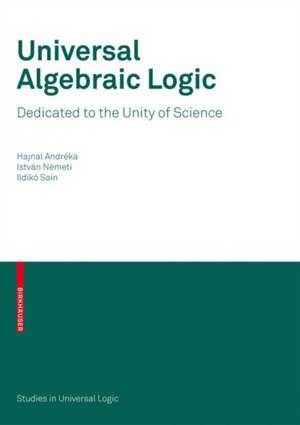
Universal Algebraic Logic: Dedicated to the Unity of Science: Studies in Universal Logic
Autor Hajnal Andréka, István Németi, Ildikó Sainen Limba Engleză Paperback – 22 iul 2021
Din seria Studies in Universal Logic
-
 Preț: 372.15 lei
 -
 Preț: 398.56 lei
 -
 Preț: 409.28 lei
 -
 Preț: 386.17 lei
 -
 Preț: 373.12 lei
 - 15%
 Preț: 535.00 lei
 - 24%
 Preț: 906.49 lei
 - 15%
 Preț: 590.04 lei
 - 15%
 Preț: 613.01 lei
 -
 Preț: 485.05 lei
 -
 Preț: 317.47 lei
 - 15%
 Preț: 721.81 lei
 - 18%
 Preț: 916.64 lei
 - 18%
 Preț: 1133.32 lei
 - 15%
 Preț: 646.18 lei
 - 24%
 Preț: 825.57 lei
 - 24%
 Preț: 895.15 lei
 - 18%
 Preț: 943.63 lei
 - 18%
 Preț: 924.59 lei
 - 24%
 Preț: 1457.92 lei
Preț: 362.75 lei
Precomandă
Puncte Express: 544
Carte nepublicată încă
Livrare prin curier în România Precomanda se expediază când titlul devine disponibil.
Transport gratuit de la 400.00 lei Plată online sau ramburs, în funcție de opțiunile comenzii.
Retur gratuit în 14 zile Comandă securizată și suport în română.
Doresc să fiu notificat când acest titlu va fi disponibil:
Se trimite...
Specificații
ISBN-13: 9783764385057
ISBN-10: 3764385057
Pagini: 260
Ediția:1st ed. 2021
Editura: Springer
Colecția Birkhäuser
Seria Studies in Universal Logic
Locul publicării:Basel, Switzerland
ISBN-10: 3764385057
Pagini: 260
Ediția:1st ed. 2021
Editura: Springer
Colecția Birkhäuser
Seria Studies in Universal Logic
Locul publicării:Basel, Switzerland
V-ar putea interesa
-
 Preț: 414.16 lei
 -
 Mathematical Thought from Ancient to Modern TimesMorris Kline-30%Preț: 952.41 lei1367.63 lei
 -
 -15%Preț: 213.79 lei252.46 lei
 -
 Handbook of Boolean AlgebrasBozzano G Luisa-27%Preț: 1243.68 lei1703.67 lei
 -
 Mechanical IntelligenceD.C. Ince-33%Preț: 367.73 lei548.66 lei
 -
 MorphogenesisP.T. Saunders-33%Preț: 364.26 lei546.86 lei
 -
 Tits Buildings and the Model Theory of GroupsKatrin Tent-11%Preț: 434.93 lei488.69 lei
 -
 Categories for TypesRoy L. Crole-19%Preț: 642.30 lei792.96 lei
 -
 -18%Preț: 1367.63 lei1667.84 lei
 -
 Preț: 364.59 lei
 -
 Mathematical Methods in EngineeringJoseph Powers-11%Preț: 560.14 lei629.37 lei
 -
 Memo Pour Prepas ScientifiquesMR Aurelien Roudier-19%Preț: 434.00 lei535.80 lei
 -
 7th Grade Staar Math Workbook 2018Reza NazariPreț: 102.02 lei
 -
 5th Grade Staar Math Workbook 2018Reza NazariPreț: 97.49 lei
 -
 4th Grade Staar Math Workbook 2018Reza NazariPreț: 97.49 lei
 -
 Universal Algebraic LogicHajnal Andréka-18%Preț: 817.96 lei997.51 lei
 -
 The Life and Work of Leon HenkinMaría ManzanoPreț: 398.56 lei
 -
 Simple Relation AlgebrasSteven Givant-24%Preț: 808.86 lei1064.28 lei
 -
 DNA ComputingMasami HagiyaPreț: 423.38 lei
 -
 8th International Conference on Automated DeductionJörg H. SiekmannPreț: 401.53 lei
 -
 DNA ComputingJunghuei ChenPreț: 372.66 lei
 -
 Cylindric-like Algebras and Algebraic LogicHajnal Andréka-15%Preț: 622.62 lei732.50 lei
 -
 Der Fuzzy Controller. Grundlagen Der FunktionsweiseStefan LandfriedPreț: 92.60 lei
 -
 Applications of NP Formalism and Ghp Formalism in General RelativityPanchal, RavikumarPreț: 311.82 lei
 -
 The Theory of AlgorithmsA. A. Markov-18%Preț: 985.19 lei1201.45 lei
Public țintă
ResearchCuprins
1.
Introduction.-
2.
Notation,
elementary
concepts:
2.1
Sets,
classes,
tuples,
simple
operations
on
sets.-
2.2
Binary
relations,
equivalence
relations,
functions.-
2.3 Orderings, ordinals, cardinals.- 2.4 Sequences.- 2.5 Direct product of families of sets.- 2.6 Relations of higher ranks.- 2.7 First-order logic (FOL).-
3. Basics from universal algebra: 3.1 Examples for algebras.- 3.2 Building new algebras from old ones (operations on algebras): 3.2.1 Subalgebra.-
3.2.2 Homomorphic image.- 3.2.3 Cartesian product, direct decomposition.- 3.2.4 Subdirect decomposition.- 3.2.5 Ultraproduct, reduced product.-
3.3 Variety characterization, quasi-variety characterization.- 3.4 Discriminator varieties.- 3.5 Boolean algebras.- 3.6 Boolean algebras with operators.- 4. General framework for studying logics: 4.1 Defining the framework.- 4.2 Concrete logics in the new framework.- 4.2.1 Distinguished logics.- 4.2.2 The finite variable fragment of FOL. Finite model theory.- 4.2.3 Summary.- 4.2.4 Solutions for some exercises of subsections 4.2.1 and 4.2.2.- 5. Bridge between the world of logics and the world of algebras: 5.1 Fine-tuning the framework.- 5.2 Algebraic characterizations of completeness and compactness properties.- 6. Generalizations.- 7. Further equivalence results (definability, interpolation, omitting types) 8. New kinds of logics 9. The guarded fragment and its finite variable hierarchy.- 10. Distinguished algebras of logic: 10.1 Cylindric algebras.- 10.2 Relation algebras, substitution cylindric algebras, polyadic algebras.- 10.3 Relativization. The non-square approach to ``taming logics''.- 10.4 Brief return to guarded fragment and related positive results.- 11. Applications of the algebraic results to logic (via our bridge).- 12. Connections with set theory and foundational thinking.- 13. Connections with abstract model theory.- 14. Extending the bridge to including logic of spacetime, connections with relativity.- 15. On the problems in the books Henkin-Monk-Tarski: Cylindric Algebras Parts I,II and Henkin-Monk-Tarski-Andreka-Nemeti.- Some further problems.
2.3 Orderings, ordinals, cardinals.- 2.4 Sequences.- 2.5 Direct product of families of sets.- 2.6 Relations of higher ranks.- 2.7 First-order logic (FOL).-
3. Basics from universal algebra: 3.1 Examples for algebras.- 3.2 Building new algebras from old ones (operations on algebras): 3.2.1 Subalgebra.-
3.2.2 Homomorphic image.- 3.2.3 Cartesian product, direct decomposition.- 3.2.4 Subdirect decomposition.- 3.2.5 Ultraproduct, reduced product.-
3.3 Variety characterization, quasi-variety characterization.- 3.4 Discriminator varieties.- 3.5 Boolean algebras.- 3.6 Boolean algebras with operators.- 4. General framework for studying logics: 4.1 Defining the framework.- 4.2 Concrete logics in the new framework.- 4.2.1 Distinguished logics.- 4.2.2 The finite variable fragment of FOL. Finite model theory.- 4.2.3 Summary.- 4.2.4 Solutions for some exercises of subsections 4.2.1 and 4.2.2.- 5. Bridge between the world of logics and the world of algebras: 5.1 Fine-tuning the framework.- 5.2 Algebraic characterizations of completeness and compactness properties.- 6. Generalizations.- 7. Further equivalence results (definability, interpolation, omitting types) 8. New kinds of logics 9. The guarded fragment and its finite variable hierarchy.- 10. Distinguished algebras of logic: 10.1 Cylindric algebras.- 10.2 Relation algebras, substitution cylindric algebras, polyadic algebras.- 10.3 Relativization. The non-square approach to ``taming logics''.- 10.4 Brief return to guarded fragment and related positive results.- 11. Applications of the algebraic results to logic (via our bridge).- 12. Connections with set theory and foundational thinking.- 13. Connections with abstract model theory.- 14. Extending the bridge to including logic of spacetime, connections with relativity.- 15. On the problems in the books Henkin-Monk-Tarski: Cylindric Algebras Parts I,II and Henkin-Monk-Tarski-Andreka-Nemeti.- Some further problems.
Caracteristici
Introduction
to
algebraic
basicsConnects
logic
with
algebra