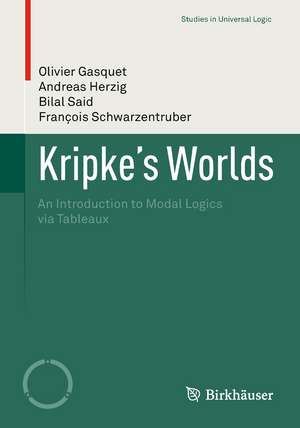
Kripke's Worlds
Autor Olivier Gasquet, Andreas Herzig, Bilal Said, François Schwarzentruberen Limba Engleză Paperback – 9 dec 2013
Acest manual reprezintă o introducere aplicată în semantica lumilor posibile, fundamentată pe conceptele introduse de Saul Kripke în anii '60. Remarcăm abordarea autorilor care, spre deosebire de sistemele tradiționale bazate pe arbori de decizie, propun o metodă generală de construcție a grafurilor. Această tehnică oferă avantajul unei proximități structurale mai mari față de modelele Kripke reale, facilitând înțelegerea modului în care nodurile și muchiile etichetate definesc adevărul în diverse sisteme logice. Structura volumului ghidează cititorul de la modelarea obiectelor cu ajutorul grafurilor către logici cu constrângeri complexe, precum cele cu relații de accesibilitate tranzitive. Reținem integrarea strânsă cu instrumentul software LoTREC, care permite utilizatorului să verifice interactiv satisfiabilitatea unei formule și să implementeze noi sisteme de calcul logic prin limbajul său grafic. Progresia narativă a textului culminează cu secțiuni dedicate verificării modelelor (model checking) și logicilor modale cu închidere tranzitivă, domenii esențiale în semantica programelor și în web-ul semantic. Cititorii familiarizați cu Handbook of Tableau Methods vor aprecia modul în care Kripke's Worlds restrânge focusul teoretic în favoarea unei metodologii de construcție pas cu pas, oferind un suport pedagogic digital absent în compendiile clasice. În timp ce Proof Methods for Modal and Intuitionistic Logics trece în revistă multiple sisteme de demonstrație (Gentzen, Hilbert), volumul de față se concentrează pe eficiența sistemelor de tabele, optimizând procesul de învățare pentru cei interesați de aplicațiile practice în inteligența artificială.
Preț: 584.13 lei
Preț vechi: 687.20 lei
-15%
Carte tipărită la comandă
Livrare economică 23 noiembrie-07 decembrie
Specificații
ISBN-10: 3764385030
Pagini: 216
Ilustrații: XV, 198 p. 73 illus.
Dimensiuni: 168 x 240 x 12 mm
Greutate: 0.35 kg
Ediția:2014
Editura: birkhäuser
Locul publicării:Basel, Switzerland
V-ar putea interesa
-
 Computability and RandomnessAndré Nies-21%Preț: 418.44 lei529.70 lei
 -
 A Course in Model TheoryBruno Poizat-15%Preț: 612.43 lei720.50 lei
 -
 Lectures in Logic and Set TheoryGeorge TourlakisPreț: 438.01 lei
 -
 Lambda Calculus with TypesHenk Barendregt-11%Preț: 698.84 lei785.21 lei
 -
 Logic and Discrete Mathematics - A ConciseIntroductionWillem ConradiePreț: 545.64 lei
 -
 Preț: 183.57 lei
 -
 Mathematical Logic for Computer ScienceMordechai Ben-Ari-20%Preț: 395.53 lei494.41 lei
 -
 The Joy of SetsKeith Devlin-15%Preț: 443.91 lei522.24 lei
 -
 Preț: 497.59 lei
 -
 Introducing InfinityBrian CleggPreț: 63.40 lei
 -
 Sets, Logic and CategoriesPeter J. CameronPreț: 280.57 lei
 -
 Lattice Theory: Special Topics and ApplicationsGeorge Grätzer-15%Preț: 656.38 lei772.20 lei
 -
 -15%Preț: 735.59 lei865.39 lei
 -
 Preț: 419.31 lei
Public țintă
ResearchDe ce să citești această carte
Recomandăm această carte cercetătorilor și studenților avansați care doresc să stăpânească logica modală prin practică, nu doar prin teorie abstractă. Beneficiul major este accesul la software-ul LoTREC, care transformă demonstrațiile logice într-un proces vizual și interactiv. Este un instrument indispensabil pentru cei care lucrează în inteligență artificială sau verificarea sistemelor informatice, oferind o punte clară între semantica grafurilor și logica formală.
Cuprins
Recenzii
“This is an excellent book to use –– either as a stand-alone text or with another textbook –– for an introductory undergraduate course in logic addressed to majors in the humanities, social sciences, computer science, or mathematics. … A basic unifying theme of the book is to construct models of possible worlds and to check formula satisfiability using graph-theoretic tableaux systems.” (Russell Jay Hendel, MAA Reviews, February, 2014)
“This book provides an accessible introduction to modal logics indeed. … The book is well written and quite informative … . It can be used as an easy-going introduction for all who are interested in automated reasoning and need some formal tools for playing with modal logics.” (Andrzej Indrzejczak, zbMATH, Vol. 1280, 2014)
Textul de pe ultima copertă
This book follows a more general approach by trying to build a graph, the advantage being that a graph is closer to a Kripke model than a tree. It provides a step-by-step introduction to possible worlds semantics (and by that to modal and other nonclassical logics) via the tableaux method. It is accompanied by a piece of software called LoTREC (www.irit.fr/Lotrec). LoTREC allows to check whether a given formula is true at a given world of a given model and to check whether a given formula is satisfiable in a given logic. The latter can be done immediately if the tableau system for that logic has already been implemented in LoTREC. If this is not yet the case LoTREC offers the possibility to implement a tableau system in a relatively easy way via a simple, graph-based, interactive language.
>dy>