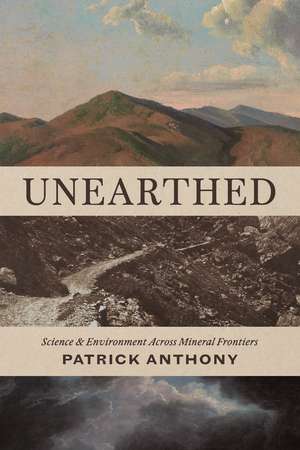
Unearthed: Science and Environment Across Mineral Frontiers
Autor Patrick Anthonyen Limba Engleză Paperback – 2 apr 2026
Unearthed depicts a pivotal moment during the nineteenth century: As European and settler schemes to govern ever larger territories intensified, the earth and atmospheric sciences were also becoming more global in scope, assembling models of the planet while making use of militarized or highly industrialized systems. These efforts were informed by the physique du monde, or global physics, of Alexander von Humboldt (1769–1859), a program of vast data collection that spanned four hemispheres that aimed to determine general, scientific laws about the planet and its environments.
Using Humboldt’s itineraries as a frame, Unearthed traces an information order that linked far-flung industrial sites and frontier stations, from Prussian provinces to the Spanish and Russian empires. Humboldt intersected with Saxon miners, Mexican cartographers, and Siberian surveyors, among other itinerant Germans who mobilized the labor and resources of widespread mining operations for global surveys of earth and air. Interweaving the histories of capital and climate, Patrick Anthony takes readers from mines to mountains to show how the sciences of Humboldt’s circuits both measured and made modern natures. These sciences of the mineral frontier, he argues, ultimately laid the groundwork for carbon-intensive economics and a logic of unending extraction. Wide-ranging and ambitious, Unearthed will interest scholars working in the history of science, global history, and the environmental humanities.
| Toate formatele și edițiile | Preț | Express |
|---|---|---|
| Paperback (1) | 233.59 lei Precomandă | |
| University of Chicago Press – 2 apr 2026 | 233.59 lei Precomandă | |
| Hardback (1) | 627.98 lei Precomandă | |
| University of Chicago Press – 2 apr 2026 | 627.98 lei Precomandă |
Preț: 233.59 lei
Precomandă
Puncte Express: 350
Preț estimativ în valută:
41.34€ • 48.47$ • 36.30£
41.34€ • 48.47$ • 36.30£
Carte nepublicată încă
Doresc să fiu notificat când acest titlu va fi disponibil:
Se trimite...
Preluare comenzi: 021 569.72.76
Specificații
ISBN-13: 9780226847511
ISBN-10: 0226847519
Pagini: 304
Ilustrații: 9 color plates, 56 halftones
Dimensiuni: 152 x 229 mm
Greutate: 0.45 kg
Ediția:First Edition
Editura: University of Chicago Press
Colecția University of Chicago Press
ISBN-10: 0226847519
Pagini: 304
Ilustrații: 9 color plates, 56 halftones
Dimensiuni: 152 x 229 mm
Greutate: 0.45 kg
Ediția:First Edition
Editura: University of Chicago Press
Colecția University of Chicago Press
Notă biografică
Patrick Anthony is a Marie Skłodowska-Curie Postdoctoral Fellow in the Department of History of Science and Ideas at Uppsala University.
Cuprins
List of Illustrations
Maps
Introduction: Underlands, Empires, and Atmospheres
1. Tableau Makers and Earth Science on a Prussian Frontier
2. Subterranean Skies: Physique du monde and Its Workers
3. Colonial Mexico and the Cordilleran Survey Sciences
4. The Geo-Atmospherics of Empire: Siberia and the Steppe
5. Berlin Between Empires: Trafficking in the Global
Conclusion: Toward a History of Extractive Sciences
Acknowledgments
List of Abbreviations
Notes
Bibliography
Index
Maps
Introduction: Underlands, Empires, and Atmospheres
1. Tableau Makers and Earth Science on a Prussian Frontier
2. Subterranean Skies: Physique du monde and Its Workers
3. Colonial Mexico and the Cordilleran Survey Sciences
4. The Geo-Atmospherics of Empire: Siberia and the Steppe
5. Berlin Between Empires: Trafficking in the Global
Conclusion: Toward a History of Extractive Sciences
Acknowledgments
List of Abbreviations
Notes
Bibliography
Index
Recenzii
“In this powerfully argued and wide-ranging work, Anthony ambitiously sets out to reorganize historical understanding of the worlds of extractive economies and climate crises. The commanding figure of Alexander von Humboldt—naturalist, traveler, and publicist—has often been used as symbol of an enlightened and liberal vision of planetary environments and their interactions. Unearthed helps reorient that account with startling analyses of relations between the labor, hardware, and knowledge of miners and cultivators, often forced and exploited, in central Europe, Mexico, and the Russian empire in the early decades of the nineteenth century. The book uses period manuscripts, imagery, and surveys to explore how an intensively carbonized economy accompanied the projects of global political and scientific systems alike.”
“This eagerly anticipated book shows how the first global Earth science emerged in the nineteenth century as a cheat sheet for rapacious imperialism. Alexander von Humboldt may have been the founder of modern ecology and a friend to anticolonial revolutionaries, but he was also, as Anthony’s painstaking research shows, a key intermediary between Russian conquests in Central Asia and US incursions into Mexico. Colonial projects from the Andes to the Urals applied the geological and meteorological language that Humboldt appropriated from central European miners. Ironically, scientists like Humboldt justified the conquest of new mineral frontiers in the name of stabilizing climate. We are still living in the world they built. This is a must-read for all environmental historians and historians of science.”