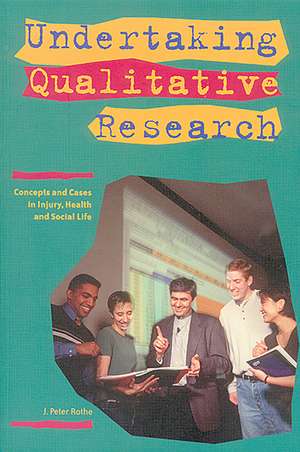
Undertaking Qualitative Research: Concepts and Cases in Injury, Health and Social Life
Autor J. Peter Rotheen Limba Engleză Paperback – aug 2000
Preț: 177.23 lei
Preț vechi: 227.77 lei
-22%
Puncte Express: 266
Carte disponibilă
Livrare economică 16-30 noiembrie
Livrare prin curier în România Termenul estimat este afișat lângă disponibilitate.
Transport gratuit de la 400.00 lei Plată online sau ramburs, în funcție de opțiunile comenzii.
Retur gratuit în 14 zile Comandă securizată și suport în română.
Specificații
ISBN-13: 9780888643674
ISBN-10: 0888643675
Pagini: 224
Dimensiuni: 152 x 229 x 13 mm
Greutate: 0.37 kg
Editura: University of Alberta Press
Colecția University of Alberta Press
Locul publicării:Edmonton, Canada
ISBN-10: 0888643675
Pagini: 224
Dimensiuni: 152 x 229 x 13 mm
Greutate: 0.37 kg
Editura: University of Alberta Press
Colecția University of Alberta Press
Locul publicării:Edmonton, Canada
V-ar putea interesa
-
 Radioactive Geochronometry: A derivative of the Treatise on GeochemistryHeinrich D. Holland-28%Preț: 531.96 lei739.90 lei
 -
 Isotope Geochemistry: A derivative of the Treatise on GeochemistryHeinrich D. Holland-27%Preț: 542.58 lei746.74 lei
 -
 Techniques in Confocal MicroscopyP. Michael Conn-8%Preț: 413.90 lei449.88 lei
 -
 The Rietveld MethodR. a. Young-30%Preț: 542.86 lei774.42 lei
 -
 -30%Preț: 720.31 lei1026.86 lei
 -
 -19%Preț: 602.16 lei743.41 lei
 -
 Building Scientific ApparatusJohn H. Moore-14%Preț: 908.51 lei1056.41 lei
 -
 Illustrated Guide to Home Chemistry ExperimentsRobert Bruce ThompsonPreț: 179.50 lei
 -
 Preț: 267.89 lei
 -
 Electron Microscopy and AnalysisPeter J. Goodhew-15%Preț: 679.95 lei799.94 lei
 -
 Elegant SolutionsPhilip BallPreț: 186.80 lei
 -
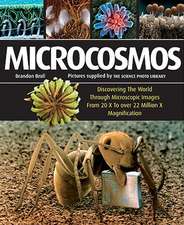 MicrocosmosBrandon BrollPreț: 147.33 lei
 -
 -21%Preț: 128.68 lei163.04 lei
Recenzii
".good, practical guide to a complex subject." Dave Bennett, CBRA
".[Rothe] introduces methods of inquiry and draws on his considerable research experience to guide potential researchers. His expositions of the sometimes confusing world of qualitative inquiry are entertaining, thorough and accurate." -Jeffrey E. Nash, Department of Sociology and Anthropology, Southwest Missouri State University
".[Rothe] introduces methods of inquiry and draws on his considerable research experience to guide potential researchers. His expositions of the sometimes confusing world of qualitative inquiry are entertaining, thorough and accurate." -Jeffrey E. Nash, Department of Sociology and Anthropology, Southwest Missouri State University