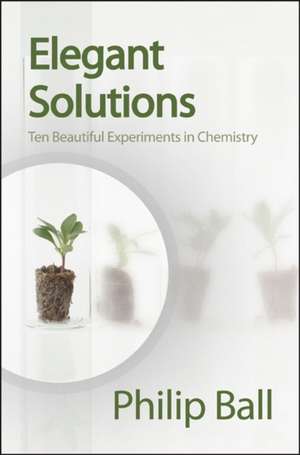
Elegant Solutions
Autor Philip Ballen Limba Engleză Hardback – 28 aug 2005
În Elegant Solutions, Philip Ball propune o metodologie de analiză a chimiei care transcede datele pur empirice, concentrându-se pe estetica și „arta” execuției experimentale. Structura materialului este riguros organizată în trei secțiuni ce urmăresc evoluția gândirii chimice: de la interogațiile fundamentale asupra naturii, la formularea unor întrebări noi prin design molecular, până la măiestria construcției de substanțe inedite. Reținem că volumul nu este un simplu catalog istoric, ci o explorare a modului în care claritatea concepției și ingeniozitatea instrumentală definesc succesul în laborator. Descoperim aici o progresie narativă susținută de zece studii de caz, intercalate cu episoade de tip „Divertissement”. Aceste pauze reflexive, precum „Chemistry as Theatre” sau „Chemical Aesthetics”, permit cititorului să înțeleagă chimia ca pe un fenomen cultural și artistic. Putem afirma că Philip Ball își continuă aici misiunea de a umaniza știința, temă centrală și în alte lucrări ale sale precum The Elements sau Alchemy. Dacă în The Elements autorul se concentra pe istoria culturală a substanțelor, în Elegant Solutions el mută reflectorul pe procesul creativ din spatele sintezei. Această lucrare reprezintă o alternativă valoroasă la The Aesthetics of Scientific Experiments pentru cursurile de istoria și filosofia științei, cu avantajul unei abordări narative mai accesibile și o focalizare specifică pe chimia experimentală, nu doar pe teorii abstracte. Față de Chemistry de Vincenzo Balzani, care este o introducere generală, volumul de față se adresează celor care doresc să înțeleagă raționamentul chimic profund și modul în care arhitectura moleculară, precum moleculele lui Platon, reflectă o estetică a preciziei.
Preț: 186.80 lei
Carte disponibilă
Livrare economică 13-27 noiembrie
Livrare express 30 octombrie-05 noiembrie pentru 31.67 lei
Specificații
ISBN-10: 0854046747
Pagini: 212
Ilustrații: Illustrations, ports.
Dimensiuni: 157 x 236 x 17 mm
Greutate: 0.45 kg
Editura: RSC Publishing
Locul publicării:United Kingdom
V-ar putea interesa
-
 Johnson, G: Ten Most Beautiful ExperimentsGeorge JohnsonPreț: 91.34 lei
 -
 Beauty: A Very Short IntroductionRoger Scruton-19%Preț: 58.06 lei71.46 lei
 -
 Preț: 232.27 lei
 -
 -14%Preț: 135.69 lei158.70 lei
 -
 The Science Museum Chemistry 100 Ideas in 100 WordsAdrian DinglePreț: 95.68 lei
 -
 The Beauty of ChemistryPhilip Ball-14%Preț: 296.04 lei342.90 lei
 -
 Instruments and Experimentation in the History of ChemistryFrederic HolmesPreț: 108.56 lei
 -
 Preț: 270.10 lei
 -
 -19%Preț: 106.59 lei131.59 lei
 -
 Experiment! - Planning, Implementing and InterpretingOivind AnderssonPreț: 379.08 lei
 -
 From Alchemy to Chemistry in Picture and StoryArthur Greenberg-8%Preț: 728.13 lei791.44 lei
 -
 Art + Science NowStephen Wilson-21%Preț: 155.99 lei196.91 lei
 -
 Notes on the Synthesis of FormChristopher AlexanderPreț: 235.55 lei
 -
 The Chemistry Between Art and ScienceJen WhitePreț: 111.62 lei
 -
 The Biggest Ideas in the Universe 2Sean CarrollPreț: 79.75 lei
 -
 The Aesthetics of Scientific ExperimentsMilena IvanovaPreț: 381.17 lei
 -
 50 Chemistry Ideas You Really Need to KnowHayley Birch-27%Preț: 52.23 lei71.42 lei
 -
 Lessons in Chemistry. Special EditionBonnie Garmus-17%Preț: 121.96 lei146.82 lei
 -
 ChemistryVincenzo BalzaniPreț: 142.11 lei
 -
 Alchemy IllustratedMichael KerriganPreț: 238.13 lei
De ce să citești această carte
Recomandăm această carte studenților și pasionaților de științe care vor să descopere latura creativă a chimiei. Cititorul câștigă o perspectivă nouă asupra laboratorului, înțelegând că un experiment reușit este la fel de mult o operă de artă pe cât este un act științific. Este o resursă esențială pentru a înțelege cum gândesc chimiștii și cum designul experimental influențează lumea modernă.
Despre autor
Philip Ball este un renumit scriitor și comunicator de știință, fost editor la prestigioasa revistă Nature timp de peste două decenii. Expertiza sa vastă acoperă domenii diverse, de la istoria culorilor în artă, în lucrarea finalistă la National Book Critics Circle Award, Bright Earth, până la fizica sistemelor complexe în Critical Mass, volum premiat cu Aventis Prize. În Elegant Solutions, Ball își folosește talentul narativ pentru a demonta miturile despre știința „rece”, plasând chimia la intersecția dintre rigoarea academică și estetica vizuală, o abordare constantă în întreaga sa bibliografie.