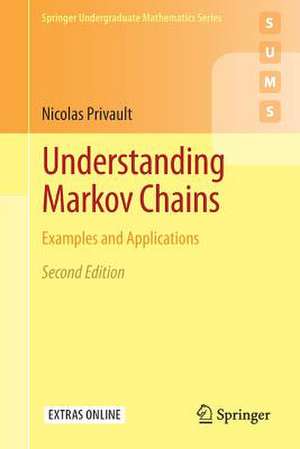
Understanding Markov Chains: Springer Undergraduate Mathematics Series
Autor Nicolas Privaulten Limba Engleză Paperback – 15 aug 2018
Din seria Springer Undergraduate Mathematics Series
-
 Preț: 392.26 lei
 -
 Preț: 430.04 lei
 - 17%
 Preț: 399.24 lei
 -
 Preț: 388.24 lei
 -
 Preț: 257.34 lei
 -
 Preț: 184.63 lei
 - 17%
 Preț: 464.86 lei
 - 20%
 Preț: 363.33 lei
 -
 Preț: 345.13 lei
 -
 Preț: 415.51 lei
 -
 Preț: 389.49 lei
 -
 Preț: 322.75 lei
 -
 Preț: 312.83 lei
 -
 Preț: 264.32 lei
 - 15%
 Preț: 506.44 lei
 -
 Preț: 261.80 lei
 -
 Preț: 258.96 lei
 -
 Preț: 256.63 lei
 -
 Preț: 255.26 lei
 -
 Preț: 319.05 lei
 -
 Preț: 184.89 lei
 -
 Preț: 263.40 lei
 -
 Preț: 264.69 lei
 -
 Preț: 263.17 lei
 -
 Preț: 254.58 lei
 -
 Preț: 259.74 lei
 -
 Preț: 260.53 lei
 -
 Preț: 262.57 lei
 -
 Preț: 180.25 lei
 -
 Preț: 258.62 lei
 - 15%
 Preț: 227.61 lei
 -
 Preț: 257.68 lei
 -
 Preț: 265.15 lei
 -
 Preț: 269.96 lei
 -
 Preț: 259.16 lei
 -
 Preț: 264.93 lei
 -
 Preț: 311.68 lei
 -
 Preț: 267.48 lei
 -
 Preț: 263.55 lei
 -
 Preț: 262.07 lei
 -
 Preț: 257.20 lei
 -
 Preț: 262.14 lei
 -
 Preț: 258.55 lei
 -
 Preț: 249.76 lei
 -
 Preț: 254.70 lei
 -
 Preț: 260.39 lei
 -
 Preț: 258.90 lei
 -
 Preț: 264.25 lei
 -
 Preț: 263.40 lei
 -
 Preț: 262.55 lei
Preț: 317.99 lei
Puncte Express: 477
Carte tipărită la comandă
Livrare economică 02-16 iulie
Livrare express 27 mai-02 iunie pentru 65.45 lei
Specificații
ISBN-13: 9789811306587
ISBN-10: 9811306583
Pagini: 392
Ilustrații: XVII, 372 p. 44 illus.
Dimensiuni: 155 x 235 x 22 mm
Greutate: 0.59 kg
Ediția:Second Edition 2018
Editura: Springer
Colecția Springer Undergraduate Mathematics Series
Seria Springer Undergraduate Mathematics Series
Locul publicării:Singapore, Singapore
ISBN-10: 9811306583
Pagini: 392
Ilustrații: XVII, 372 p. 44 illus.
Dimensiuni: 155 x 235 x 22 mm
Greutate: 0.59 kg
Ediția:Second Edition 2018
Editura: Springer
Colecția Springer Undergraduate Mathematics Series
Seria Springer Undergraduate Mathematics Series
Locul publicării:Singapore, Singapore
Cuprins
Probability Background.- Gambling Problems.- Random Walks.- Discrete-Time Markov Chains.- First Step Analysis.- Classification of States.- Long-Run Behavior of Markov Chains.- Branching Processes.- Continuous-Time Markov Chains.- Discrete-Time Martingales.- Spatial Poisson Processes.- Reliability Theory.
Notă biografică
The author is an associate professor from the Nanyang Technological University (NTU) and is well-established in the field of stochastic processes and a highly respected probabilist. He has authored the book, Stochastic Analysis in Discrete and Continuous Settings: With Normal Martingales, Lecture Notes in Mathematics, Springer, 2009 and was a co-editor for the book, Stochastic Analysis with Financial Applications, Progress in Probability, Vol. 65, Springer Basel, 2011. Aside from these two Springer titles, he has authored several others. He is currently teaching the course M27004-Probability Theory and Stochastic Processes at NTU. The manuscript has been developed over the years from his courses on Stochastic Processes.
Textul de pe ultima copertă
This book provides an undergraduate-level introduction to discrete and continuous-time Markov chains and their applications, with a particular focus on the first step analysis technique and its applications to average hitting times and ruin probabilities. It also discusses classical topics such as recurrence and transience, stationary and limiting distributions, as well as branching processes. It first examines in detail two important examples (gambling processes and random walks) before presenting the general theory itself in the subsequent chapters. It also provides an introduction to discrete-time martingales and their relation to ruin probabilities and mean exit times, together with a chapter on spatial Poisson processes. The concepts presented are illustrated by examples, 138 exercises and 9 problems with their solutions.
Caracteristici
Easily accessible to both mathematics and non-mathematics majors who are taking an introductory course on Stochastic Processes Filled with numerous exercises to test students' understanding of key concepts A gentle introduction to help students ease into later chapters, also suitable for self-study Accompanied with computer simulation codes in R and Python Request lecturer material: sn.pub/lecturer-material