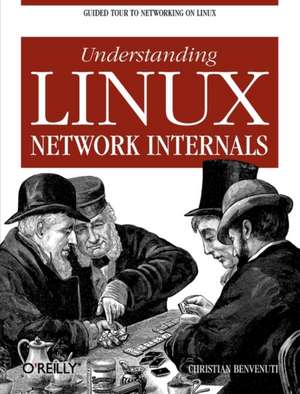
Understanding Linux Network Internals: O'Reilly Ser.
Autor Christian Benvenutien Limba Engleză Paperback – 7 feb 2006
Adresată programatorilor de sistem și inginerilor de rețea de nivel intermediar și avansat, Understanding Linux Network Internals reprezintă o resursă tehnică monumentală pentru cei care doresc să descifreze modul în care nucleul Linux gestionează traficul de date. Reținem că volumul nu se rezumă la o simplă expunere teoretică, ci propune o explorare riguroasă a codului sursă C, oferind cititorului instrumentele necesare pentru a urmări execuția reală a protocoalelor IP. Notăm cu interes modul în care Christian Benvenuti a structurat această lucrare de peste 1000 de pagini. Progresia este logică și granulară: se începe cu structurile de date critice și interfața user-space, continuând cu procesele de inițializare a dispozitivelor PCI și înregistrarea driverelor NIC. Partea centrală a cărții disecă mecanismele de recepție și transmisie a cadrelor, oferind o claritate rară asupra modului în care întreruperile și handler-ele de protocol interacționează sub presiunea traficului. Cititorul care a aplicat deja conceptele fundamentale din Understanding the Linux Kernel va găsi aici continuarea firească, focalizată strict pe subsistemul de networking, completând viziunea de ansamblu asupra managementului resurselor de sistem. Spre deosebire de Linux Kernel Networking de Rami Rosen, care oferă un tur ghidat mai succint al implementărilor curente, lucrarea de față insistă pe integrarea pieselor disparate și pe dezvăluirea relațiilor dintre funcții și structuri de date aflate la distanță în cod. Credem că valoarea adăugată constă în diagramele de flux și explicațiile despre compromisurile de design, care transformă un subiect arid într-o lecție aplicată de arhitectură de sistem.

Preț: 325.42 lei
Preț vechi: 406.77 lei
-20%
Carte disponibilă
Livrare economică 06-20 noiembrie
Livrare express 22-28 octombrie pentru 84.90 lei
Specificații
ISBN-10: 0596002556
Pagini: 1062
Ilustrații: 1, black & white illustrations
Dimensiuni: 179 x 236 x 60 mm
Greutate: 1.66 kg
Editura: O'Reilly
Colecția O'Reilly Ser.
Seria O'Reilly Ser.
Locul publicării:United States
V-ar putea interesa
-
 Computer Networks: A Systems ApproachLarry L. Peterson-41%Preț: 558.53 lei941.05 lei
 -
 Introduction to Networks Companion Guide (Ccnav7)Cisco Networking Academy-19%Preț: 576.69 lei711.97 lei
 -
 TCP/IP IllustratedKevin Fall-20%Preț: 403.13 lei503.92 lei
 -
 Design and Implementation of the FreeBSD Operating System, TheGeorge Neville-Neil-20%Preț: 443.60 lei554.50 lei
 -
 Linux Command Line and Shell Scripting BibleRichard Blum-20%Preț: 291.11 lei363.88 lei
 -
![Computer Networking [Global Edition]](https://i1.books-express.ro/bt/9781292405469/computer-networking-global-edition.jpg) Computer Networking [Global Edition]James Kurose-20%Preț: 566.68 lei708.35 lei
Computer Networking [Global Edition]James Kurose-20%Preț: 566.68 lei708.35 lei -
 Networking All-In-One for DummiesDoug Lowe-20%Preț: 258.11 lei322.63 lei
 -
 -20%Preț: 335.34 lei419.18 lei
 -
 The TCP/IP GuideCharles M. Kozierok-28%Preț: 497.72 lei686.90 lei
 -
 -20%Preț: 264.28 lei330.35 lei
 -
 System Programming in Linux: A Hands-On IntroductionStewart Weiss-35%Preț: 481.36 lei739.15 lei
 -
 -36%Preț: 284.14 lei440.90 lei
 -
 The Book of PF, 4th Edition: A No-Nonsense Guide to the OpenBSD FirewallPeter N.M. Hansteen-36%Preț: 279.74 lei437.64 lei
 -
 Packet Tracer for Young Intermediate AdminsDamian Strojek-20%Preț: 260.94 lei326.17 lei
 -
 Computer Networks in Packet Tracer for BeginnersDamian Strojek-20%Preț: 260.25 lei325.32 lei
 -
 Computer Networks in Packet Tracer for Intermediate UsersDamian Strojek-20%Preț: 265.31 lei331.65 lei
De ce să citești această carte
Recomandăm această carte profesioniștilor care au nevoie să înțeleagă arhitectura internă a rețelelor în Linux la nivel de cod. Este un instrument esențial pentru cei care dezvoltă drivere, optimizează stive de protocoale sau depanează probleme complexe de kernel. Cititorul câștigă o înțelegere profundă a modului în care datele circulă de la hardware la aplicație, beneficiind de expertiza unui designer de sisteme de operare.
Despre autor
Christian Benvenuti este un inginer și designer de sisteme de operare, specializat în infrastructura de rețele. Expertiza sa vastă în ecosistemul Linux și în protocoalele TCP/IP i-a permis să scrie una dintre cele mai detaliate lucrări de referință din portofoliul O'Reilly. În prezent, el colaborează cu lideri din industria tehnologică pentru dezvoltarea de soluții de networking de înaltă performanță, experiența sa practică fiind reflectată în modul în care analizează deciziile de design în interiorul kernel-ului.
Cuprins
- Preface
- Part I: General Background
- Chapter 1: Introduction
- Chapter 2: Critical Data Structures
- Chapter 3: User-Space-to-Kernel Interface
- Part II: System Initialization
- Chapter 4: Notification Chains
- Chapter 5: Network Device Initialization
- Chapter 6: The PCI Layer and Network Interface Cards
- Chapter 7: Kernel Infrastructure for Component Initialization
- Chapter 8: Device Registration and Initialization
- Part III: Transmission and Reception
- Chapter 9: Interrupts and Network Drivers
- Chapter 10: Frame Reception
- Chapter 11: Frame Transmission
- Chapter 12: General and Reference Material About Interrupts
- Chapter 13: Protocol Handlers
- Part IV: Bridging
- Chapter 14: Bridging: Concepts
- Chapter 15: Bridging: The Spanning Tree Protocol
- Chapter 16: Bridging: Linux Implementation
- Chapter 17: Bridging: Miscellaneous Topics
- Part V: Internet Protocol Version 4 (IPv4)
- Chapter 18: Internet Protocol Version 4 (IPv4): Concepts
- Chapter 19: Internet Protocol Version 4 (IPv4): Linux Foundations and Features
- Chapter 20: Internet Protocol Version 4 (IPv4): Forwarding and Local Delivery
- Chapter 21: Internet Protocol Version 4 (IPv4): Transmission
- Chapter 22: Internet Protocol Version 4 (IPv4): Handling Fragmentation
- Chapter 23: Internet Protocol Version 4 (IPv4): Miscellaneous Topics
- Chapter 24: Layer Four Protocol and Raw IP Handling
- Chapter 25: Internet Control Message Protocol (ICMPv4)
- Part VI: Neighboring Subsystem
- Chapter 26: Neighboring Subsystem: Concepts
- Chapter 27: Neighboring Subsystem: Infrastructure
- Chapter 28: Neighboring Subsystem: Address Resolution Protocol (ARP)
- Chapter 29: Neighboring Subsystem: Miscellaneous Topics
- Part VII: Routing
- Chapter 30: Routing: Concepts
- Chapter 31: Routing: Advanced
- Chapter 32: Routing: Li nux Implementation
- Chapter 33: Routing: The Routing Cache
- Chapter 34: Routing: Routing Tables
- Chapter 35: Routing: Lookups
- Chapter 36: Routing: Miscellaneous Topics
- Colophon
Descriere scurtă
Like the popular O'Reilly book, Understanding the Linux Kernel, this book clearly explains the underlying concepts and teaches you how to follow the actual C code that implements it. Although some background in the TCP/IP protocols is helpful, you can learn a great deal from this text about the protocols themselves and their uses. And if you already have a base knowledge of C, you can use the book's code walkthroughs to figure out exactly what this sophisticated part of the Linux kernel is doing.
Part of the difficulty in understanding networks -- and implementing them -- is that the tasks are broken up and performed at many different times by different pieces of code. One of the strengths of this book is to integrate the pieces and reveal the relationships between far-flung functions and data structures. Understanding Linux Network Internals is both a big-picture discussion and a no-nonsense guide to the details of Linux networking. Topics include:
* Key problems with networking
* Network interface card (NIC) device drivers
* System initialization
* Layer 2 (link-layer) tasks and implementation
* Layer 3 (IPv4) tasks and implementation
* Neighbor infrastructure and protocols (ARP)
* Bridging
* Routing
* ICMP
Author Christian Benvenuti, an operating system designer specializing in networking, explains much more than how Linux code works. He shows the purposes of major networking features and the trade-offs involved in choosing one solution over another. A large number of flowcharts and other diagrams enhance the book's understandability.