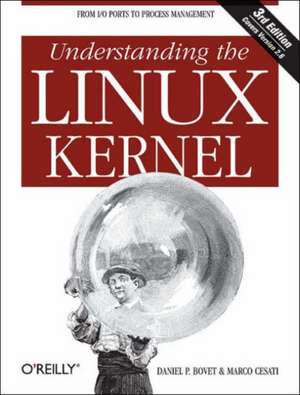
Understanding the Linux Kernel
Autor Daniel P. Bovet, Marco Cesatien Limba Engleză Paperback – dec 2005
Observăm că a treia ediție a volumului Understanding the Linux Kernel rămâne un punct de referință tehnic esențial pentru înțelegerea versiunii 2.6 a nucleului Linux. Această iterație este crucială deoarece documentează schimbările structurale profunde apărute în gestiunea memoriei și a subsistemelor de dispozitive, oferind o perspectivă riguroasă asupra modului în care sistemul de operare interacționează cu hardware-ul. Suntem de părere că rigoarea analizei este susținută direct de profilul academic al autorului Daniel P. Bovet, a cărui lucrare anterioară, Algorithms and Complexity, trădează o preocupare constantă pentru eficiența computațională, temă centrală și în optimizarea kernel-ului. Notăm cu interes modul în care autorii disecă segmente de cod linie cu linie, trecând dincolo de o descriere funcțională spre fundamentul teoretic al deciziilor de design. Cartea explorează mecanisme complexe precum planificarea proceselor (scheduling), semnalele, întreruperile și interfețele driverelor de dispozitiv. Complementar volumului Linux Kernel Development de Robert Love, care adoptă o abordare mai orientată spre implementarea practică și dezvoltarea de cod nou, Understanding the Linux Kernel acoperă zona de arhitectură internă și algoritmi fundamentali dintr-o perspectivă analitică profundă, fiind mai degrabă un ghid de înțelegere a sistemului existent. Structura este una densă, de 920 de pagini, potrivită pentru cei care doresc să stăpânească gestiunea memoriei virtuale (VFS) sau sistemele de fișiere Ext2 și Ext3. Spre deosebire de How Linux Works, 3rd Edition, care oferă o viziune de ansamblu asupra ecosistemului (inclusiv containere și rețele), acest titlu publicat de O'Reilly rămâne focalizat strict pe „inima” sistemului de operare, oferind detaliile tehnice necesare pentru a maximiza performanța pe arhitecturi Intel.
Preț: 374.84 lei
Preț vechi: 468.54 lei
-20%
Carte disponibilă
Livrare economică 04-18 noiembrie
Livrare express 21-27 octombrie pentru 79.93 lei
Specificații
ISBN-10: 0596005652
Pagini: 920
Dimensiuni: 177 x 233 x 53 mm
Greutate: 1.54 kg
Ediția:3rd ed
Editura: O'Reilly
Locul publicării:United States
V-ar putea interesa
-
 Thinking in JavaBruce Eckel-20%Preț: 406.17 lei507.71 lei
 -
 Star Wars: Path of DestructionDrew KarpyshynPreț: 63.49 lei
 -
 Preț: 76.26 lei
 -
 The Victors: Eisenhower and His Boys: The Men of World War IIStephen E. AmbrosePreț: 121.88 lei
 -
 Operational AmplifiersG B ClaytonPreț: 330.46 lei
 -
 Beginning Digital Electronics Through ProjectsAndrew Singmin-35%Preț: 264.77 lei409.07 lei
 -
 Beginning Analog Electronics Through ProjectsAndrew SingminPreț: 339.63 lei
 -
 The Jazz Bass Book: Technique and TraditionJohn GoldsbyPreț: 178.93 lei
 -
 Preț: 153.27 lei
 -
 The Tales of Beedle the Bard: New EditionJ. K. Rowling-27%Preț: 41.87 lei57.20 lei
 -
 Modern Compiler DesignDick Grune-20%Preț: 823.30 lei1029.13 lei
 -
 D-Day: June 6, 1944: The Battle For The Normandy BeachesStephen E. Ambrose-39%Preț: 59.35 lei96.60 lei
 -
 Band Of BrothersStephen E. Ambrose-8%Preț: 66.69 lei72.62 lei
 -
 Modern Compiler DesignDick Grune-20%Preț: 620.87 lei776.08 lei
 -
 The Book Of Pf, 3rd EditionPeter N.M. Hansteen-20%Preț: 156.62 lei195.78 lei
 -
 World of Warcraft Chronicle, Volume 1Blizzard EntertainmentPreț: 330.70 lei
 -
 World of Warcraft Chronicle, Volume 2Blizzard Entertainment-17%Preț: 317.22 lei381.13 lei
 -
 Linux for Networking ProfessionalsRob Vandenbrink-20%Preț: 277.69 lei347.11 lei
 -
 Introduction to Digital Signal ProcessingTae Hong Park-20%Preț: 969.50 lei1211.88 lei
De ce să citești această carte
Recomandăm această carte inginerilor de sistem și programatorilor care doresc să înțeleagă mecanismele interne ale Linux la un nivel granular. Veți câștiga o perspectivă clară asupra modului în care kernel-ul gestionează resursele limitate și cum sunt implementați algoritmii de scheduling. Este un instrument indispensabil pentru oricine vrea să depășească nivelul de utilizator și să înțeleagă arhitectura software de sub capota versiunii 2.6.
Descriere scurtă
In order to thoroughly understand what makes Linux tick and why it works so well on a wide variety of systems, you need to delve deep into the heart of the kernel. The kernel handles all interactions between the CPU and the external world, and determines which programs will share processor time, in what order. It manages limited memory so well that hundreds of processes can share the system efficiently, and expertly organizes data transfers so that the CPU isn't kept waiting any longer than necessary for the relatively slow disks.
The third edition of Understanding the Linux Kernel takes you on a guided tour of the most significant data structures, algorithms, and programming tricks used in the kernel. Probing beyond superficial features, the authors offer valuable insights to people who want to know how things really work inside their machine. Important Intel-specific features are discussed.
Relevant segments of code are dissected line by line. But the book covers more than just the functioning of the code; it explains the theoretical underpinnings of why Linux does things the way it does. This edition of the book covers Version 2.6, which has seen significant changes to nearly every kernel subsystem, particularly in the areas of memory management and block devices.
The book focuses on the following topics: * Memory management, including file buffering, process swapping, and Direct memory Access (DMA) * The Virtual Filesystem layer and the Second and Third Extended Filesystems * Process creation and scheduling * Signals, interrupts, and the essential interfaces to device drivers * Timing * Synchronization within the kernel * Interprocess Communication (IPC) * Program execution Understanding the Linux Kernel will acquaint you with all the inner workings of Linux, but it's more than just an academic exercise. You'll learn what conditions bring out Linux's best performance, and you'll see how it meets the challenge of providing good system response during process scheduling, file access, and memory management in a wide variety of environments. This book will help you make the most of your Linux system.
Cuprins
- Preface
- Chapter 1: Introduction
- Chapter 2: Memory Addressing
- Chapter 3: Processes
- Chapter 4: Interrupts and Exceptions
- Chapter 5: Kernel Synchronization
- Chapter 6: Timing Measurements
- Chapter 7: Process Scheduling
- Chapter 8: Memory Management
- Chapter 9: Process Address Space
- Chapter 10: System Calls
- Chapter 11: Signals
- Chapter 12: The Virtual Filesystem
- Chapter 13: I/O Architecture and Device Drivers
- Chapter 14: Block Device Drivers
- Chapter 15: The Page Cache
- Chapter 16: Accessing Files
- Chapter 17: Page Frame Reclaiming
- Chapter 18: The Ext2 and Ext3 Filesystems
- Chapter 19: Process Communication
- Chapter 20: Program ExZecution
- Appendix A: System Startup
- Appendix B: Modules
- Bibliography
- Colophon