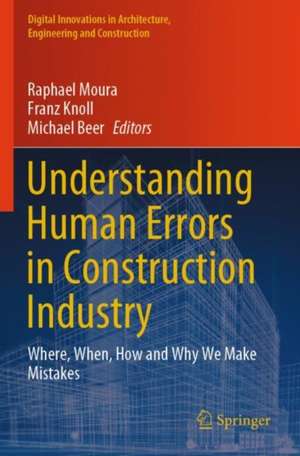
Understanding Human Errors in Construction Industry: Digital Innovations in Architecture, Engineering and Construction
Editat de Raphael Moura, Franz Knoll, Michael Beeren Limba Engleză Paperback – 17 aug 2024
The book features a discussion of the circumstances related to error proneness, the review of some sixty mishaps or near misses from real-life construction, the systematic analysis of 238 large-scale accidents in engineering systems, the perspective of psychology on the origin of faulty human performance, and a review of the relation of management to error proneness.
Din seria Digital Innovations in Architecture, Engineering and Construction
- 18%
 Preț: 942.89 lei
 - 18%
 Preț: 965.27 lei
 - 24%
 Preț: 965.41 lei
 -
 Preț: 315.24 lei
 - 18%
 Preț: 977.03 lei
 - 24%
 Preț: 1319.29 lei
 - 24%
 Preț: 1002.04 lei
 - 24%
 Preț: 1349.43 lei
 - 24%
 Preț: 1052.17 lei
 - 19%
 Preț: 615.35 lei
 - 20%
 Preț: 1077.04 lei
 - 23%
 Preț: 627.15 lei
 - 24%
 Preț: 817.57 lei
 - 24%
 Preț: 817.48 lei
 - 18%
 Preț: 924.36 lei
 - 24%
 Preț: 962.96 lei
 - 23%
 Preț: 741.60 lei
 -
 Preț: 447.49 lei
 - 24%
 Preț: 946.41 lei
 - 18%
 Preț: 976.82 lei
 - 24%
 Preț: 1725.97 lei
 -
 Preț: 535.34 lei
 - 18%
 Preț: 1741.75 lei
 - 24%
 Preț: 940.38 lei
 - 24%
 Preț: 962.49 lei
 - 24%
 Preț: 881.90 lei
 - 24%
 Preț: 1386.10 lei
 - 24%
 Preț: 1189.95 lei
 - 18%
 Preț: 875.26 lei
Preț: 1059.22 lei
Preț vechi: 1393.70 lei
-24%
Puncte Express: 1589
Carte tipărită la comandă
Livrare economică 03-09 decembrie
Livrare prin curier în România Termenul estimat este afișat lângă disponibilitate.
Transport gratuit pentru acest produs Plată online sau ramburs, în funcție de opțiunile comenzii.
Retur gratuit în 14 zile Comandă securizată și suport în română.
Specificații
ISBN-13: 9783031376696
ISBN-10: 3031376692
Pagini: 228
Dimensiuni: 155 x 235 x 13 mm
Greutate: 0.35 kg
Editura: Springer
Colecția Digital Innovations in Architecture, Engineering and Construction
Seria Digital Innovations in Architecture, Engineering and Construction
ISBN-10: 3031376692
Pagini: 228
Dimensiuni: 155 x 235 x 13 mm
Greutate: 0.35 kg
Editura: Springer
Colecția Digital Innovations in Architecture, Engineering and Construction
Seria Digital Innovations in Architecture, Engineering and Construction
V-ar putea interesa
-
 -29%Preț: 634.84 lei887.96 lei
 -
 -19%Preț: 238.82 lei295.97 lei
 -
 -14%Preț: 136.46 lei158.02 lei
 -
 How to Make Mistakes On Purpose: Bring Chaos to Your OrderLaurie Rosenwald-24%Preț: 109.16 lei143.86 lei
 -
 To Err Is HumanCommittee on Quality of Health Care in America-5%Preț: 329.44 lei346.78 lei
 -
 Handbook of Perioperative and Procedural Patient SafetyJuan A. Sanchez-27%Preț: 567.71 lei778.18 lei
 -
 -30%Preț: 267.90 lei384.55 lei
 -
 Normal AccidentsCharles PerrowPreț: 290.63 lei
 -
 Hacking HumanityLara LewingtonPreț: 123.80 lei
 -
 Architect's Legal Handbook: The Law for ArchitectsAnthony Speaight KCPreț: 466.12 leiRecomandat
 -
 -19%Preț: 451.56 lei557.48 lei
 -
 -11%Preț: 644.83 lei724.53 lei
 -
 Preț: 363.33 lei
 -
 Barry's Construction TechnologyStephen EmmittPreț: 379.66 lei
 -
 The Human Side of ConstructionAngelo SuntresPreț: 365.61 lei
 -
 Preț: 123.51 lei
 -
 Tilcsik, A: MeltdownAndras Tilcsik-35%Preț: 61.04 lei93.93 lei
 -
 Being WrongKathryn SchulzPreț: 68.98 lei
 -
 The Naked PilotDavid BeatyPreț: 132.79 lei
 -
 Preț: 112.21 lei
 -
 -25%Preț: 180.51 lei241.90 lei
 -
 The Secret SurveyorAnonymousPreț: 133.64 lei
 -
 Preț: 440.20 lei
 -
 Accents of added value in construction 4.0Bianca Christina Weber-LewerenzPreț: 330.00 lei
 -
 Innovation Empowerment in Construction 4.0 by the CDR-ApproachBianca Christina Weber-Lewerenz-15%Preț: 666.44 lei784.05 lei
 -
 Diversity in Construction - The GamechangersBianca Christina Weber-Lewerenz-15%Preț: 657.81 lei773.89 lei
Cuprins
Human Errors in Engineering.- Design & Construction Case Studies.- Learning from Large-Scale Accidents.- Insights from Psychology.- Insights from Construction Management.- Evaluation of Case Studies / A Template Approach.
Notă biografică
Raphael Moura is a Regulatory Specialist and Researcher focused on the key elements of an effective safety management system at high-risk facilities, including human factors. He is Superintendent for R&D and Environment at the Brazilian National Agency for Petroleum, Natural Gas and Biofuels — ANP. Dr. Moura is also editor of the ASCE-ASME Journal of Risk and Uncertainty in Engineering Systems Part B: Mechanical Engineering. His industrial experience includes 8 years as Technician and as Engineer, designing offshore facilities for civilian and military applications.
Franz Knoll has continuously been involved in research about human errors in construction. He has been the voice of the practice, being a practical engineer himself during most of his career of more than 60 years. In his publications and lectures, he has discussed strategies and methods to limit the frequency of human errors (gross errors as recognized by Gauss) and their effect on the quality and proneness to accidents in construction work.
Franz Knoll has continuously been involved in research about human errors in construction. He has been the voice of the practice, being a practical engineer himself during most of his career of more than 60 years. In his publications and lectures, he has discussed strategies and methods to limit the frequency of human errors (gross errors as recognized by Gauss) and their effect on the quality and proneness to accidents in construction work.
Michael Beer is Professor and Head of the Institute for Risk and Reliability, Leibniz Universität Hannover, Germany. His research activity focuses on uncertainty quantification in engineering with emphasis on imprecise probabilities. He is Editor-in-Chief of the ASCE-ASME Journal of Risk and Uncertainty in Engineering Systems, Part A Civil Engineering and Part B Mechanical Engineering. He also served as Editor-in-Chief of the Encyclopedia of Earthquake Engineering (Springer 2015). He is Chairman of the European Safety and Reliability Association (ESRA) and Co-Chair of Risk and Resilience Measurements Committee (RRMC), Infrastructure Resilience Division (IRD), ASCE; he is serving on the Executive Board of the International Safety and Reliability Association (IASSAR) and on the Board of Directors of the International Association for Probabilistic Safety Assessment and Management (IAPSAM).
Textul de pe ultima copertă
This book provides an analysis of the origin and effect of human errors in engineering. Using cases from everyday construction and large-scale accidents, the circumstances associated with the creation of errors are illustrated, along with strategies for their prevention, with the goal to eventually minimize cost overruns, delays, and accidents.
The book features a discussion of the circumstances related to error proneness, the review of some sixty mishaps or near misses from real-life construction, the systematic analysis of 238 large-scale accidents in engineering systems, the perspective of psychology on the origin of faulty human performance, and a review of the relation of management to error proneness.
The book features a discussion of the circumstances related to error proneness, the review of some sixty mishaps or near misses from real-life construction, the systematic analysis of 238 large-scale accidents in engineering systems, the perspective of psychology on the origin of faulty human performance, and a review of the relation of management to error proneness.
Caracteristici
Presents a rigorous analysis of real-world construction errors using pattern recognition technology Brings together expertise from engineering, management, and psychology Combines comprehensive practical experience with deep theoretical research