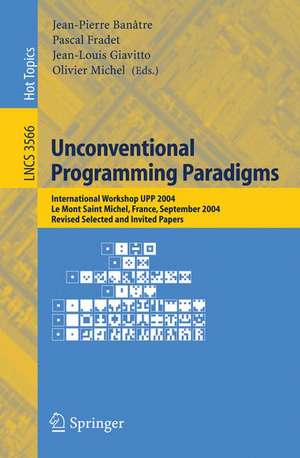
Unconventional Programming Paradigms
Editat de Jean-Pierre Banâtre, Pascal Fradet, Jean-Louis Giavitto, Olivier Michelen Limba Engleză Paperback – 15 iul 2005
Preț: 339.52 lei
Preț vechi: 424.40 lei
-20%
Puncte Express: 509
Carte tipărită la comandă
Livrare economică 01-15 decembrie
Livrare prin curier în România Termenul estimat este afișat lângă disponibilitate.
Transport gratuit de la 400.00 lei Plată online sau ramburs, în funcție de opțiunile comenzii.
Retur gratuit în 14 zile Comandă securizată și suport în română.
Specificații
ISBN-13: 9783540278849
ISBN-10: 3540278842
Pagini: 384
Ilustrații: XI, 367 p.
Dimensiuni: 155 x 235 x 21 mm
Greutate: 0.54 kg
Ediția:2005
Editura: Springer
Locul publicării:Berlin, Heidelberg, Germany
ISBN-10: 3540278842
Pagini: 384
Ilustrații: XI, 367 p.
Dimensiuni: 155 x 235 x 21 mm
Greutate: 0.54 kg
Ediția:2005
Editura: Springer
Locul publicării:Berlin, Heidelberg, Germany
V-ar putea interesa
-
 -38%Preț: 191.72 lei306.80 lei
 -
 Game AnalyticsMagy Seif El-Nasr-20%Preț: 821.99 lei1027.48 lei
 -
 Experience Design: Concepts and Case StudiesPeter Benz-15%Preț: 244.80 lei288.73 lei
 -
 Designers, Users and JusticeTurkka Keinonen-33%Preț: 772.24 lei1147.85 lei
 -
 This is Service Design DoingMarc Stickdorn-20%Preț: 264.28 lei330.35 lei
 -
 Haptic Devices for Studies on Human Grasp and RehabilitationAlessandro Altobelli-20%Preț: 664.78 lei830.98 lei
 -
 Cognition Beyond the BrainStephen J. Cowley-20%Preț: 890.38 lei1112.96 lei
 -
 Game DynamicsOliver Korn-20%Preț: 964.15 lei1205.18 lei
 -
 Smart GraphicsYaxi Chen-20%Preț: 331.19 lei413.99 lei
 -
 -20%Preț: 379.38 lei474.23 lei
 -
 Brain-Computer Interface Research: A State-of-the-Art Summary 5Christoph Guger-20%Preț: 312.62 lei390.78 lei
 -
 -20%Preț: 975.27 lei1219.09 lei
 -
 -20%Preț: 552.18 lei690.23 lei
 -
 -20%Preț: 638.76 lei798.45 lei
 -
 -20%Preț: 325.30 lei406.63 lei
 -
 -20%Preț: 642.40 lei803.00 lei
 -
 -20%Preț: 334.49 lei418.11 lei
 -
 -20%Preț: 345.28 lei431.59 lei
 -
 -20%Preț: 315.48 lei394.35 lei
 -
 -20%Preț: 328.94 lei411.17 lei
 -
 -20%Preț: 330.54 lei413.16 lei
 -
 Morphogenetic EngineeringRené Doursat-20%Preț: 864.89 lei1081.11 lei
 -
 Work at the Boundaries of ScienceC. L. Palmer-20%Preț: 644.47 lei805.58 lei
Public țintă
ResearchCuprins
Invited Talk.- From Quantum Physics to Programming Languages: A Process Algebraic Approach.- Chemical Computing.- Chemical Computing.- Programming Reaction-Diffusion Processors.- From Prescriptive Programming of Solid-State Devices to Orchestrated Self-organisation of Informed Matter.- Relational Growth Grammars – A Graph Rewriting Approach to Dynamical Systems with a Dynamical Structure.- A New Programming Paradigm Inspired by Artificial Chemistries.- Higher-Order Chemical Programming Style.- Amorphous Computing.- to Amorphous Computing.- Abstractions for Directing Self-organising Patterns.- Programming an Amorphous Computational Medium.- Computations in Space and Space in Computations.- Bio-inspired Computing.- Bio-inspired Computing Paradigms (Natural Computing).- Inverse Design of Cellular Automata by Genetic Algorithms: An Unconventional Programming Paradigm.- Design, Simulation, and Experimental Demonstration of Self-assembled DNA Nanostructures and Motors.- Membrane Systems: A Quick Introduction.- Cellular Meta-programming over Membranes.- Modelling Dynamically Organised Colonies of Bio-entities.- P Systems: Some Recent Results and Research Problems.- Outlining an Unconventional, Adaptive, and Particle-Based Reconfigurable Computer Architecture.- Autonomic Computing.- Autonomic Computing: An Overview.- Enabling Autonomic Grid Applications: Dynamic Composition, Coordination and Interaction.- Grassroots Approach to Self-management in Large-Scale Distributed Systems.- Autonomic Runtime System for Large Scale Parallel and Distributed Applications.- Generative Programming.- Towards Generative Programming.- Overview of Generative Software Development.- A Comparison of Program Generation with Aspect-Oriented Programming.- Generative Programming from a PostObject-Oriented Programming Viewpoint.