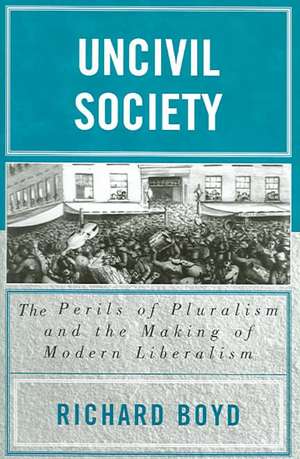
Uncivil Society: The Perils of Pluralism and the Making of Modern Liberalism: Applications of Political Theory
Autor Richard Boyden Limba Engleză Paperback – 18 aug 2004
Din seria Applications of Political Theory
- 22%
 Preț: 331.83 lei
 - 24%
 Preț: 323.55 lei
 - 25%
 Preț: 307.67 lei
 -
 Preț: 499.40 lei
 - 22%
 Preț: 339.50 lei
 - 22%
 Preț: 340.73 lei
 - 25%
 Preț: 305.41 lei
 - 25%
 Preț: 367.83 lei
 - 23%
 Preț: 1085.71 lei
 - 33%
 Preț: 580.87 lei
 - 12%
 Preț: 281.77 lei
 - 23%
 Preț: 334.69 lei
 - 22%
 Preț: 324.61 lei
 - 23%
 Preț: 320.82 lei
 - 23%
 Preț: 320.50 lei
 - 27%
 Preț: 273.87 lei
 - 23%
 Preț: 336.93 lei
 - 23%
 Preț: 320.82 lei
 - 27%
 Preț: 277.94 lei
 - 22%
 Preț: 324.61 lei
 - 25%
 Preț: 363.36 lei
 - 29%
 Preț: 343.67 lei
 - 27%
 Preț: 268.95 lei
 - 23%
 Preț: 322.08 lei
 - 23%
 Preț: 320.61 lei
 - 23%
 Preț: 322.31 lei
 - 28%
 Preț: 386.70 lei
 - 22%
 Preț: 325.10 lei
Preț: 326.65 lei
Preț vechi: 419.31 lei
-22%
Puncte Express: 490
Carte tipărită la comandă
Livrare economică 27 noiembrie-11 decembrie
Livrare prin curier în România Termenul estimat este afișat lângă disponibilitate.
Transport gratuit de la 400.00 lei Plată online sau ramburs, în funcție de opțiunile comenzii.
Retur gratuit în 14 zile Comandă securizată și suport în română.
Specificații
ISBN-13: 9780739109090
ISBN-10: 073910909X
Pagini: 351
Dimensiuni: 152 x 228 x 22 mm
Greutate: 0.56 kg
Editura: Bloomsbury Publishing
Colecția Lexington Books
Seria Applications of Political Theory
Locul publicării:New York, United States
ISBN-10: 073910909X
Pagini: 351
Dimensiuni: 152 x 228 x 22 mm
Greutate: 0.56 kg
Editura: Bloomsbury Publishing
Colecția Lexington Books
Seria Applications of Political Theory
Locul publicării:New York, United States
Cuprins
1 Introduction: Civic Associations and the Liberal Tradition
2 Chapter One: Thomas Hobbes and the Perils of Pluralism
3 Chapter Two: John Locke, Toleration, and Sectarianism
4 Chapter Three: Reappraising the Scottish Moralists and Civil Society
5 Chapter Four: Edmund Burke's Defense of Civil Society
6 Chapter Five: John Stuart Mill and the Modern Liberal Ambivalence to Groups
7 Chapter Six: Alexis de Tocqueville and the Perils of Pluralism Revisited
8 Chapter Seven: Michael Oakeshott and the Transformational (Im)possibilities of the Liberal State
9 Chapter Eight: F. A. Hayek and the Limits of Liberal Constitutionalism
10 Conclusion: Liberal Neutrality, Purposive Community, and the Logic of Contemporary Pluralism
2 Chapter One: Thomas Hobbes and the Perils of Pluralism
3 Chapter Two: John Locke, Toleration, and Sectarianism
4 Chapter Three: Reappraising the Scottish Moralists and Civil Society
5 Chapter Four: Edmund Burke's Defense of Civil Society
6 Chapter Five: John Stuart Mill and the Modern Liberal Ambivalence to Groups
7 Chapter Six: Alexis de Tocqueville and the Perils of Pluralism Revisited
8 Chapter Seven: Michael Oakeshott and the Transformational (Im)possibilities of the Liberal State
9 Chapter Eight: F. A. Hayek and the Limits of Liberal Constitutionalism
10 Conclusion: Liberal Neutrality, Purposive Community, and the Logic of Contemporary Pluralism
Recenzii
In his book, Richard Boyd offers a thoughtful reappraisal of the relation between the idea of civil society and the tradition of liberal political thought. He questions the view held by many contemporary political theorists that the development of civil society, understood as the realm of what Tocqueville called "voluntary associations" mediating between the individual and the state, is a necessary condition for the maintenance of liberal democracy. Against this position, Boyd argues that an earlier tradition of liberal thought was justifiably suspicious of the potential for subpolitical social groups-especially, but not limited to, intolerant religious sects-to undermine rather than support liberal institutions. In a series of well-argued chapters, he traces the trajectory of the connected ideas of civil society and social pluralism from initial suspicion to perhaps uncritical acceptance.
Richard Boyd has written an ambitious, intelligent, insightful, and challenging book . . . anyone interested in the history of liberalism, in the current debates over the lack of community, in the status or location of civil society will be both challenged and enlightened.
Richard Boyd has written an ambitious, intelligent, insightful, and challenging book . . . anyone interested in the history of liberalism, in the current debates over the lack of community, in the status or location of civil society will be both challenged and enlightened.