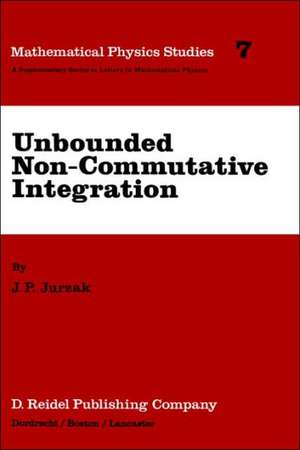
Unbounded Non-Commutative Integration
Autor J. P. Jurzaken Limba Engleză Hardback – 30 iun 1985
Preț: 618.40 lei
Preț vechi: 727.53 lei
-15%
Puncte Express: 928
Preț estimativ în valută:
109.36€ • 128.94$ • 94.86£
109.36€ • 128.94$ • 94.86£
Carte tipărită la comandă
Livrare economică 21 martie-04 aprilie
Specificații
ISBN-13: 9789027718150
ISBN-10: 9027718156
Pagini: 216
Ilustrații: XX, 191 p.
Dimensiuni: 161 x 240 x 18 mm
Greutate: 0.5 kg
Ediția:1985
Editura: Springer
Locul publicării:Dordrecht, Netherlands
ISBN-10: 9027718156
Pagini: 216
Ilustrații: XX, 191 p.
Dimensiuni: 161 x 240 x 18 mm
Greutate: 0.5 kg
Ediția:1985
Editura: Springer
Locul publicării:Dordrecht, Netherlands
V-ar putea interesa
-
 -22%Preț: 357.43 lei455.59 lei
 -
 Sociophysics: An IntroductionParongama Sen-21%Preț: 600.41 lei763.21 lei
 -
 Lie Groups and Lie Algebras - A Physicist's PerspectiveAdam M. Bincer-23%Preț: 506.97 lei655.81 lei
 -
 On the Topology and Future Stability of the UniverseHans Ringström-33%Preț: 673.24 lei1005.11 lei
 -
 Preț: 430.64 lei
 -
 Mathematics for PhysicistsBrian R. MartinPreț: 412.90 lei
 -
 Principia: The Authoritative TranslationIsaac NewtonPreț: 139.15 lei
 -
 Computational Methods for PhysicsJoel Franklin-11%Preț: 501.52 lei563.50 lei
 -
 Lectures on Quantum MechanicsSteven WeinbergPreț: 409.25 lei
 -
 A Student's Guide to Dimensional AnalysisDon S. LemonsPreț: 189.68 lei
 -
 Group Theory for High Energy PhysicistsMohammad Saleem-18%Preț: 1353.84 lei1651.03 lei
 -
 Brownian Motion: Elements, Dynamics & ApplicationsMark A McKibben-26%Preț: 1748.78 lei2363.89 lei
 -
 Introduction to Mathematica® for PhysicistsAndrey GrozinPreț: 438.72 lei
 -
 Mathematical PhysicsSadri Hassani-15%Preț: 620.41 lei729.90 lei
 -
 Towards the Mathematics of Quantum Field TheoryFrédéric Paugam-18%Preț: 1080.11 lei1317.20 lei
 -
 -33%Preț: 567.40 lei848.57 lei
Public țintă
ResearchCuprins
Examples and Observations.- 1: Main Spaces.- 2: Density Theorems.- 3: Technical Properties of the Domain.- 4: Elementary Operations.- 5: Gelfand Transformation.- 6: Cofinal Central Systems and Derivations.- 7: Notion of Representation: The G.N.S. Case.- 8: The State Space.- 9: G-Invariance and G-Traces.- 10: Other Commutation Theorems.- 11: On Strong and Ultrastrong Topologies.- References.