
Ukraine's Quest for Identity: Embracing Cultural Hybridity in Literary Imagination, 1991–2011
Autor Maria G. Rewakowiczen Limba Engleză Paperback – 11 feb 2020
Recomandăm Ukraine's Quest for Identity ca pe o resursă academică esențială pentru înțelegerea modului în care ficțiunea a modelat conștiința națională ucraineană după prăbușirea imperiului sovietic. Studiile de caz propuse de Maria G. Rewakowicz se concentrează pe primele două decenii de independență, investigând modul în care marginalizarea socială, criminalitatea și chiar bolile sunt utilizate ca instrumente narative pentru a reflecta traumele tranziției. Analiza pornește de la premisa hibridității culturale, respingând viziunile monolitice asupra identității în favoarea unui model pluralist, negociat permanent între centru și periferie.
Considerăm că structura volumului este deosebit de riguroasă, ghidând cititorul de la strategii de lectură și geografie culturală către discursul feminin și alegerea limbii ca act politic. Capitolul dedicat literaturii populare este deosebit de relevant pentru curriculumul de științe politice, demonstrând cum genurile accesibile au contribuit la construcția identitară la fel de mult ca literatura înaltă. Această lucrare completează perspectiva oferită de Ukrainian, Russophone, (Other) Russian de Marco Puleri, adăugând o analiză aprofundată a contextelor regionale și de gen pe care Puleri le tratează mai degrabă prin prisma dinamicii pieței și a politicii lingvistice globale.
În contextul operei autoarei, acest volum reprezintă o evoluție firească de la studiul Literature, Exile, Alterity. Dacă în lucrarea anterioară Maria G. Rewakowicz explora estetica exilului prin grupul de la New York, aici ea își mută atenția către interiorul granițelor Ucrainei, analizând cum „alteritatea” este gestionată acasă. Merită menționat că, deși intervalul principal este 1991–2011, epilogul aduce discuția în actualitate, oferind repere critice despre literatura scrisă sub presiunea conflictului armat.
Preț: 259.87 lei
Preț vechi: 359.20 lei
-28%
Carte tipărită la comandă
Livrare economică 09-23 iunie
Specificații
ISBN-10: 1498538835
Pagini: 290
Dimensiuni: 152 x 226 x 21 mm
Greutate: 0.44 kg
Editura: Bloomsbury Publishing
Colecția Lexington Books
Locul publicării:New York, United States
V-ar putea interesa
-
 Something Within: Religion in African-American Political ActivismFredrick C. Harris-13%Preț: 193.81 lei224.05 lei
 -
 From Glasnost to the InternetFrank Ellis-15%Preț: 620.10 lei729.53 lei
 -
 Personal Roots of RepresentationBarry C. BurdenPreț: 288.42 lei
 -
 Preț: 327.47 lei
 -
 Asian Tradition and Cosmopolitan PoliticsHan Sang-Jin-18%Preț: 794.33 lei968.69 lei
 -
 Contemporary Ukraine on the Cultural Map of EuropeLarissa M. L. Zaleska Onyshkevych-18%Preț: 1208.25 lei1473.47 lei
 -
 World Crisis and UnderdevelopmentDavid Ingram-29%Preț: 674.03 lei951.47 lei
 -
 Managing BiotechnologyFrancoise SimonPreț: 330.30 lei
 -
 The Syrian Uprising: Domestic Origins and Early TrajectoryRaymond Hinnebusch-18%Preț: 1073.64 lei1309.31 lei
 -
 Preț: 206.68 lei
 -
 -34%Preț: 555.37 lei837.41 lei
 -
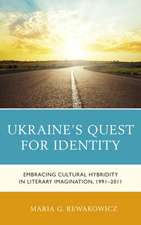 Ukraine's Quest for IdentityMaria G Rewakowicz-23%Preț: 695.64 lei903.42 lei
 -
 -37%Preț: 648.88 lei1022.70 lei
 -
 -34%Preț: 555.01 lei837.18 lei
 -
 -35%Preț: 483.39 lei742.88 lei
 -
 -25%Preț: 1496.50 lei2008.12 lei
 -
 Socrates and Divine RevelationLewis Lewis Fallis-19%Preț: 674.21 lei832.37 lei
 -
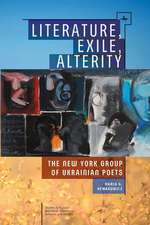 Literature, Exile, Alterity: The New York Group of Ukrainian PoetsMaria G. RewakowiczPreț: 171.97 lei
 -
 Understanding Cybersecurity: Emerging Governance and StrategyGary Schaub, Jr.-20%Preț: 308.49 lei386.84 lei
 -
 -52%Preț: 37.70 lei77.91 lei
 -
 Preț: 444.85 lei
De ce să citești această carte
Această monografie, premiată pentru rigoare științifică, este ideală pentru cercetătorii în științe sociale și studenții la litere. Cititorul câștigă o înțelegere nuanțată a decolonizării culturale ucrainene, dincolo de clișeele geopolitice. Este un instrument critic necesar pentru a decoda cum literatura poate deveni un spațiu de rezistență și de definire a unei noi identități naționale într-un context post-totalitar complex.
Descriere
Ukraine's Quest for Identity: Embracing Cultural Hybridity in Literary Imagination, 1991-2011 is the first study that looks at the literary process in post-independence Ukraine comprehensively and attempts to draw the connection between literary production and identity construction. In its quest for identity Ukraine has followed a path similar to other postcolonial societies, the main characteristics of which include a slow transition, hybridity, and identities negotiated on the center-periphery axis. This monograph concentrates on major works of literature produced during the first two decades of independence and places them against the background of clearly identifiable contexts such as regionalism, gender issues, language politics, social ills, and popular culture. It also shows that Ukrainian literary politics of that period privileges the plurality and hybridity of national and cultural identities. By engaging postcolonial discourse and insisting that literary production is socially instituted, Maria G. Rewakowicz explores the reasons behind the tendency toward cultural hybridity and plural identities in literary imagination. Ukraine's Quest for Identity will appeal to all those keen to study cultural, social and political ramifications of the collapse of the Soviet empire in Eastern Europe and beyond.
Cuprins
Chapter 2: Cultural Geographies: Regionalism and Territorial Identities in Literature
Chapter 3: Gender Matters: Women's Literary Discourse
Chapter 4: Language Choice and Language as Protagonist
Chapter 5: Ways of Social Marginalization in Post-Independence Fiction: Ideology, Disease, and Crime
Chapter 6: Popular Literature and National Identity Construction
Conclusion: Toward a New National Literature
Epilogue: Literature in a Time of War
Recenzii
This is Rewakowicz's third scholarly book and in it she examines several aspects of post-communist Ukrainian prose and poetry and individual and national self-formation. Rewakowicz (Rutgers Univ.; Univ. of Washington) proposes that multi-thematic, multiform literary creations reflect the sociopolitical and cultural growing pains that accompanied the two decades in which Ukraine shed its enslaving Russian communist rule. The postcolonial themes and attitudes of literary work reflect the deeply rooted inferiority complex engendered by the years of despicable references to non-native Russian speakers of occupied nations. Rewakowicz points out that the secondary role of native tongue is difficult to overcome, even when legalized as national language. The author analyzes several works, looking at national and political Ukrainian allegiance in the authors' use of surzhyk patois; popular literature assumes the role of a signpost, directing readers' attention to the shaping of national cultural and linguistic identity. Offering postmodern feminist and post-imperialist perspectives, this is fine scholarship.
Summing Up: Highly recommended. Graduate students, researchers, faculty.
Ukraine's Quest for Identityis a very valuable contribution to the study of contemporary Ukrainian literature. Its wide scope allows it to expand upon important topics on the subject that have been introduced in the past and to bring up issues that evolve as Ukraine approaches it its third decade of independence. . . [Rewakowicz's] well-researched and engagingly organized monograph will be a very helpful tool for the growing number of people who study contemporary Ukraine and sense the importance that its literature holds in understanding the country's complex identity today.
This is an ambitious and insightful work. It synthesizes much recent critical literature and provides an analysis of post-independence Ukrainian writing. By focusing on the concepts of hybridity and pluralism, Maria G. Rewakowicz demonstrates the different ways in which national identity is currently imagined-through local geography, women's writings, Russian-language Ukrainian prose, and popular literature depicting national traumas, such as the Second World War and Chornobyl. What emerges is an account of the fascinating process by which cultural memory is constructed and an inclusive identity created. This study is an excellent introduction to contemporary Ukrainian writing and the prominent discourses that underpin it.
In Ukraine's Quest for Identity: Embracing Cultural Hybridity in Literary Imagination, 1991-2011, Maria G. Rewakowicz surveys and analyzes two decades of Ukrainian writing on identity issues. Using postcolonial arguments and culturological tools developed by Pierre Bourdieu, she examines the 'space of possibles,' the cultural context from which post-independence Ukrainian literature arises. She discovers an intriguing and complex field where identities are actively explored, asserted, tested, molded, and, most importantly, compared, combined, and reconciled with one another. The range of issues involved in these explorations of identity include national identity, language, history, gender, religion, class, geography, age, crime, drugs, sex, and violence. Rewakowicz skillfully navigates the social and cultural currents of the contemporary Ukrainian literary landscape to uncover their characteristic multiplicity, fluidity, and hybridity.
Maria G. Rewakowicz has written the first comprehensive study of the development of Ukrainian literature since the Soviet collapse. Rewakowicz interprets major Ukrainian literary texts as construction sites for ethnic, regional, linguistic, and gender representations and concludes that the key feature of the post-communist Ukrainian literary scene-cultural hybridity-reflects the uncertainty of the nation's warped post-Soviet transition.
Maria G. Rewakowicz provides here an insightful, critical survey of literature and writing about literature in Ukraine in the first two decades since independence. She chronicles the painful processes of cultural decolonization and the spaces opened for cultural hybridity and bilingualism as key components of an emergent civic identity and plural literary canons, including popular literature (detective novels). She also highlights the importance of women as writers, critics, and fictional character, language choice (Ukrainian vs. Russian), the role of place (region and city), history, and trauma in this comprehensive snapshot of Ukrainian culture in this momentous period in the country's history.