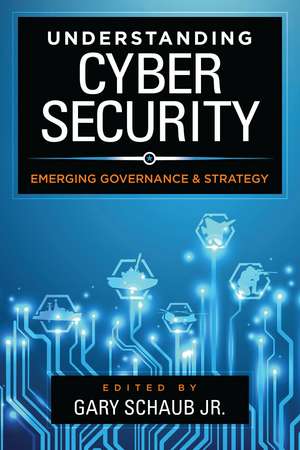
Understanding Cybersecurity: Emerging Governance and Strategy
Editat de Gary Schaub, Jr.en Limba Engleză Paperback – 29 ian 2018
Gary Schaub is also the co-editor of "Private Military and Security Contractors" (2016).
Preț: 324.30 lei
Preț vechi: 399.47 lei
-19%
Puncte Express: 486
Carte tipărită la comandă
Livrare economică 18 noiembrie-02 decembrie
Livrare prin curier în România Termenul estimat este afișat lângă disponibilitate.
Transport gratuit de la 400.00 lei Plată online sau ramburs, în funcție de opțiunile comenzii.
Retur gratuit în 14 zile Comandă securizată și suport în română.
Specificații
ISBN-13: 9781786606808
ISBN-10: 1786606801
Pagini: 224
Ilustrații: 2 tables; 2 charts
Dimensiuni: 149 x 232 x 23 mm
Greutate: 0.46 kg
Editura: Bloomsbury Publishing
Colecția Rowman & Littlefield
Locul publicării:New York, United States
ISBN-10: 1786606801
Pagini: 224
Ilustrații: 2 tables; 2 charts
Dimensiuni: 149 x 232 x 23 mm
Greutate: 0.46 kg
Editura: Bloomsbury Publishing
Colecția Rowman & Littlefield
Locul publicării:New York, United States
Cuprins
Preface, W. Michael Guillot / The Future of Things Cyber, Michael V. Hayden / 1. Internet Governance and National Security, Panayotis A. Yannakogeorgos / 2. Managing Decentralized Cyber Governance, Mark Raymond / 3. Tragedy of the Cyber Commons? Roger Hurwitz and Gary Schaub Jr. / 4. Rise of a Cybered Westphalian Age 2.0, Chris C. Demchak and Peter Dombrowski / 5. Blown to Bits: China's War in Cyberspace, August-September 2025, Christopher Bronk / 6. Nuclear Lessons for Cybersecurity? Joseph S. Nye Jr. / 7. Escalation Dynamics and Conflict Termination in Cyberspace, Herbert Lyn Jr. / 8. Specter of Non-Obvious Warfare, Martin C. Libicki / 9. Act and Actor Attribution in Cyberspace, Eric F. Mejia / 10. Strengthening Private-Public Partnerships in National Cybersecurity, James P. Farwell / Bibliography / Notes on the Contributors / Index
Recenzii
Does the US mature cyber as a strategic capability and become a world class player in this domain or cede the field to opponents and perpetually react to their actions? Gaining cyber dominance will be a long and arduous journey. The substantial gap between capability and policy will impede our rate of progress. A first step to narrow this critical gap and accelerate our journey is to read this volume, internalize the key challenges and broaden the debate across the policy, legal, privacy, information technology, military and intelligence sectors.
Recommended: A compilation of updated articles sourced from the US Air Force journal Strategic Studies Quarterly, this volume looks at cyberspace from a governmental and military standpoint, focusing on defense planning and strategy. Schaub (Univ. of Copenhagen) has edited a cohesive monograph on the topic, and contributors include an authoritative combination of academics and industry experts. While officially divided into two complementary sections, governance and operations, Understanding Cybersecurity seamlessly delves first into the philosophical issues of governing a realm "bound only by the limits of human innovation" (p. 3), then looks at the logistical issues of governance, and finally discusses defense and operational strategy. With cyberspace now considered the "fifth domain" of security operations by the US Department of Defense, it stands to reason that the largest portion of this monograph presents a militaristic view of managing cyber conflict and planning for cyber warfare. While many current works approach cybersecurity from an information technology perspective, this work provides a needed academic primer on the philosophy and logistics behind how governmental agencies are creating policy in regards to cybersecurity and securing infrastructures against cyber threats.
This compact volume includes some of the best scholarship in the field, providing a deeper understanding of the dynamics of cyberspace and cyberwar. The research and analysis here are essential reading to understand the important cybersecurity challenges facing the United States and the international community today.
Long acknowledged as the fifth domain of military operations, cyberspace remains the least understood - a "place" where daily skirmishes involve nation-states, private corporations, and individuals on territory lacking the boundaries, rules, and doctrine that delimit the counterpart domains of air, space, land, and sea. The hard and necessary work of maturing cyber doctrine and practice will be built upon the careful scholarship such as that found in this volume - a must read for any who will operate in cyberspace, and all who will depend on their success.
Schaub (Univ. of Copenhagen) has edited a cohesive monograph on the topic, and contributors include an authoritative combination of academics and industry experts.
this work provides a needed academic primer on the philosophy and logistics behind how governmental agencies are creating policy in regards to cybersecurity and securing infrastructures against cyber threats.
Summing Up: Recommended. Advanced undergraduates through faculty and professionals.
Readership Level: Upper-division Undergraduates, Graduate Students, Researchers/Faculty, Professionals/Practitioners
Recommended: A compilation of updated articles sourced from the US Air Force journal Strategic Studies Quarterly, this volume looks at cyberspace from a governmental and military standpoint, focusing on defense planning and strategy. Schaub (Univ. of Copenhagen) has edited a cohesive monograph on the topic, and contributors include an authoritative combination of academics and industry experts. While officially divided into two complementary sections, governance and operations, Understanding Cybersecurity seamlessly delves first into the philosophical issues of governing a realm "bound only by the limits of human innovation" (p. 3), then looks at the logistical issues of governance, and finally discusses defense and operational strategy. With cyberspace now considered the "fifth domain" of security operations by the US Department of Defense, it stands to reason that the largest portion of this monograph presents a militaristic view of managing cyber conflict and planning for cyber warfare. While many current works approach cybersecurity from an information technology perspective, this work provides a needed academic primer on the philosophy and logistics behind how governmental agencies are creating policy in regards to cybersecurity and securing infrastructures against cyber threats.
This compact volume includes some of the best scholarship in the field, providing a deeper understanding of the dynamics of cyberspace and cyberwar. The research and analysis here are essential reading to understand the important cybersecurity challenges facing the United States and the international community today.
Long acknowledged as the fifth domain of military operations, cyberspace remains the least understood - a "place" where daily skirmishes involve nation-states, private corporations, and individuals on territory lacking the boundaries, rules, and doctrine that delimit the counterpart domains of air, space, land, and sea. The hard and necessary work of maturing cyber doctrine and practice will be built upon the careful scholarship such as that found in this volume - a must read for any who will operate in cyberspace, and all who will depend on their success.
Schaub (Univ. of Copenhagen) has edited a cohesive monograph on the topic, and contributors include an authoritative combination of academics and industry experts.
this work provides a needed academic primer on the philosophy and logistics behind how governmental agencies are creating policy in regards to cybersecurity and securing infrastructures against cyber threats.
Summing Up: Recommended. Advanced undergraduates through faculty and professionals.
Readership Level: Upper-division Undergraduates, Graduate Students, Researchers/Faculty, Professionals/Practitioners