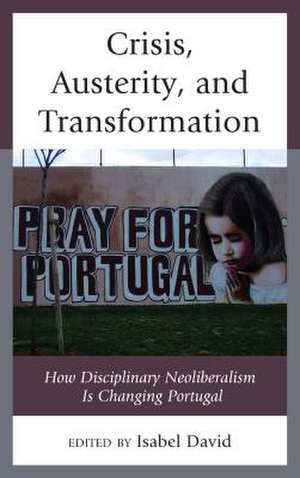
Crisis, Austerity, and Transformation: How Disciplinary Neoliberalism Is Changing Portugal
Editat de Isabel David Contribuţii de Giovanni Allegretti, Ricardo Campos, Carla Guapo Costa, Mafalda Esteves, Marcos Farias Ferreira, Maria João Ferreira, Dora Fonseca, Pedro Fonseca, Luís Filipe Gonçalves Mendes, Jordi Nofre, Inês Pereira, José Alberto Simões, João Terrenasen Limba Engleză Hardback – 22 ian 2018
Portugal has been portrayed as the Troika's good pupil by obediently adopting all prescribed austerity measures. In the process, the nation's fragile social fabric has been destroyed. Massive emigration, particularly by young people, massive increases in poverty and a foundering economy have triggered a collective framing of the crisis and austerity as unjust and punitive of a collectivity that, at the beginning, naively believed in the neoliberal narrative of the benign effects of the cuts. This reframing unleashed an unprecedented wave of social and political mobilization in an otherwise traditionally apathetic society. This resistance needs to be addressed as a direct effect of austerity policies and properly analyzed for what it really represents: a process of repoliticization and re-democratization sweeping Europe. These mobilizations include direct democracy experiments, the growing influence of social movements (the massive March 2011 demonstrations were a direct inspiration for the creation of the Indignado movement in Spain, attesting the contagion effect), solidarity economy and the major political change in the country's 42 years of democratic rule: an alliance of the left parties, unthinkable before the crisis, and which is reframing relations with the European Union.
This volume offers a first approach to the massive political, social and cultural transformations taking place in the country that make Portugal, in certain aspects, a lab for innovative practices (e.g. participatory budgets and the alliance of the left parties) that may be used elsewhere as alternatives to current understandings of economic and political orthodoxy
Preț: 555.01 lei
Preț vechi: 837.18 lei
-34%
Puncte Express: 833
Carte tipărită la comandă
Livrare economică 08-22 iunie
Specificații
ISBN-13: 9781498543873
ISBN-10: 1498543871
Pagini: 238
Ilustrații: 12 b/w illustrations; 4 tables;
Dimensiuni: 158 x 239 x 23 mm
Greutate: 0.5 kg
Editura: Bloomsbury Publishing
Colecția Lexington Books
Locul publicării:New York, United States
ISBN-10: 1498543871
Pagini: 238
Ilustrații: 12 b/w illustrations; 4 tables;
Dimensiuni: 158 x 239 x 23 mm
Greutate: 0.5 kg
Editura: Bloomsbury Publishing
Colecția Lexington Books
Locul publicării:New York, United States
Cuprins
Part I: The Impact of the Crisis
Chapter 1: Portugese Economy: How (Not) to Get Away with Financial Crisis and Economic Adjustment Programs, by Carla Guapo Costa
Chapter 2: Tourism Gentrification in Lisbon: The Panacea of Touristification as a Scenario of Post-Capitalist Crisis, by Luís Filipe Gonçalves Mendes
Part II: Resisting the Crisis
Chapter 3: The Anti-Austerity Protest Cycle in Portugal: The Ambiguous Relations between Social Movements and Left-Wing Political Parties, by Dora Fonseca
Chapter 4: Digital Activism, Political Participation and Social Movements in Times of Crisis, by José Alberto Simões, Ricardo Campos, Inês Pereira, Mafalda Esteves and Jordi Nofre
Chapter 5: The People's Assemble of Algés: Heterotopia and Radical Democracy in Crisis-Stricken Portugal, by Marcos Farias Ferreira and João Terrenas
Chapter 6: The Crisis on the Wall: Political Muralism and Street Art in Lisbon, by Ricardo Campos
Part III: Beyond Crisis and Stereotyping: A Laboratory for Innovative Practices
Chapter 7:
Chapter 1: Portugese Economy: How (Not) to Get Away with Financial Crisis and Economic Adjustment Programs, by Carla Guapo Costa
Chapter 2: Tourism Gentrification in Lisbon: The Panacea of Touristification as a Scenario of Post-Capitalist Crisis, by Luís Filipe Gonçalves Mendes
Part II: Resisting the Crisis
Chapter 3: The Anti-Austerity Protest Cycle in Portugal: The Ambiguous Relations between Social Movements and Left-Wing Political Parties, by Dora Fonseca
Chapter 4: Digital Activism, Political Participation and Social Movements in Times of Crisis, by José Alberto Simões, Ricardo Campos, Inês Pereira, Mafalda Esteves and Jordi Nofre
Chapter 5: The People's Assemble of Algés: Heterotopia and Radical Democracy in Crisis-Stricken Portugal, by Marcos Farias Ferreira and João Terrenas
Chapter 6: The Crisis on the Wall: Political Muralism and Street Art in Lisbon, by Ricardo Campos
Part III: Beyond Crisis and Stereotyping: A Laboratory for Innovative Practices
Chapter 7:
Recenzii
This volume enhances our knowledge about Southern Europe during the eurozone crisis by highlighting the lesser-studied case of Portugal. With a strong focus on popular resistance to austerity, this interesting collection of case studies ranges across topics including social media activism, political graffiti, popular assemblies and the formation of the unprecedented government of the left in 2015. It is recommended reading for those seeking further understanding of the consequences of crisis for the bailout countries and particularly the societal response to neoliberal recipes.
This volume examines the effects of disciplinary neoliberalism in Portugal in the context of the Troika bailout, and explores its impact in the political, economic and social fields. It shows the impoverishment produced as a result of austerity and the acceleration of gentrification processes. At the same time, it illustrates the resilience of Portuguese society through social movement activism and participatory democracy experiments, which challenges the widespread idea that the Portuguese were compliant with austerity. It fills an important vacuum in the literature and it should be of relevance to anyone interested in the consequences of austerity policies.
The essays in this book provide a compelling set of accounts of the effects of the Troika loan program on Portuguese economic performance and on political and social life more generally, in what was experienced as a 'one size fits all', market-conforming model of adjustment. Written by a team of authors who know the country intimately and who are totally in control of their material, the diverse chapters make a valuable contribution to our understanding of how Portugal fared during the crisis, and offer informed insight into what the longer-term legacies might be as the country struggles to recover.
The book is a most welcome addition to the sociology and politics of European neoliberalism. Appropriately entrenched in and bringing into dialogue multiple research traditions, this is a strong example of how fruitful it can be to contextualize crisis and resistance spatially, temporally as well as across disciplines.
This volume examines the effects of disciplinary neoliberalism in Portugal in the context of the Troika bailout, and explores its impact in the political, economic and social fields. It shows the impoverishment produced as a result of austerity and the acceleration of gentrification processes. At the same time, it illustrates the resilience of Portuguese society through social movement activism and participatory democracy experiments, which challenges the widespread idea that the Portuguese were compliant with austerity. It fills an important vacuum in the literature and it should be of relevance to anyone interested in the consequences of austerity policies.
The essays in this book provide a compelling set of accounts of the effects of the Troika loan program on Portuguese economic performance and on political and social life more generally, in what was experienced as a 'one size fits all', market-conforming model of adjustment. Written by a team of authors who know the country intimately and who are totally in control of their material, the diverse chapters make a valuable contribution to our understanding of how Portugal fared during the crisis, and offer informed insight into what the longer-term legacies might be as the country struggles to recover.
The book is a most welcome addition to the sociology and politics of European neoliberalism. Appropriately entrenched in and bringing into dialogue multiple research traditions, this is a strong example of how fruitful it can be to contextualize crisis and resistance spatially, temporally as well as across disciplines.