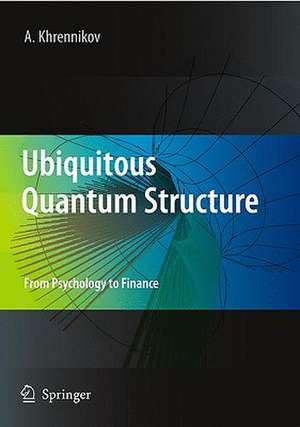
Ubiquitous Quantum Structure
Autor Andrei Y. Khrennikoven Limba Engleză Hardback – 12 feb 2010
This book is not about quantum mechanics as a physical theory. The short review of quantum postulates is therefore mainly of historical value: quantum mechanics is just the first example of the successful application of non-Kolmogorov probabilities, the first step towards a contextual probabilistic description of natural, biological, psychological, social, economical or financial phenomena. A general contextual probabilistic model (Växjö model) is presented. It can be used for describing probabilities in both quantum and classical (statistical) mechanics as well as in the above mentioned phenomena. This model can be represented in a quantum-like way, namely, in complex and more general Hilbert spaces. In this way quantum probability is totally demystified: Born's representation of quantum probabilities by complex probability amplitudes, wave functions, is simply a special representation of this type.
Preț: 667.68 lei
Preț vechi: 785.50 lei
-15%
Puncte Express: 1002
Carte tipărită la comandă
Livrare economică 22 decembrie 26 - 05 ianuarie 27
Livrare prin curier în România Termenul estimat este afișat lângă disponibilitate.
Transport gratuit pentru acest produs Plată online sau ramburs, în funcție de opțiunile comenzii.
Retur gratuit în 14 zile Comandă securizată și suport în română.
Specificații
ISBN-13: 9783642051005
ISBN-10: 3642051006
Pagini: 232
Ilustrații: XIII, 216 p.
Dimensiuni: 160 x 241 x 18 mm
Greutate: 0.51 kg
Ediția:2009
Editura: Springer
Locul publicării:Berlin, Heidelberg, Germany
ISBN-10: 3642051006
Pagini: 232
Ilustrații: XIII, 216 p.
Dimensiuni: 160 x 241 x 18 mm
Greutate: 0.51 kg
Ediția:2009
Editura: Springer
Locul publicării:Berlin, Heidelberg, Germany
V-ar putea interesa
-
 Operator Methods in Quantum MechanicsO.L. de Lange-33%Preț: 637.96 lei945.82 lei
-
 -18%Preț: 557.66 lei683.68 lei
-
 Mathematical Theory of Quantum FieldsHuzihiro Araki-22%Preț: 476.99 lei607.91 lei
-
 -27%Preț: 540.88 lei737.74 lei
-
 The Mathematical Language of Quantum TheoryTeiko Heinosaari-14%Preț: 725.36 lei843.44 lei
-
 Coming of Age With Quantum InformationChristopher A FuchsPreț: 521.71 lei
-
 Quantum Processes Systems, and InformationBenjamin Schumacher-8%Preț: 560.37 lei609.10 lei
-
 Hamiltonian Mechanics of Gauge SystemsLev V. Prokhorov-14%Preț: 961.59 lei1118.13 lei
-
 Quantum Information, Computation and CommunicationJonathan A. Jones-11%Preț: 491.22 lei551.94 lei
-
 Exploring Quantum Physics Through Hands-On ProjectsDavid Prutchi-8%Preț: 490.59 lei533.24 lei
-
 Schrödinger's Killer App: Race to Build the World's First Quantum ComputerJonathan P. DowlingPreț: 432.83 lei
-
 -18%Preț: 794.78 lei969.24 lei
-
 DecoherenceMaximilian A. Schlosshauer-15%Preț: 677.28 lei796.80 lei
Public țintă
ResearchCuprins
Quantum-like Paradigm.- Classical (Kolmogorovian) and Quantum (Born) Probability.- Contextual Probabilistic Model #x2013; V#x00E4;xj#x00F6; Model.- Quantum-like Representation Algorithm #x002D; QLRA.- The Quantum-like Brain.- Experimental Tests of Quantum-like Behavior of the Mind.- Quantum-like Decision Making and Disjunction Effect.- Macroscopic Games and Quantum Logic.- Contextual Approach to Quantum-like Macroscopic Games.- Psycho-financial Model.- The Problem of Smoothness of Bohmian Trajectories.
Notă biografică
Andrei Khrennikov was born in 1958 in Volgorad and spent his childhood in town Bratsk, in Siberia, north from the lake Baikal. In the period 1975-1980 he studied at Moscow State University, department of Mechanics and Mathematics and then in 1983 obtained his PhD in mathematical physics. Since 1997 he has been professor at Linnaueus University, Sweden, and, since 2002, the director of the multidisciplinary research center, International Center for Mathematical Modeling in Physics, Engineering, Economics, and Cognitive Science. The research interests of Prof Khrennikov are also characterized by multi-disciplinarity, and include, among others foundations of quantum physics and quantum information, foundations of probability, cognitive modeling, ultrametric (non-Archimedean) mathematics, dynamical systems, quantum-like models in psychology, economics and finances, social and political sciences. He is the author of about 400 papers and 20 monographs. Andrei Khrennikov is theorganizer of the internationally well-known series of annual conferences (held in Växjö since 2000) on the foundations of quantum physics, information, and probability.
Textul de pe ultima copertă
Quantum-like structure is present practically everywhere. Quantum-like (QL) models, i.e. models based on the mathematical formalism of quantum mechanics and its generalizations can be successfully applied to cognitive science, psychology, genetics, economics, finances, and game theory.
This book is not about quantum mechanics as a physical theory. The short review of quantum postulates is therefore mainly of historical value: quantum mechanics is just the first example of the successful application of non-Kolmogorov probabilities, the first step towards a contextual probabilistic description of natural, biological, psychological, social, economical or financial phenomena. A general contextual probabilistic model (Växjö model) is presented. It can be used for describing probabilities in both quantum and classical (statistical) mechanics as well as in the above mentioned phenomena. This model can be represented in a quantum-like way, namely, in complex and more general Hilbert spaces. In this way quantum probability is totally demystified: Born's representation of quantum probabilities by complex probability amplitudes, wave functions, is simply a special representation of this type.
This book is not about quantum mechanics as a physical theory. The short review of quantum postulates is therefore mainly of historical value: quantum mechanics is just the first example of the successful application of non-Kolmogorov probabilities, the first step towards a contextual probabilistic description of natural, biological, psychological, social, economical or financial phenomena. A general contextual probabilistic model (Växjö model) is presented. It can be used for describing probabilities in both quantum and classical (statistical) mechanics as well as in the above mentioned phenomena. This model can be represented in a quantum-like way, namely, in complex and more general Hilbert spaces. In this way quantum probability is totally demystified: Born's representation of quantum probabilities by complex probability amplitudes, wave functions, is simply a special representation of this type.
Caracteristici
Expounds a new "quantum-inspired" approach to mathematical modeling Draws attention to structural similarities in diverse fields Rich source of ideas for further study Includes supplementary material: sn.pub/extras