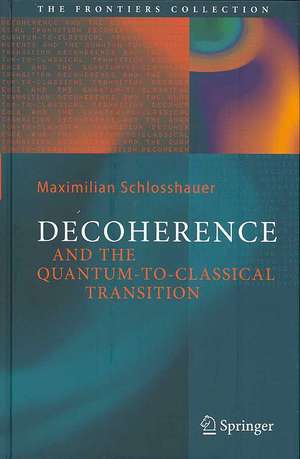
Decoherence
Autor Maximilian A. Schlosshaueren Limba Engleză Hardback – 30 iul 2007
În cercetarea fizicii contemporane, aplicabilitatea practică a decoerenței a depășit granițele teoretice, devenind un element central în dezvoltarea tehnologiilor de calcul cuantic și în nanoinginerie. În volumul Decoherence, Maximilian A. Schlosshauer propune o sinteză riguroasă a acestui fenomen, tratându-l nu doar ca pe un obstacol în calea procesării informației, ci ca pe o punte fundamentală între substratul cuantic și realitatea macroscopică. Considerăm că această lucrare este esențială pentru cercetătorii care doresc să navigheze între interpretările filosofice ale mecanicii cuantice și rigoarea setărilor experimentale. Textul extinde cadrul propus de Decoherence and the Appearance of a Classical World in Quantum Theory de Erich Joos cu date noi din experimentele recente, oferind o perspectivă actualizată asupra modului în care interacțiunea cu mediul duce la localizarea macroscopică. Structura cărții este concepută pentru a asigura o progresie logică: începe cu formalismul de bază și ecuațiile master, trece prin modelele canonice de spini și oscilatori, și culminează cu analiza observațiilor experimentale directe. Un aspect distinctiv este capitolul dedicat decoerenței în sistemele biologice și creierul cuantic, subiecte adesea tratate superficial în alte manuale. Autorul reușește să mențină o balanță echilibrată între rigoarea matematică necesară unui text de nivel de cercetare și claritatea conceptuală, clarificând neînțelegerile comune privind interpretarea rezultatelor experimentale.
Preț: 677.28 lei
Preț vechi: 796.80 lei
-15%
Carte tipărită la comandă
Livrare economică 26 noiembrie-10 decembrie
Specificații
ISBN-10: 3540357734
Pagini: 436
Ilustrații: XV, 418 p.
Dimensiuni: 160 x 241 x 28 mm
Greutate: 0.77 kg
Ediția:2007
Editura: Springer
Locul publicării:Berlin, Heidelberg, Germany
V-ar putea interesa
-
 Quantum MechanicsLeonard Susskind-30%Preț: 65.63 lei93.77 lei
 -
 Quantum InformationStephen Barnett-10%Preț: 336.49 lei375.75 lei
 -
 The Theory of Open Quantum SystemsHeinz-Peter Breuer-27%Preț: 540.24 lei742.89 lei
 -
 -20%Preț: 539.02 lei671.84 lei
 -
 Physics in MindWerner LoewensteinPreț: 197.24 lei
 -
 An Introduction to Advanced Quantum PhysicsHans P. PaarPreț: 470.66 lei
 -
 Quantum Field Theory 2eF MandlPreț: 412.91 lei
 -
 Measuring the Quantum State of LightUlf Leonhardt-11%Preț: 407.06 lei457.38 lei
 -
 Introduction to Quantum Effects in GravityViatcheslav Mukhanov-14%Preț: 875.12 lei1017.58 lei
 -
 Computer Simulation in Chemical PhysicsM P Allen-15%Preț: 618.41 lei727.55 lei
 -
 Quantum Computation and Quantum InformationMichael A. Nielsen-8%Preț: 534.12 lei580.56 lei
 -
 Schrödinger's Killer App: Race to Build the World's First Quantum ComputerJonathan P. DowlingPreț: 425.92 lei
 -
 Statistical Structure of Quantum TheoryAlexander S. Holevo-18%Preț: 973.74 lei1187.49 lei
 -
 -18%Preț: 928.99 lei1132.92 lei
 -
 -15%Preț: 479.63 lei564.27 lei
 -
 PRINCIPLES OF QUANT COMPUTAT (V2)Benenti GiulianoPreț: 465.72 lei
 -
 PROB & SOL IN QUAN COMPUT & QUAN 3EDSteeb Willi-Hans-15%Preț: 570.01 lei670.60 lei
 -
 Black HolesSean Alan Hayward-15%Preț: 581.58 lei684.22 lei
Public țintă
ResearchDe ce să citești această carte
Recomandăm această carte fizicienilor și doctoranzilor care au nevoie de o înțelegere profundă a tranziției cuantic-clasic. Cititorul câștigă acces la un compendiu care îmbină teoria ecuațiilor master cu dovezi experimentale concrete (SQUID, molecule C60). Este un instrument indispensabil pentru cei care lucrează în informatică cuantică, oferind contextul fizic necesar pentru a înțelege și combate pierderea coerenței în sistemele complexe.
Despre autor
Maximilian A. Schlosshauer este un cercetător recunoscut la nivel internațional în domeniul fundamentelor mecanicii cuantice și al decoerenței. După studii universitare la Universitatea din Freiburg, Germania, și un masterat la Universitatea din Lund, Suedia, acesta și-a obținut doctoratul în fizică la University of Washington, Seattle, sub îndrumarea lui Arthur Fine. Cercetările sale postdoctorale s-au concentrat pe tranziția de la cuantic la clasic, domeniu în care a publicat numeroase lucrări de referință. Expertiza sa vastă, acumulată în centre de cercetare de prestigiu, se reflectă în abordarea multidisciplinară a volumului de față.
Descriere scurtă
Cuprins
Recenzii
"A thorough and readable representation of today's understanding of the topic ... An excellent overview of the various theoretical approaches to the physics that leads to decoherence. A particular strength is that it includes accounts of several experiments demonstrating the decoherence mechanism in detail ... An important resource for anyone interested in decoherence. It is very well written and it will contribute to further conceptual and theoretical development and to new experiments."
Review by Anton Zeilinger, published in Nature 451, 18 (2008)
"An excellent monograph about what the best current thoughts are on the link between quantum and classical physics. … rewarding reading for physicists who do not have the time or the mathematical preparation to delve into all the details. For such readers, the book includes interesting and accessible discussions of recent experiments … . a welcome contribution. The index is well organized to help readers find their way around. And the more than 500 up-to-date references are a bonus for the more interested, persistent reader." (Eugen Merzbacher, Physics Today, September, 2008)
"A very fine tour of the decoherence program in all its facets. ... Schlosshauer's book is highly recommended. ... [He] has written an excellent survey of a field that is of the greatest possible interest for the foundations of quantum physics." (N. P. Landsman, Studies in History and Philosophy of Modern Physics, Vol. 40, 2009)
Notă biografică
Textul de pe ultima copertă
Topics include:
• Foundational problems at the quantum–classical border;
• The role of the environment and entanglement;
• Environment-induced loss of coherence and superselection;
• Scattering-induced decoherence and spatial localization;
• Master equations;
• Decoherence models;
• Experimental realization of "Schrödinger kittens" and their decoherence;
• Quantum computing, quantum error correction, and decoherence-free subspaces;
• Implications of decoherence for interpretations of quantum mechanics and for the
"measurement problem";
• Decoherence in the brain.
Written in a lucid and concise style that is accessible to all readers with a basic knowledge of quantum mechanics, this stimulating book tells the "classical from quantum" story in a comprehensive and coherent manner that brings together the foundational, technical, and experimental aspects of decoherence. It will be an indispensable resource for newcomers and experts alike.
"Reads like a bestseller. An engaging and intuitive treatment of a very important subject, combining the scope of a monograph with the clarity of a textbook and the intellectual excitement of a Sherlock Holmes adventure."
Wojciech Zurek, Los Alamos
"Everyone who works in the borderlands between quantum and classical physics, from philosophers of physics to quantum-computer technologists, will find much here to stimulate andinspire."
Gerard Milburn, University of Queensland
"A thorough, readable, and very useful account of decoherence theory and its diverse applications. Valuable as a text and as a reference work, both for graduate students and for active researchers in the field."
Steve Adler, IAS, Princeton