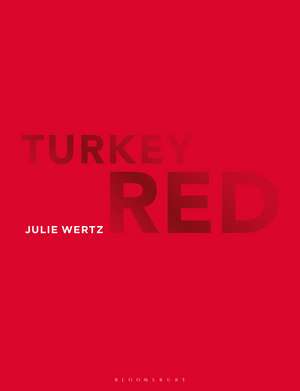
Turkey Red: Textiles that Changed the World
Autor Julie Wertzen Limba Engleză Paperback – 22 feb 2024
This multi-disciplinary study examines the exceptional Turkey red textile dyeing process and product. Prized for its brilliant colour and durability, yet notoriously difficult to produce, the textile was consumed locally and exported around the world. Considered one of the first instances of industrial espionage, the expansion of the Turkey red industry is closely linked to the Industrial Revolution and the emergence of a new global economy. Significant technological advances in chemistry and dyeing were motivated by the demands of Turkey red dyers and printers, who were located primarily in the west of Scotland, the north of England, and around Mulhouse, Switzerland.
This book explores the arc of the Turkey red industry, the evolution of the process through key producers and technical developments, the complicated printing process, and finishes with an examination of significant Turkey red collections and a selection of object case studies. The chemistry of the process is described in an accessible, contextual manner, highlighting the significance of the distinctive technique that yielded the best red attainable on cotton.
Drawing on both historical and contemporary study, Turkey Red presents significant new research on the material characterisation of this fascinating, eye-catching textile, and offers an in-depth historical example of the global effect of textile consumption.


Preț: 204.47 lei
Preț vechi: 248.74 lei
-18%
Puncte Express: 307
Carte disponibilă
Livrare economică 12-26 noiembrie
Livrare prin curier în România Termenul estimat este afișat lângă disponibilitate.
Transport gratuit de la 400.00 lei Plată online sau ramburs, în funcție de opțiunile comenzii.
Retur gratuit în 14 zile Comandă securizată și suport în română.
Specificații
ISBN-13: 9781350216501
ISBN-10: 135021650X
Pagini: 232
Ilustrații: 92 color illus
Dimensiuni: 188 x 244 x 14 mm
Greutate: 0.65 kg
Editura: Bloomsbury Publishing
Colecția Bloomsbury Visual Arts
Seria Textiles that Changed the World
Locul publicării:London, United Kingdom
ISBN-10: 135021650X
Pagini: 232
Ilustrații: 92 color illus
Dimensiuni: 188 x 244 x 14 mm
Greutate: 0.65 kg
Editura: Bloomsbury Publishing
Colecția Bloomsbury Visual Arts
Seria Textiles that Changed the World
Locul publicării:London, United Kingdom
V-ar putea interesa
-
 INDIGO PBDouglas LuhankoPreț: 124.13 lei
 -
 A Perfect RedAmy Butler GreenfieldPreț: 111.40 lei
 -
 Empire of CottonSven Beckert-26%Preț: 90.90 lei123.62 lei
 -
 Preț: 328.82 lei
 -
 Preț: 193.24 lei
 -
 World TextilesMary Schoeser-16%Preț: 94.43 lei111.83 lei
 -
 IndigoCatherine Legrand-8%Preț: 472.34 lei513.41 lei
 -
 Preț: 372.88 lei
 -
 The Travels of a T-Shirt in the Global EconomyPietra RivoliPreț: 130.70 lei
 -
 The Story of Colour in TextilesSusan Kay-Williams-24%Preț: 189.93 lei250.44 lei
 -
 A Revolution in Colour: Natural Dyes and Dress in Europe, c. 1400-1800Prof. Giorgio Riello-36%Preț: 562.56 lei879.16 lei
 -
 A Revolution in Colour: Natural Dyes and Dress in Europe, c. 1400-1800Prof. Giorgio Riello-24%Preț: 217.06 lei286.40 lei
 -
 -36%Preț: 551.83 lei864.11 lei
 -
 Plant Dyes: Make Your Own Natural Fabric and Yarn DyesCamille Binet-Dezert-17%Preț: 91.80 lei110.54 lei
 -
 The Fabric of Civilization: How Textiles Made the WorldVirginia Postrel-44%Preț: 89.07 lei157.94 lei
 -
 Wearable Prints, 1760-1860Greene-8%Preț: 602.29 lei654.66 lei
 -
 Sustainable Coloration Techniques in TextilesSaptarshi Maiti-18%Preț: 1158.76 lei1413.12 lei
 -
 Advancements in Textile ColorationMohammad Shahid-18%Preț: 1159.58 lei1414.13 lei
Cuprins
List of Figures
Preface
Acknowledgments
Note on the text
Introduction
1. The Most Brilliant Color Dyed on Cotton
1.1. Defining Turkey red
1.1.1. A reputable red
1.1.2. A complicated process
1.2. Identifying Turkey red
1.3. Material record
1.4. Conclusion
2. Global Exchanges and Anthraquinone Dyes
2.1. The origin and dissemination of Turkey red
2.1.1. India
2.1.2. Indonesia
2.1.3. The Levant and the Ottoman Empire
2.1.4. The Hapsburg Empire
2.1.5. France
2.1.6. Britain
2.2. Madder
2.2.1. The cultivation of madder
2.2.2. Madder composition and derivatives
2.3. Synthetic alizarin
2.3.1. Understanding alizarin
2.3.2. Alizarin synthesis and patent disputes
2.3.3. Synthetic alizarin products
2.4. Conclusion
3. The Dyeing, Chemistry, and Technological Advances of Turkey Red
3.1 Oiling
3.1.1Oiling in the old process
3.1.2The chemistry of oiled cotton
3.1.3Ruminant dung and tannins
3.1.4Turkey red oil and the new process
3.1.5The Steiner process
3.2 Aluminium
3.2.1Precipitated aluminium soaps
3.3 Dyeing
3.3.1Color complexes in Turkey red
3.3.2 Blood and albumen
3.4. Clearing
3.5. Conclusions
4. Printed Turkey Red
4.1. Textile printing methods
4.2. Discharge printing
1.1.3.Lead plate press discharging
1.1.4.Acid paste discharging
4.3. A bright palette
1.1.5.Black, blue, yellow, and green
1.1.6.Identifying colorants on Turkey red prints
4.4. Design
1.1.7.Industrial design and production
1.1.8.European design for the export market
4.5. Conclusions
5. Turkey Red in the Industrial Revolution
5.1. Turkey red industry by country
5.1.1.France
5.1.2. England
5.1.3. Scotland
5.1.4. Switzerland
5.1.5. The Netherlands
5.1.6. North America
5.1.7. Other locations
5.2. Working conditions and labor
5.3. Colonialism
5.4. Conclusions
6. Trade, Use, and Object Record
6.1. Documentary evidence of availability
6.2. How Turkey red was used
6.2.1. Bandanas
6.2.2. Domestic textiles, quilts and bedcovers
6.2.3. Accessories, garments, and tools
6.3.Conclusions
Conclusions
Glossary
References
Index
Preface
Acknowledgments
Note on the text
Introduction
1. The Most Brilliant Color Dyed on Cotton
1.1. Defining Turkey red
1.1.1. A reputable red
1.1.2. A complicated process
1.2. Identifying Turkey red
1.3. Material record
1.4. Conclusion
2. Global Exchanges and Anthraquinone Dyes
2.1. The origin and dissemination of Turkey red
2.1.1. India
2.1.2. Indonesia
2.1.3. The Levant and the Ottoman Empire
2.1.4. The Hapsburg Empire
2.1.5. France
2.1.6. Britain
2.2. Madder
2.2.1. The cultivation of madder
2.2.2. Madder composition and derivatives
2.3. Synthetic alizarin
2.3.1. Understanding alizarin
2.3.2. Alizarin synthesis and patent disputes
2.3.3. Synthetic alizarin products
2.4. Conclusion
3. The Dyeing, Chemistry, and Technological Advances of Turkey Red
3.1 Oiling
3.1.1Oiling in the old process
3.1.2The chemistry of oiled cotton
3.1.3Ruminant dung and tannins
3.1.4Turkey red oil and the new process
3.1.5The Steiner process
3.2 Aluminium
3.2.1Precipitated aluminium soaps
3.3 Dyeing
3.3.1Color complexes in Turkey red
3.3.2 Blood and albumen
3.4. Clearing
3.5. Conclusions
4. Printed Turkey Red
4.1. Textile printing methods
4.2. Discharge printing
1.1.3.Lead plate press discharging
1.1.4.Acid paste discharging
4.3. A bright palette
1.1.5.Black, blue, yellow, and green
1.1.6.Identifying colorants on Turkey red prints
4.4. Design
1.1.7.Industrial design and production
1.1.8.European design for the export market
4.5. Conclusions
5. Turkey Red in the Industrial Revolution
5.1. Turkey red industry by country
5.1.1.France
5.1.2. England
5.1.3. Scotland
5.1.4. Switzerland
5.1.5. The Netherlands
5.1.6. North America
5.1.7. Other locations
5.2. Working conditions and labor
5.3. Colonialism
5.4. Conclusions
6. Trade, Use, and Object Record
6.1. Documentary evidence of availability
6.2. How Turkey red was used
6.2.1. Bandanas
6.2.2. Domestic textiles, quilts and bedcovers
6.2.3. Accessories, garments, and tools
6.3.Conclusions
Conclusions
Glossary
References
Index
Recenzii
A glossary, a list of chemicals, a detailed list of the footnotes which frequent the text, and an extensive list of references complete this very well-written book, which should be of much interest to the serious practising natural dyer, as well as many other textile enthusiasts.
Wertz manages to wrangle the long history, broad geographies, scientific intricacies, and varied applications of Turkey red into a highly readable and easily understood text - a feat as awe-inspiring as the dyeing process that is the book's topic.
What a fantastic read! Mystery, time and magic have defined the process of creating bright red colours on cotton for centuries. Julie Wertz explains it very clearly in her beautifully illustrated book. A perfect read for both textile historians and modern-day enthusiasts of dyeing and colour.
Wertz's study goes beyond existing works on the subject and brings to a modern audience a clear and informative account of how and why this colour was so successful.
Wertz manages to wrangle the long history, broad geographies, scientific intricacies, and varied applications of Turkey red into a highly readable and easily understood text - a feat as awe-inspiring as the dyeing process that is the book's topic.
What a fantastic read! Mystery, time and magic have defined the process of creating bright red colours on cotton for centuries. Julie Wertz explains it very clearly in her beautifully illustrated book. A perfect read for both textile historians and modern-day enthusiasts of dyeing and colour.
Wertz's study goes beyond existing works on the subject and brings to a modern audience a clear and informative account of how and why this colour was so successful.
Caracteristici
Presents a historical example of the global textile industry in an era when the global impact of textile consumption was an increasingly pressing concern
Notă biografică
Julie Wertz is Beal Family Postgraduate Fellow in Conservation Science at Harvard Art Museums, USA.