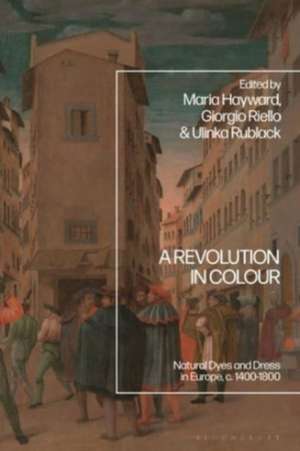
A Revolution in Colour: Natural Dyes and Dress in Europe, c. 1400-1800
Editat de Prof. Giorgio Riello, Dr Maria Hayward, Ulinka Rublacken Limba Engleză Hardback – 17 oct 2024
Contributors shed new light on the economic, environmental, and cultural dimensions of colour in dress. The range of dyes expanded considerably in the sixteenth and seventeenth centuries, drawing on Asian and Mediterranean knowledge, new collections of recipes, and the greater diversity of plants available through New World trade. Working creatively with organic plant, animal, and mineral materials to make colours involved considerable knowledge, pleasure and skill. The creation of colour through dyes thus reveals a whole range of global agricultural and craft technologies that can inspire future material worlds and transforms our understanding of Europe´s cultural heritage.
Preț: 562.56 lei
Preț vechi: 879.16 lei
-36%
Puncte Express: 844
Carte disponibilă
Livrare economică 06-20 noiembrie
Livrare express 22-28 octombrie pentru 195.08 lei
Livrare prin curier în România Termenul estimat este afișat lângă disponibilitate.
Transport gratuit pentru acest produs Plată online sau ramburs, în funcție de opțiunile comenzii.
Retur gratuit în 14 zile Comandă securizată și suport în română.
Specificații
ISBN-13: 9781350405622
ISBN-10: 1350405620
Pagini: 280
Ilustrații: 50 colour illus
Dimensiuni: 162 x 240 x 18 mm
Greutate: 0.62 kg
Editura: Bloomsbury Publishing
Colecția Bloomsbury Academic
Locul publicării:London, United Kingdom
ISBN-10: 1350405620
Pagini: 280
Ilustrații: 50 colour illus
Dimensiuni: 162 x 240 x 18 mm
Greutate: 0.62 kg
Editura: Bloomsbury Publishing
Colecția Bloomsbury Academic
Locul publicării:London, United Kingdom
Cuprins
List of Illustrations
Editors' Introduction
1. The Arrival of the Crimson Dyeing Technique in Italy in the Late Fourteenth Century Luca Molà (University of Warwick, UK)
2. The Woad We Have Lost? The Changing Supply Networks of Tuscan dye Businesses between the Local and the Global, 1450-1650 Stephanie Lietzel (Harvard University, USA)
3. Crimson Dyes and the Law in Renaissance Italy Lisa Monnas and Jo Kirby (both Independent Scholars, UK)
4. The Limits of Global Trade: Cochineal and Indigo in the Pre-modern Period Giorgio Riello (European University Institute, Italy)
5. A Dyeing Art: Reconstructing Rosetti's Plictho Sophie Pitman (Aalto University, Finland)
6. The Colourful Language of Dyeing Black Sven Dupré (University of Utrecht, The Netherlands) and Natalia Ortegasaez (Antwerp, The Netherlands)
7. Re-Colouring Renaissance Dress: Matthäus Schwarz of Augsburg Ulinka Rublack (Cambridge University, UK)
8. Creating colour in the Stuart Royal Wardrobes, 1566-1701 Maria Hayward (University of Southampton, UK)
9. Innovations and Imitations of Fashion: Colour and Novelty in Early Modern Italian Dress Paula Hohti Erichsen (Aalto University, Finland)
10. French Indigo Trade from Marseille to Levant Marguerite Martin (IDHES - Université Paris I Panthéon Sorbonne, France)
11. Dyes and Dyeing in the Business of Indienne in the Eighteenth Century Kim Siebenhüner (Historisches Institut, Jena, Germany)
12. Identifying Different Pathways to Historical Colour for Scientific Analysis Anita Quye (University of Glasgow, UK)
Conclusion: The Cost of Colour: Colonial Networks and Embodied Histories Beverly Lemire (University of Alberta, Canada)
Index
Editors' Introduction
1. The Arrival of the Crimson Dyeing Technique in Italy in the Late Fourteenth Century Luca Molà (University of Warwick, UK)
2. The Woad We Have Lost? The Changing Supply Networks of Tuscan dye Businesses between the Local and the Global, 1450-1650 Stephanie Lietzel (Harvard University, USA)
3. Crimson Dyes and the Law in Renaissance Italy Lisa Monnas and Jo Kirby (both Independent Scholars, UK)
4. The Limits of Global Trade: Cochineal and Indigo in the Pre-modern Period Giorgio Riello (European University Institute, Italy)
5. A Dyeing Art: Reconstructing Rosetti's Plictho Sophie Pitman (Aalto University, Finland)
6. The Colourful Language of Dyeing Black Sven Dupré (University of Utrecht, The Netherlands) and Natalia Ortegasaez (Antwerp, The Netherlands)
7. Re-Colouring Renaissance Dress: Matthäus Schwarz of Augsburg Ulinka Rublack (Cambridge University, UK)
8. Creating colour in the Stuart Royal Wardrobes, 1566-1701 Maria Hayward (University of Southampton, UK)
9. Innovations and Imitations of Fashion: Colour and Novelty in Early Modern Italian Dress Paula Hohti Erichsen (Aalto University, Finland)
10. French Indigo Trade from Marseille to Levant Marguerite Martin (IDHES - Université Paris I Panthéon Sorbonne, France)
11. Dyes and Dyeing in the Business of Indienne in the Eighteenth Century Kim Siebenhüner (Historisches Institut, Jena, Germany)
12. Identifying Different Pathways to Historical Colour for Scientific Analysis Anita Quye (University of Glasgow, UK)
Conclusion: The Cost of Colour: Colonial Networks and Embodied Histories Beverly Lemire (University of Alberta, Canada)
Index
Recenzii
A work with both poetic and practical applications, in its pages learn about the world of colour in textiles before industrialization.
Reversing the notion that the wealthy elites preferred to wear black, A Revolution in Colour explores the vibrant textile world of early-modern Europeans when people thought they saw color rather than light.
In these pages we feel the textile of early modern consumers, both elite and demotic, come alive through a dazzling array sources. Delight in the colours of the natural world was exceeded only by the technical and material accomplishments in bringing more and more dyes, colours and hues to more and more people.
Reversing the notion that the wealthy elites preferred to wear black, A Revolution in Colour explores the vibrant textile world of early-modern Europeans when people thought they saw color rather than light.
In these pages we feel the textile of early modern consumers, both elite and demotic, come alive through a dazzling array sources. Delight in the colours of the natural world was exceeded only by the technical and material accomplishments in bringing more and more dyes, colours and hues to more and more people.