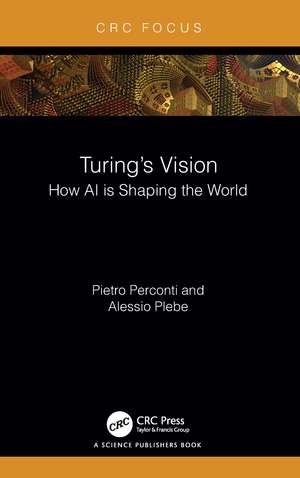
Turing's Vision: How AI is Shaping the World
Autor Pietro Perconti, Alessio Plebeen Limba Engleză Hardback – 3 iul 2025
The book is intended for scholars, researchers, and readers intrigued by the intersections across disciplines interested in understanding the philosophical, ethical, and social implications of Artificial Intelligence and its impact on human nature.
Preț: 439.79 lei
Preț vechi: 517.40 lei
-15%
Puncte Express: 660
Carte tipărită la comandă
Livrare economică 13-27 noiembrie
Livrare express 09-15 octombrie pentru 36.69 lei
Livrare prin curier în România Termenul estimat este afișat lângă disponibilitate.
Transport gratuit pentru acest produs Plată online sau ramburs, în funcție de opțiunile comenzii.
Retur gratuit în 14 zile Comandă securizată și suport în română.
Specificații
ISBN-13: 9781032561219
ISBN-10: 1032561211
Pagini: 158
Ilustrații: 24
Dimensiuni: 138 x 216 x 15 mm
Greutate: 0.45 kg
Ediția:1
Editura: CRC Press
Colecția CRC Press
ISBN-10: 1032561211
Pagini: 158
Ilustrații: 24
Dimensiuni: 138 x 216 x 15 mm
Greutate: 0.45 kg
Ediția:1
Editura: CRC Press
Colecția CRC Press
V-ar putea interesa
-
 How To Think About AI: A Guide For The PerplexedRichard Susskind-35%Preț: 64.50 lei99.18 lei
 -
 Imagining AI: How the World Sees Intelligent MachinesStephen J. Cave-34%Preț: 229.78 lei349.68 lei
 -
 Artificial IntelligenceMelanie Mitchell-35%Preț: 54.46 lei83.86 lei
 -
 Preț: 94.44 leiRecomandat
 -
 The Most Human HumanBrian Christian-19%Preț: 63.00 lei77.84 lei
 -
 The LineJames BoylePreț: 193.43 lei
 -
 Shared WisdomAlex PentlandPreț: 148.26 lei
 -
 Against the MachinePaul KingsnorthPreț: 189.93 lei
 -
 Artificial IntelligenceMichael Wooldridge-36%Preț: 47.47 lei74.43 lei
 -
 Preț: 269.99 lei
 -
 The Essential Book of AIAnne Rooney-20%Preț: 74.61 lei93.27 lei
 -
 -42%Preț: 56.60 lei97.70 lei
 -
 Preț: 137.81 lei
 -
 -28%Preț: 50.75 lei70.25 lei
 -
 The Last Book Written by a Human: Becoming Wise in the Age of AIJeff BurninghamPreț: 145.00 lei
 -
 Introducing Artificial IntelligenceHenry Brighton-20%Preț: 54.25 lei67.81 lei
 -
 NavigatingBrian Clegg-20%Preț: 80.65 lei100.82 lei
 -
 Empire of AIKaren HaoPreț: 143.18 lei
Public țintă
General, Postgraduate, and Professional ReferenceCuprins
Preface. The Idea Itself. New Landscape: Deep Learning and Other Breakthroughs. Playing with the Essence of Thought: Language Models. Do Machines Really Understand? Accountability in an Artificial World. Artificial Consciousness. Beyond Humanity: The Case for Robo-Ethics. References. Index.
Notă biografică
Pietro Perconti is Professor of Philosophy of Mind at the University of Messina. He co-founded the ICCS, International Center for Consciousness Studies (hardproblem.it). His previous books include Kantian Linguistics (Nodus, 1999) and The Future of the Artificial Mind (with Alessio Plebe, CRC, 2022). His research interests include social cognition, consciousness, and the social role of cognitive science.
Alessio Plebe received a degree in Electronic Engineering in 1981 from the University of Rome and a PhD in Philosophy of Language from the University of Palermo in 2004. He is Professor of Philosophy of Science at the University of Messina. He co-founded the ICCS, International Center for Consciousness Studies. His main research areas are neural computation, its epistemology, and its explanatory power for several cognitive functions. Currently, he is investigating the rise of deep learning, its causes and its impact on philosophy and cognitive science. An updated picture of what artificial intelligence is becoming nowadays is in his recent book, authored with Pietro Perconti, The Future of the Artificial Mind.
Alessio Plebe received a degree in Electronic Engineering in 1981 from the University of Rome and a PhD in Philosophy of Language from the University of Palermo in 2004. He is Professor of Philosophy of Science at the University of Messina. He co-founded the ICCS, International Center for Consciousness Studies. His main research areas are neural computation, its epistemology, and its explanatory power for several cognitive functions. Currently, he is investigating the rise of deep learning, its causes and its impact on philosophy and cognitive science. An updated picture of what artificial intelligence is becoming nowadays is in his recent book, authored with Pietro Perconti, The Future of the Artificial Mind.
Descriere
The book argues that Turing's “vision” is reshaping the world. This vision rests on the idea that intelligence is not an intrinsic property of human beings but an attribute we are naturally inclined to ascribe to certain entities when their behavior elicits this deeply rooted attitude which is tied to the interpretative practice of language.