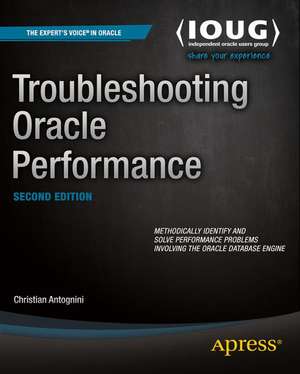
Troubleshooting Oracle Performance
Autor Christian Antogninien Limba Engleză Paperback – 2 iun 2014
What do you do when your database application isn’t running fast enough? You troubleshoot, of course. Finding the slow part of an application is often the easy part of the battle. It’s finding a solution that’s difficult. Troubleshooting Oracle Performance, 2nd Edition helps by providing a systematic approach to addressing the underlying causes of poor database application performance. The author freely shares his experience while explaining the underlying foundations of how SQL statements are executed by the Oracle database engine. You'll be able to draw a solid foundation of theory and shared experience as you face head-on the performance challenges in your daily work.
- Written for developers by an application developer who has learned by doing
- Gives a systematic approach to solving database application performance problems
- Helps you plan for performance as you would for any other application requirement
Preț: 624.62 lei
Preț vechi: 780.77 lei
-20%
Puncte Express: 937
Carte tipărită la comandă
Livrare economică 07-21 decembrie
Livrare prin curier în România Termenul estimat este afișat lângă disponibilitate.
Transport gratuit pentru acest produs Plată online sau ramburs, în funcție de opțiunile comenzii.
Retur gratuit în 14 zile Comandă securizată și suport în română.
Specificații
ISBN-13: 9781430257585
ISBN-10: 143025758X
Pagini: 740
Ilustrații: XXIX, 740 p. 155 illus.
Dimensiuni: 191 x 235 x 39 mm
Greutate: 1.36 kg
Ediția:2nd edition
Editura: Apress
Locul publicării:Berkeley, CA, United States
ISBN-10: 143025758X
Pagini: 740
Ilustrații: XXIX, 740 p. 155 illus.
Dimensiuni: 191 x 235 x 39 mm
Greutate: 1.36 kg
Ediția:2nd edition
Editura: Apress
Locul publicării:Berkeley, CA, United States
V-ar putea interesa
-
 Language of SQL, TheLarry Rockoff-20%Preț: 141.44 lei176.80 lei
 -
 SQL Queries for Mere MortalsJohn Viescas-20%Preț: 334.07 lei417.58 lei
 -
 -20%Preț: 211.63 lei264.55 lei
 -
 Understanding Software DynamicsRichard Sites-20%Preț: 310.88 lei388.60 lei
 -
 Database and Application SecurityR Sarma Danturthi-20%Preț: 292.70 lei365.87 lei
 -
 MeditationsMarcus AureliusPreț: 34.00 lei
 -
 Database SystemsRamez Elmasri-20%Preț: 552.09 lei690.12 lei
 -
 Oracle 12cJoan Casteel-23%Preț: 683.13 lei886.92 lei
 -
 SQL Essentials for DummiesRichard Blum-20%Preț: 65.83 lei82.30 lei
 -
 -20%Preț: 312.33 lei390.41 lei
 -
 Learning SQL: Generate, Manipulate, and Retrieve DataAlan Beaulieu-20%Preț: 324.02 lei405.03 lei
 -
 Beginning Oracle Database 11g AdministrationIgnatius Fernandez-20%Preț: 284.06 lei355.08 lei
 -
 Troubleshooting Java, Second EditionLaurentiu Spilca-20%Preț: 337.14 lei421.42 lei
 -
 100 SQL Server Mistakes and How to Avoid ThemPeter Carter-20%Preț: 336.93 lei421.17 lei
 -
 Learn SQL in a Month of LunchesJeff Iannucci-20%Preț: 287.75 lei359.68 lei
 -
 Murachs Oracle SQL & PL / SQL for DevelopersJoel Murach-20%Preț: 304.42 lei380.52 lei
 -
 Oracle SQL and PL/SQL: (3rd Edition)Joel Murach-20%Preț: 309.10 lei386.38 lei
 -
 DBA Essentials for 21cDivit Gupta-20%Preț: 176.55 lei220.68 lei
Public țintă
Popular/generalNotă biografică
Since 1995, Christian Antognini has been focusing on understanding how the Oracle database engine works. His main interests range from logical and physical database design, to the integration of databases with Java applications, the query optimizer, and basically everything else related to performance management and tuning. He is working as a senior consultant and trainer at Trivadis AG in Z rich, Switzerland. If he is not helping one of his customers to get the most out of Oracle, he is somewhere lecturing on optimization or new Oracle database features for developers. He is member of the Trivadis Performance Team and of the OakTable Network).
Caracteristici
Troubleshooting Oracle Performance 2nd Edition provides a systematic approach to addressing the underlying causes of poor database application performance.
Cuprins
Part I.- Chapter 1: Performance Problems.- Chapter 2: Key Concepts.- Part II.- Chapter 3: Analysis of Reproducible Problems.- Chapter 4: Real-Time Analysis of Irreproducible Problems.- Chapter 5: Post-mortem Analysis of Irreproducible Problems.- Part III.- Chapter 6: Introducing the Query Optimizer.- Chapter 7: System Statistics.- Chapter 8: Object Statistics.- Chapter 9: Configuring the Query Optimizer.- Chapter 10: Execution Plans.- Part IV.- Chapter 11: SQL Optimization Techniques.- Chapter 12: Parsing.- Chapter 13: Optimizing Data Accesses.- Chapter 14: Optimizing Joins.- Chapter 15: Parallel Execution.- Chapter 16: Precomputing and Caching Data.- Chapter 17: Optimizing Network Round Trips.- Chapter 18: Optimizing the Physical Design.- Appendix A.