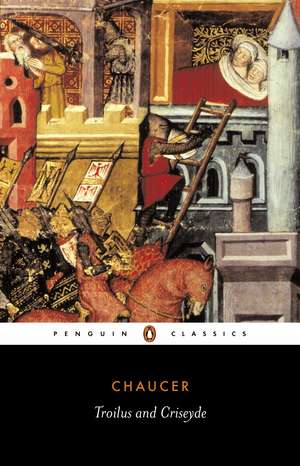
Troilus and Criseyde
Autor Geoffrey Chaucer Traducere de Nevill Coghillen Limba Engleză Paperback – 30 apr 1971
Preț: 92.05 lei
Puncte Express: 138
Carte disponibilă
Livrare economică 23 septembrie-07 octombrie
Livrare express 09-15 septembrie pentru 21.94 lei
Livrare prin curier în România Termenul estimat este afișat lângă disponibilitate.
Transport gratuit de la 400.00 lei Plată online sau ramburs, în funcție de opțiunile comenzii.
Retur gratuit în 14 zile Comandă securizată și suport în română.
Specificații
ISBN-13: 9780140442397
ISBN-10: 0140442391
Pagini: 368
Dimensiuni: 129 x 196 x 18 mm
Greutate: 0.26 kg
Editura: Penguin Publishing Group
Locul publicării:London, United Kingdom
ISBN-10: 0140442391
Pagini: 368
Dimensiuni: 129 x 196 x 18 mm
Greutate: 0.26 kg
Editura: Penguin Publishing Group
Locul publicării:London, United Kingdom
V-ar putea interesa
-
 InfernoDante AlighieriPreț: 28.01 lei
 -
 The Canterbury TalesGeoffrey ChaucerPreț: 52.04 lei
 -
 The Canterbury Tales: A retelling by Peter AckroydGeoffrey Chaucer-36%Preț: 59.64 lei92.63 lei
 -
 The Oxford ChaucerChristopher Cannon-5%Preț: 256.65 lei271.52 lei
 -
 PoeticsAristotle-20%Preț: 19.62 lei24.48 lei
 -
 Cyrano de BergeracEdmond RostandPreț: 47.77 lei
 -
 The PoemsWilliam ShakespearePreț: 55.19 lei
 -
 The Testament of Cresseid & Seven FablesRobert HenrysonPreț: 105.27 lei
 -
 A Double SorrowLavinia GreenlawPreț: 69.97 lei
 -
 Odyssey, Volume IHomerPreț: 213.97 lei
 -
 Preț: 230.19 lei
 -
 IliadHomerPreț: 231.20 lei
 -
 -8%Preț: 441.34 lei479.71 lei
 -
 Troilus and CressidaWilliam ShakespearePreț: 39.47 lei
 -
 The Iliad of HomerHomerPreț: 74.33 lei
 -
 Troilus and Criseyde in Modern VerseGeoffrey Chaucer-17%Preț: 95.33 lei115.21 lei
 -
 The Divine ComedyDante AlighieriPreț: 45.74 lei
 -
 The IliadHomerPreț: 36.91 lei
 -
 Canterbury Tales (Deluxe Hardbound Edition), TheGeoffrey ChaucerPreț: 128.54 lei
Notă biografică
Geoffrey Chaucer was born in London, the son of a vintner around 1342. He is known to have been a page to the Countess of Ulster in 1357 and Edward III valued him highly enough to pay a part of his ransom in 1360, after he had been captured fighting in France. It is probably in France that Chaucer became interested in poetry; he bagan to translate the Roman de la Rose and became interested in Boccaccio on trips to Italy. The order of his works is uncertain but they include The Book of the Duchess, The Canterbury Tales and The Parliament of Fowls. He died in 1400 and was buried in Westminster Abbey.
Nevill Coghill held many appointments at Oxford University, where he was Merton Professor of English Literature from 1957 to 1966. He wrote several books on English Literature and was particularly interested in Shakespearean drama. His translation of Chaucer's Canterbury Tales is also published by Penguin Classics and is an enduring bestseller. He died in November 1980.
Nevill Coghill held many appointments at Oxford University, where he was Merton Professor of English Literature from 1957 to 1966. He wrote several books on English Literature and was particularly interested in Shakespearean drama. His translation of Chaucer's Canterbury Tales is also published by Penguin Classics and is an enduring bestseller. He died in November 1980.
Recenzii
Geoffrey Chaucer’s most significant literary accomplishment may well be Troilus and Criseyde, a single, profoundly philosophical narrative of a tragic love affair. Set in ancient Troy and telling the story of the rise and fall, in love and war, of prince Troilus, Troilus and Criseyde is an archetypal medieval romance. The widowed Criseyde is a powerful woman, complex and intelligent, and the naïve Troilus is ambushed by his overwhelming love for her; Pandarus, Troilus’s friend and the enabler of the couple’s love, provides comic relief. Chaucer used his familiarity with the works of Giovanni Boccaccio and Benoît de Sainte-Maure to build his own historical world, depicting pagan beliefs and myths with sympathy and imagination.
This edition is based on the Corpus Christi College Cambridge manuscript of Troilus and Criseyde; the manuscript text is conservatively edited and the original Middle English text is used. Difficult words are conveniently glossed in the margins, and explanatory footnotes help with references and allusions.
“James Dean and Harriet Spiegel have produced an elegant edition of Chaucer’s masterpiece that will stand next to the Broadview Canterbury Tales as the most widely adapted classroom edition. It wears its considerable learning lightly and lets Chaucer’s poetry speak for itself, while still providing helpful notes and glosses to guide the reader. Spiegel is widely known as a translator of medieval literature and Dean is one of the most respected scholars and editors of his generation. Together they make a great team, and it shows on every page and every line of this edition. It will be on my syllabus, and I recommend it to everyone who teaches the Troilus.” — John Ganim, University of California at Riverside
“Everything a reader of Troilus would want: generous glossing; a lucid review of critical history; excerpts from Boccaccio and Benoît de Sainte-Maure; and a full text and translation, prepared specifically for this edition, of Henryson’s Testament. And much more.” — Sarah Stanbury, College of the Holy Cross
“Our students deserve to encounter the Troilus more often than they do, and this impressive edition will make such encounters possible. Its price (digital and print) takes into account the exigencies of student budgets. Thoughtfully accommodating all the dimensions of accessibility, the editors and press have given us a clear, up-to-date edition whose single-text editorial approach will make it useful not only in courses in medieval literature, but also those in textual studies or editorial theory. Everyone who teaches Chaucer should acquire this edition.” — Karla Taylor, Arthuriana
“The Broadview Troilus is an excellent edition for undergraduate students, helpful in its glossing and rich in its commentary.” — John C. Hirsh, Georgetown University
This edition is based on the Corpus Christi College Cambridge manuscript of Troilus and Criseyde; the manuscript text is conservatively edited and the original Middle English text is used. Difficult words are conveniently glossed in the margins, and explanatory footnotes help with references and allusions.
“James Dean and Harriet Spiegel have produced an elegant edition of Chaucer’s masterpiece that will stand next to the Broadview Canterbury Tales as the most widely adapted classroom edition. It wears its considerable learning lightly and lets Chaucer’s poetry speak for itself, while still providing helpful notes and glosses to guide the reader. Spiegel is widely known as a translator of medieval literature and Dean is one of the most respected scholars and editors of his generation. Together they make a great team, and it shows on every page and every line of this edition. It will be on my syllabus, and I recommend it to everyone who teaches the Troilus.” — John Ganim, University of California at Riverside
“Everything a reader of Troilus would want: generous glossing; a lucid review of critical history; excerpts from Boccaccio and Benoît de Sainte-Maure; and a full text and translation, prepared specifically for this edition, of Henryson’s Testament. And much more.” — Sarah Stanbury, College of the Holy Cross
“Our students deserve to encounter the Troilus more often than they do, and this impressive edition will make such encounters possible. Its price (digital and print) takes into account the exigencies of student budgets. Thoughtfully accommodating all the dimensions of accessibility, the editors and press have given us a clear, up-to-date edition whose single-text editorial approach will make it useful not only in courses in medieval literature, but also those in textual studies or editorial theory. Everyone who teaches Chaucer should acquire this edition.” — Karla Taylor, Arthuriana
“The Broadview Troilus is an excellent edition for undergraduate students, helpful in its glossing and rich in its commentary.” — John C. Hirsh, Georgetown University
Cuprins
Acknowledgements
Introduction
Geoffrey Chaucer: A Brief Chronology
A Note on the Text
Troilus and Criseyde
Glossary
Appendix A: The Story of Troilus and Criseyde
Introduction
Geoffrey Chaucer: A Brief Chronology
A Note on the Text
Troilus and Criseyde
- Book I
Book II
Book III
Book IV
Book V
Glossary
Appendix A: The Story of Troilus and Criseyde
- From Benoît de Sainte-Maure, Le Roman de Troie (1160)
- From Giovanni Boccaccio, Il Filostrato (1335–40)
- Robert Henryson, The Testament of Cresseid (1532)
- From Ovid, Metamorphoses (7 CE)
- From Ovid, Ars Amatoria (3 BCE)
- From Boethius, The Consolation of Philosophy (524 CE)
- From Andreas Capellanus, On Love (1185–90)
- From Jean de Meun, The Romance of the Rose (c. 1275)
- Francis Petrarch, Sonnet 132 (c. 1370)
- From Constantine the African, Viaticum (c. 1060)
- From Gerard of Berry, Glosses on the Viaticum (late 12th century CE)
- From Bona Fortuna, Treatise on the Viaticum (early 14th century CE)
- From Macrobius, On Dreams (c. 400)
- The Ptolemaic Universe (c. 1539)