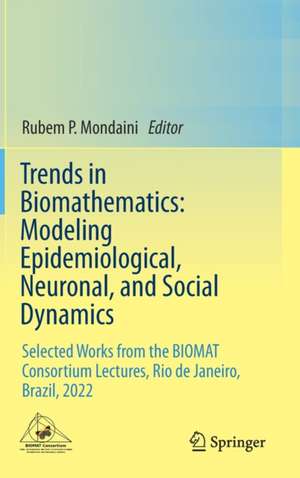
Trends in Biomathematics: Modeling Epidemiological, Neuronal, and Social Dynamics: Selected Works from the BIOMAT Consortium Lectures, Rio de Janeiro, Brazil, 2022
Editat de Rubem P. Mondainien Limba Engleză Hardback – 25 iul 2023
Topics touched on in this volume include infection spread in a population described by an agent-based approach; the study of gene essentiality via network-based computational modeling; stochastic models of neuronal dynamics; and the modeling of a statistical distribution of amino acids in protein domain families. The reader will also find texts in epidemic models with dynamic social distancing; with no vertical transmission; and with general incidence rates. Aspects of COVID-19 dynamics: the use of an SEIR model to analyze its spread in Brazil; the age-dependent manner of modeling its spread pattern; the impact of media awareness programs; and a web-based computational tool for Non-invasive hemodynamics evaluation of coronary stenosis are also covered.
Held every year since 2001, The BIOMAT International Symposium gathers together, in a single conference, researchers from Mathematics, Physics, Biology, and affine fields to promote the interdisciplinary exchange of results, ideas and techniques, promoting truly international cooperation for problem discussion. BIOMAT volumes published from 2017 to 2021 are also available by Springer.
| Toate formatele și edițiile | Preț | Express |
|---|---|---|
| Paperback (3) | 622.29 lei 6-8 săpt. | |
| Springer International Publishing – 10 ian 2019 | 622.29 lei 6-8 săpt. | |
| Springer International Publishing – 28 iul 2022 | 860.53 lei 6-8 săpt. | |
| Springer International Publishing – 3 ian 2024 | 861.90 lei 6-8 săpt. | |
| Hardback (7) | 628.40 lei 6-8 săpt. | |
| Springer International Publishing – 28 aug 2018 | 628.40 lei 6-8 săpt. | |
| Springer International Publishing – 6 iul 2020 | 763.32 lei 6-8 săpt. | |
| Springer International Publishing – 27 iul 2021 | 866.45 lei 6-8 săpt. | |
| Springer International Publishing – 2 ian 2023 | 867.82 lei 6-8 săpt. | |
| Springer International Publishing – 17 oct 2019 | 868.56 lei 6-8 săpt. | |
| Springer Nature Switzerland – 25 iul 2023 | 918.59 lei 6-8 săpt. | |
| Springer Nature Switzerland – 28 iun 2024 | 969.60 lei 6-8 săpt. |
Preț: 918.59 lei
Preț vechi: 1120.23 lei
-18% Nou
Puncte Express: 1378
Preț estimativ în valută:
162.52€ • 189.63$ • 142.09£
162.52€ • 189.63$ • 142.09£
Carte tipărită la comandă
Livrare economică 16-30 ianuarie 26
Preluare comenzi: 021 569.72.76
Specificații
ISBN-13: 9783031330490
ISBN-10: 3031330498
Ilustrații: X, 392 p. 118 illus., 97 illus. in color.
Dimensiuni: 155 x 235 mm
Greutate: 0.74 kg
Ediția:1st ed. 2023
Editura: Springer Nature Switzerland
Colecția Springer
Locul publicării:Cham, Switzerland
ISBN-10: 3031330498
Ilustrații: X, 392 p. 118 illus., 97 illus. in color.
Dimensiuni: 155 x 235 mm
Greutate: 0.74 kg
Ediția:1st ed. 2023
Editura: Springer Nature Switzerland
Colecția Springer
Locul publicării:Cham, Switzerland
Cuprins
Dynamics of an SIS Epidemic Model with no Vertical Transmission.- Infection Spread in Populations: An Agent Based Model.- Network-based Computational Modeling to unravel Gene Essentiality.- Nonlinear Dynamics in an SIR model with Ratio-Dependent Incidence and Holling type III Treatment Rate Functions.- Comparative Study of Deterministic and Stochastic Predator Prey System incorporating a Prey Refuge.- Mathematical Modeling and Numerical Analysis of HIV-1 Infection with long-lived infected cells during Combination Therapy and Humoral Immunity.- A Reaction-Diffusion Fractional Model for Cancer Virotherapy with Immune Response and Hattaf Time-Fractional Derivative.- A Review of Stochastic Models of Neuronal Dynamics: From a Single Neuron to Networks.- Modeling the Impact of Media Coverage on the Spread of Infectious Diseases: The curse of 21st Century.- Cultural and Biological Transmission: A Simple Case of Evolutionary Discrete Dynamics.- The Maximal Extension ofthe Strict Concavity Region on the Parameter Space for Sharma-Mittal Entropy Measures – II.- An Eco-epidemic Predator-Prey Model with Selective Predation and Time Delays.- Epidemic Patterns of Emerging Variants with Dynamical Social Distancing.- On Time-delayed Two-strain Epidemic Model with General Incidence Rates and Therapy.- Clustering of Countries based on the Associated Social Contact Patterns in Epidemiological Modelling.- Multiple Predation on Prey Herding and Counteracting the Hunting.- Benefits of Application of Process Optimization in Pharmaceutical Manufacturing — A Panoramic View.- AWeb-based Non-invasive Estimation of Fractional Flow Reserve (FFR): Models, Algorithms and Application in Diagnostics.- Perturbing Coupled Multi-variable Systems.- Analysis of Covid-19 dynamics in Brazil by recursive state and parameter estimations.- Computational Modeling of Membrane Blockage via Precipitation: a 2D Extended Poisson-Nernst-Planck Model.- Index.
Notă biografică
Rubem P. Mondaini is President of the BIOMAT Consortium/International Institute for Interdisciplinary Sciences and a Full Professor of Mathematical Biology and Biological Physics at the Federal University of Rio de Janeiro, Brazil. He holds a PhD in Theoretical Physics from the Brazilian Centre for Physical Research, Brazil. His research activities abroad include a period as a Visiting Scientist at the International Centre for Theoretical Physics (ICTP), Trieste, Italy (1978) and as a Senior Postdoc at the Department of Mathematics of King's College, University of London, UK (1986). He was also a Visiting Professor at the Centre of Physics of Condensed Matter, Lisbon, Portugal (1986) and at the Department of Chemical Engineering of Princeton University (2008). He has been the Chairman of the Annual BIOMAT Conferences since their inception during the BIOMAT 2001 Symposium in Rio de Janeiro, Brazil.
Textul de pe ultima copertă
This volume gathers together selected peer-reviewed works presented at the BIOMAT 2022 International Symposium, which was virtually held on November 7-11, 2022, with an organization staff based in Rio de Janeiro, Brazil.
Topics touched on in this volume include infection spread in a population described by an agent-based approach; the study of gene essentiality via network-based computational modeling; stochastic models of neuronal dynamics; and the modeling of a statistical distribution of amino acids in protein domain families. The reader will also find texts in epidemic models with dynamic social distancing; with no vertical transmission; and with general incidence rates. Aspects of COVID-19 dynamics: the use of an SEIR model to analyze its spread in Brazil; the age-dependent manner of modeling its spread pattern; the impact of media awareness programs; and a web-based computational tool for Non-invasive hemodynamics evaluation of coronary stenosis are also covered.
Held every year since 2001, The BIOMAT International Symposium gathers together, in a single conference, researchers from Mathematics, Physics, Biology, and affine fields to promote the interdisciplinary exchange of results, ideas and techniques, promoting truly international cooperation for problem discussion. BIOMAT volumes published from 2017 to 2021 are also available by Springer.
Topics touched on in this volume include infection spread in a population described by an agent-based approach; the study of gene essentiality via network-based computational modeling; stochastic models of neuronal dynamics; and the modeling of a statistical distribution of amino acids in protein domain families. The reader will also find texts in epidemic models with dynamic social distancing; with no vertical transmission; and with general incidence rates. Aspects of COVID-19 dynamics: the use of an SEIR model to analyze its spread in Brazil; the age-dependent manner of modeling its spread pattern; the impact of media awareness programs; and a web-based computational tool for Non-invasive hemodynamics evaluation of coronary stenosis are also covered.
Held every year since 2001, The BIOMAT International Symposium gathers together, in a single conference, researchers from Mathematics, Physics, Biology, and affine fields to promote the interdisciplinary exchange of results, ideas and techniques, promoting truly international cooperation for problem discussion. BIOMAT volumes published from 2017 to 2021 are also available by Springer.
Caracteristici
Features applications of mathematical and computational models in real-world challenges Regards the interplay of societal and biological aspects in a truly multidisciplinary approach Convenes timely contributions covering epidemiological, tumor, and cellular modeling