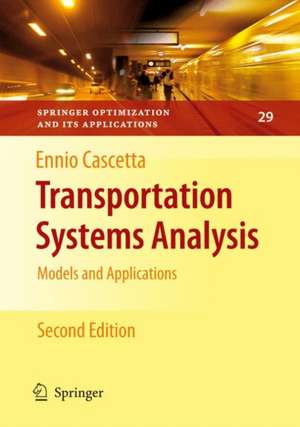
Transportation Systems Analysis
Autor Ennio Cascettaen Limba Engleză Hardback – 15 sep 2009
Într-un context global definit de urbanizarea accelerată și de necesitatea optimizării resurselor logistice, planificarea infrastructurii nu mai poate fi lăsată la voia întâmplării. Observăm că eficiența unui sistem de transport nu depinde doar de calitatea asfaltului sau a materialului rulant, ci de înțelegerea matematică a interacțiunii dintre cererea de mobilitate și oferta de servicii. Această ediție a doua a lucrării Transportation Systems Analysis oferă rigoarea necesară pentru a transforma datele brute în strategii de acțiune concrete. Ne-a atras atenția modul în care Ennio Cascetta reușește să sintetizeze complexitatea fluxurilor de trafic prin modele de utilitate aleatorie și teorii de alocare în rețea. Structura cărții este una progresivă: pornește de la conceptele preliminare de modelare, trece prin analiza ofertei și a cererii, și culminează cu metode avansate de alocare dinamică în cadrul aceleiași zile (intraperiod). Această abordare indică o acoperire exhaustivă, de la bazele teoretice până la execuția unor proiecte de mare anvergură, precum noi rețele feroviare sau optimizarea graficelor de circulație. Pe linia practică a volumului Introduction to Transportation Analysis, Modeling and Simulation, dar cu un focus mult mai accentuat pe fundamentarea teoretică a cercetării operaționale, lucrarea de față servește drept tratat de referință pentru ingineria sistemelor de transport. Descoperim aici un instrumentar analitic esențial pentru oricine dorește să înțeleagă cum funcționează modelele de atribuire statică și avansată în rețelele de transport. Cartea nu se limitează la teorie, ci oferă metodele necesare pentru a face aceste modele operaționale în evaluarea impactului social și economic al infrastructurii.
Preț: 1624.74 lei
Preț vechi: 1981.39 lei
-18%
Carte tipărită la comandă
Livrare economică 09-23 decembrie
Specificații
ISBN-10: 0387758569
Pagini: 742
Ilustrații: XVIII, 742 p. 100 illus.
Dimensiuni: 164 x 241 x 51 mm
Greutate: 1.23 kg
Ediția:2nd edition
Editura: Springer Us
Locul publicării:New York, NY, United States
V-ar putea interesa
-
 Behavioral Operational ResearchMartin Kunc-18%Preț: 1269.60 lei1548.28 lei
 -
 Unmasking Project ManagementC. Moraveck-15%Preț: 615.57 lei724.21 lei
 -
 Optimal Inventory Control and Management TechniquesMandeep Mittal-18%Preț: 966.10 lei1178.17 lei
 -
 -18%Preț: 928.48 lei1132.29 lei
 -
 Search MethodologiesEdmund K. Burke-15%Preț: 723.29 lei850.93 lei
 -
 Sustainable Logistics and Strategic Transportation PlanningToma¿ Kramberger-18%Preț: 1285.72 lei1567.95 lei
 -
 Excel Data AnalysisHector Guerrero-15%Preț: 673.55 lei792.41 lei
 -
 Introduction to Nonsmooth OptimizationAdil Bagirov-18%Preț: 953.50 lei1162.80 lei
 -
 Agricultural Cooperative Management and PolicyConstantin Zopounidis-15%Preț: 626.40 lei736.94 lei
 -
 Multiobjective Linear ProgrammingDinh The LucPreț: 442.97 lei
 -
 Understanding the Lean EnterpriseAndrea Chiarini-15%Preț: 643.63 lei757.22 lei
 -
 Gems of Combinatorial Optimization and Graph AlgorithmsAndreas S. SchulzPreț: 498.81 lei
 -
 Preț: 512.18 lei
 -
 Stochastic Modelling in Production PlanningAlexander HüblPreț: 366.44 lei
 -
 Multiagent SchedulingAlessandro Agnetis-15%Preț: 643.25 lei756.75 lei
 -
 Handling Societal ComplexityDorien Detombe-15%Preț: 715.04 lei841.22 lei
 -
 Strategic Management of Global Manufacturing NetworksThomas Friedli-15%Preț: 471.91 lei555.19 lei
 -
 Strategic Business DecisionsR. SrinivasanPreț: 392.97 lei
 -
 Benchmarking for Performance EvaluationSubhash C. Ray-15%Preț: 643.63 lei757.22 lei
 -
 -15%Preț: 625.97 lei736.44 lei
 -
 -15%Preț: 640.27 lei753.26 lei
 -
 -15%Preț: 655.95 lei771.72 lei
 -
 -18%Preț: 751.74 lei916.75 lei
Public țintă
ResearchDe ce să citești această carte
Această lucrare este indispensabilă cercetătorilor și inginerilor care fundamentează decizii de transport la nivel macro. Cititorul câștigă o înțelegere profundă a modelelor matematice care guvernează fluxurile de trafic, dobândind capacitatea de a proiecta și evalua sisteme complexe. Este resursa definitivă pentru cei care vor să treacă de la simpla colectare de date la ingineria sistemelor de transport bazată pe rigoare științifică.
Despre autor
Ennio Cascetta, născut la Napoli în 1953, este profesor universitar de Teoria Sistemelor de Transport la Universitatea din Napoli „Federico II”. Cu o carieră academică impresionantă ce include stagii de cercetare la instituții de prestigiu precum MIT și Universitatea din Montreal, Cascetta este recunoscut ca o autoritate în domeniul ingineriei transporturilor. A coordonat numeroase proiecte de cercetare naționale și internaționale, fiind director al celui de-al doilea Proiect Special pentru Transporturi din cadrul Consiliului Național de Cercetare din Italia (CNR). Experiența sa vastă se reflectă în calitatea de editor asociat pentru publicații internaționale de profil.
Descriere scurtă
Cuprins
Textul de pe ultima copertă
In this 2nd edition the author extends and generalizes the contents of the previous edition entitled "Transportation Systems Engineering: Theory and Methods" published in 2001. In addition to entirely new material dealing with the recent developments in the field, the text has been revised to simplify the presentation. The Bibliography has also been expanded significantly. All the topics are presented with simple numerical examples as well as with references to real-life applications.
The material is structured so as to offer different levels of complexity and different reading paths based on the reader’s needs. It is suitable for graduate level courses on transportation analysis and planning. Prerequisites include a basic knowledge of calculus, optimization techniques, probability theory and statistics. Due to the breadth and depth of topics covered, the book will also serve as an excellent reference guide for researchers, teachers and practitioners.