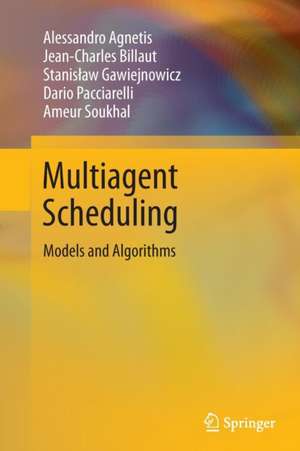
Multiagent Scheduling
Autor Alessandro Agnetis, Jean-Charles Billaut, Stanis¿aw Gawiejnowicz, Dario Pacciarelli, Ameur Soukhalen Limba Engleză Paperback – 27 aug 2016
In this book, we close this gap by presenting and developing multi-agent scheduling models in which subsets of jobs sharing the same resources are evaluated by different criteria. Several scenarios are introduced, depending on the definition and the intersection structure of the job subsets. Complexity results, approximation schemes, heuristics and exact algorithms are discussed for single-machine and parallel-machine scheduling environments. Definitions and algorithms are illustrated with the help of examples and figures.
Preț: 643.25 lei
Preț vechi: 756.75 lei
-15%
Puncte Express: 965
Carte tipărită la comandă
Livrare economică 05-19 decembrie
Livrare prin curier în România Termenul estimat este afișat lângă disponibilitate.
Transport gratuit pentru acest produs Plată online sau ramburs, în funcție de opțiunile comenzii.
Retur gratuit în 14 zile Comandă securizată și suport în română.
Specificații
ISBN-13: 9783662506356
ISBN-10: 3662506351
Pagini: 288
Ilustrații: XIII, 271 p. 55 illus.
Dimensiuni: 155 x 235 x 16 mm
Greutate: 0.44 kg
Ediția:Softcover reprint of the original 1st edition 2014
Editura: Springer
Locul publicării:Berlin, Heidelberg, Germany
ISBN-10: 3662506351
Pagini: 288
Ilustrații: XIII, 271 p. 55 illus.
Dimensiuni: 155 x 235 x 16 mm
Greutate: 0.44 kg
Ediția:Softcover reprint of the original 1st edition 2014
Editura: Springer
Locul publicării:Berlin, Heidelberg, Germany
V-ar putea interesa
-
 -23%Preț: 395.42 lei516.41 lei
 -
 Rethinking Rational Choice TheoryJan De Jonge-15%Preț: 673.28 lei792.10 lei
 -
 Making Negotiations PredictableDavid De CremerPreț: 437.46 lei
 -
 Foresight and InnovationE. Hiltunen-18%Preț: 755.06 lei920.80 lei
 -
 Managing Service OperationsBill Hollins-18%Preț: 744.01 lei907.34 lei
 -
 Introduction to Stochastic ProgrammingJohn R Birge-15%Preț: 604.81 lei711.53 lei
 -
 Newton-Type Methods for Optimization and Variational ProblemsAlexey F. Izmailov-18%Preț: 831.28 lei1013.75 lei
 -
 Integer ProgrammingMichele Conforti-43%Preț: 244.72 lei429.70 lei
Cuprins
1. Multiagent Scheduling Fundamentals.- 2. Problems, Algorithms and Complexity.- 3. Single Machine Problems.- 4. Batching Scheduling Problems.- 5. Parallel Machine Scheduling Problems.- 6. Scheduling Problems with Variable Job Processing Times.- References.
Recenzii
“It is very readable and precisely written. The major results are proved and 43 algorithmic descriptions are provided. The book contains also several numerical examples to illustrate the presented solution approaches. The book is recommended not only for researchers and practitioners working in scheduling, but also for graduate students since only basic knowledge in discrete mathematics, complexity theory, algorithms, and programming languages is required.” (Frank Werner, Mathematical Reviews, May, 2017)
Textul de pe ultima copertă
Scheduling theory has received a growing interest since its origins in the second half of the 20th century. Developed initially for the study of scheduling problems with a single objective, the theory has been recently extended to problems involving multiple criteria. However, this extension has still left a gap between the classical multi-criteria approaches and some real-life problems in which not all jobs contribute to the evaluation of each criterion.
In this book, we close this gap by presenting and developing multi-agent scheduling models in which subsets of jobs sharing the same resources are evaluated by different criteria. Several scenarios are introduced, depending on the definition and the intersection structure of the job subsets. Complexity results, approximation schemes, heuristics and exact algorithms are discussed for single-machine and parallel-machine scheduling environments. Definitions and algorithms are illustrated with the help of examples and figures.
In this book, we close this gap by presenting and developing multi-agent scheduling models in which subsets of jobs sharing the same resources are evaluated by different criteria. Several scenarios are introduced, depending on the definition and the intersection structure of the job subsets. Complexity results, approximation schemes, heuristics and exact algorithms are discussed for single-machine and parallel-machine scheduling environments. Definitions and algorithms are illustrated with the help of examples and figures.
Caracteristici
The first monograph on models and problems of multiagent scheduling Comprehensive presentation focused on applications and solution methods Numerous examples help the reader to understand the content Tables with summary of complexity results allow to find quickly needed data Bibliography with about 200 items and bibliographic remarks simplify familiarization with literature