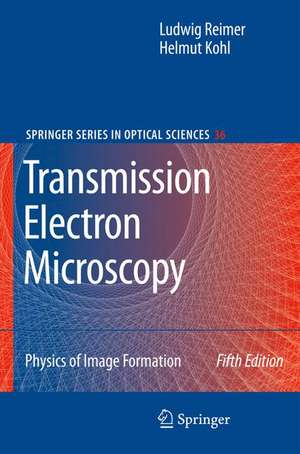
Transmission Electron Microscopy
Autor Ludwig Reimer, Helmut Kohlen Limba Engleză Hardback – 28 aug 2008
| Toate formatele și edițiile | Preț | Express |
|---|---|---|
| Paperback (1) | 1075.88 lei 6-8 săpt. | |
| Springer – 19 noi 2010 | 1075.88 lei 6-8 săpt. | |
| Hardback (1) | 1084.98 lei 6-8 săpt. | |
| Springer – 28 aug 2008 | 1084.98 lei 6-8 săpt. |
Preț: 1084.98 lei
Preț vechi: 1323.15 lei
-18% Nou
191.99€ • 225.13$ • 168.61£
Carte tipărită la comandă
Livrare economică 07-21 februarie 26
Specificații
ISBN-10: 0387400931
Pagini: 590
Ilustrații: XVI, 590 p. 276 illus.
Dimensiuni: 159 x 244 x 40 mm
Greutate: 1.02 kg
Ediția:5th edition
Editura: Springer
Locul publicării:New York, NY, United States
V-ar putea interesa
-
 -35%Preț: 871.45 lei1344.51 lei
 -
 High-Resolution Electron MicroscopyJohn C H Spence-23%Preț: 995.40 lei1292.73 lei
 -
 -8%Preț: 396.55 lei431.04 lei
 -
 Fundamentals of Light Microscopy and Electronic ImagingDouglas B Murphy-9%Preț: 972.09 lei1068.23 lei
 -
 Preț: 405.88 lei
 -
 -18%Preț: 751.83 lei916.86 lei
 -
 Scientific Researches in Atomic Force MicroscopyKate Wright-18%Preț: 606.15 lei739.20 lei
 -
 -23%Preț: 1323.49 lei1718.81 lei
 -
 ErinnerungenHelmut KohlPreț: 216.56 lei
 -
 Erinnerungen - 1990 bis 1994Helmut KohlPreț: 233.66 lei
 -
 Preț: 392.02 lei
Public țintă
ResearchCuprins
Recenzii
“A classical monograph on the physics of image formation, electron-specimen interactions, and image interpretation in transmission electron microscopy. … the student and the instructor can find applications of many fundamental concepts of physics in this book. … could be used, of course by scientists in the field of transmission electron microscopy and by students attending a summer school on the technique. … In conclusion, this book will probably be found in libraries and on the shelves of the expert in transmission electron microscopy … .” (Gary J. Long, Belgian Physical Society Magazine, Issue 1, 2011)
Textul de pe ultima copertă
Transmission Electron Microscopy: Physics of Image Formation is written for scientists and application engineers in fields such as physics, chemistry, mineralogy, materials science and biology. Researchers, students, and other users of a transmission electron microscope can also benefit from this text.
Caracteristici
Descriere
The aim of this monograph is to outline the physics of image formation, electron–specimen interactions, and image interpretation in transmission el- tron microscopy. Since the last edition, transmission electron microscopy has undergone a rapid evolution. The introduction of monochromators and - proved energy ?lters has allowed electron energy-loss spectra with an energy resolution down to about 0.1 eV to be obtained, and aberration correctors are now available that push the point-to-point resolution limit down below 0.1 nm. After the untimely death of Ludwig Reimer, Dr. Koelsch from Springer- Verlag asked me if I would be willing to prepare a new edition of the book. As it had served me as a reference for more than 20 years, I agreed without hesitation. Distinct from more specialized books on speci?c topics and from books intended for classroom teaching, the Reimer book starts with the basic principles and gives a broad survey of the state-of-the-art methods, comp- mented by a list of references to allow the reader to ?nd further details in the literature. The main objective of this revised edition was therefore to include the new developments but leave the character of the book intact. The presentation of the material follows the format of the previous e- tion as outlined in the preface to that volume, which immediately follows. A few derivations have been modi?ed to correspond more closely to modern textbooks on quantum mechanics, scattering theory, or solid state physics.