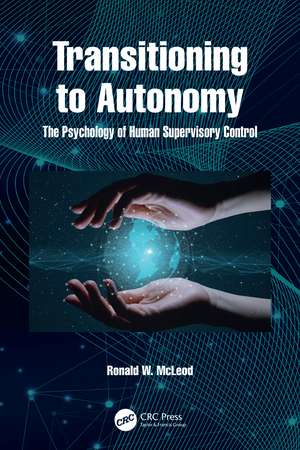
Transitioning to Autonomy: The Psychology of Human Supervisory Control
Autor Ronald McLeoden Limba Engleză Hardback – 10 feb 2026
Transitioning to Autonomy: The Psychology of Human Supervisory Control focuses on the transition period when automation is being introduced, and the human needs to learn and develop the competence to perform their new role effectively. The first Part extracts general lessons from the author’s experience taking ownership of a new car which, under certain circumstances, was capable of driving autonomously. Part 2 explores the psychology behind the lessons extracted in Part 1 and proposes a comprehensive model of human supervisory control. The final Part focuses on six principal risks associated with human supervisory control and examines how the expectation that people will be proactive in monitoring for threats to the automation’s performance is often relied on as a defence, or “Barrier”, against serious adverse events. The core benefit for the reader is a deeper understanding of what it takes, cognitively, emotionally, and organisationally, to ensure safe and effective human oversight in the age of automation. It aims to give the reader the lowdown on delivering safer systems.
The book is for managers, engineers, safety professionals and those from other technical disciplines who have responsibility for the design, development and/or assurance of products that automate the control of real-time activities; it’s for regulators and others responsible for setting policy and ensuring products automating real-time activities are safe; and it’s for Human Factors and other professionals who need to understand and develop competence in aspects of the psychology associated with automated systems.
Preț: 960.05 lei
Preț vechi: 1170.79 lei
-18%
Puncte Express: 1440
Carte tipărită la comandă
Livrare economică 01-15 decembrie
Livrare prin curier în România Termenul estimat este afișat lângă disponibilitate.
Transport gratuit pentru acest produs Plată online sau ramburs, în funcție de opțiunile comenzii.
Retur gratuit în 14 zile Comandă securizată și suport în română.
Specificații
ISBN-13: 9781041154464
ISBN-10: 1041154461
Pagini: 336
Ilustrații: 104
Dimensiuni: 156 x 234 mm
Greutate: 0.78 kg
Ediția:1
Editura: CRC Press
Colecția CRC Press
ISBN-10: 1041154461
Pagini: 336
Ilustrații: 104
Dimensiuni: 156 x 234 mm
Greutate: 0.78 kg
Ediția:1
Editura: CRC Press
Colecția CRC Press
V-ar putea interesa
-
 Roadcraft - the Police Drivers HandbookThe Police FoundationPreț: 207.05 lei
 -
 The Means of Prediction: How AI Really Works (and Who Benefits)Maximilian Kasy-20%Preț: 121.37 lei151.71 lei
 -
 The Glass CageNicholas CarrPreț: 94.75 lei
 -
 Oh's Intensive Care ManualJonathan M. Handy-29%Preț: 692.37 lei971.74 leiRecomandat
 -
 Sabiston Textbook of Surgery: The Biological Basis of Modern Surgical PracticeDouglas Scott Tyler-29%Preț: 1169.15 lei1645.26 leiRecomandat
 -
 -29%Preț: 222.84 lei315.67 lei
 -
 -31%Preț: 224.51 lei324.87 lei
 -
 -14%Preț: 738.12 lei858.27 lei
 -
 Driving Intelligence: The Green Book: Routes to AutonomyJ. Mark Bishop-20%Preț: 297.95 lei372.44 lei
 -
 Autonomous Vehicles Set: 2-Volume SetJoseph Giacomin-8%Preț: 587.92 lei639.05 lei
 -
 -20%Preț: 419.94 lei524.92 lei
 -
 Human Factors Handbook for Process Plant OperationsCenter for Chemical Process Safety (CCPS)-23%Preț: 1045.34 lei1357.59 lei
 -
 The First 90 DaysMichael WatkinsPreț: 176.86 lei
 -
 -35%Preț: 45.12 lei68.98 lei
 -
 -20%Preț: 191.04 lei239.83 lei
 -
 Human-Automation InteractionVincent G. Duffy-20%Preț: 1106.44 lei1383.05 lei
 -
 Autonomes FahrenBernd H. Oppermann-24%Preț: 643.94 lei847.30 lei
 -
 -26%Preț: 89.57 lei120.56 leiRecomandat
 -
 More HumanRasmus HougaardPreț: 188.05 lei
Public țintă
Professional ReferenceCuprins
1. Introduction. 2. Key Concepts and Terminology. Part 1: Transitioning To A Self-Driving Car: A Learning Experience. 4. A Journey Of Discovery. 5. So What Was Learned? Part 2: Modelling Human Supervisory Control. 6. Learnings From Incidents. 7. Models Of Human Supervisory Control. 8. What's Missing From Models Of Human Supervisory Control. 9. A Comprehensive Model Of Human Supervisory Control. Part 3: Supervisory Control As A Safety Defence. 10. Assuring The Reliability Of Human Supervisory Control. 11. Proactive Operator Monitoring As A Barrier. 12. The Proactive Operator Monitoring Assessment Tool For Supervisory Control (POMATsc).
Notă biografică
Ron McLeod holds an Honours degree in Psychology, an MSc in Ergonomics and a Ph.D. in Engineering and Applied Science and has spent more than 40 years as a Human Factors specialist working primarily in safety critical and high hazard industries.
Ron has been influential helping industry learn, develop, and apply best practice in Human Factors in the management of major hazards. As well as his 2015 book, ‘Designing for Human reliability: Human Factors Engineering in the Oil, Gas and Process Industries’, Ron has published more than 30 papers in the technical and scientific press in his own name, as well as contributing to numerous industry guides and best practices produced by a variety of professional and industry bodies. He has taken an active, and often a leadership, role in organisations including the International Oil and Gas Producer’s Association (IOGP), the Society of Petroleum Engineers (SPE), the UK’s Process Safety Advisory Committee (PSAC), the Energy Institute (EI), the Chartered Institute of Ergonomics and Human Factors (CIEHF) and the Centre for Chemical Process Safety (CCPS).
Ron holds a position as Honorary Professor of Engineering Psychology at Heriot-Watt University, Edinburgh, and has been Visiting Professor of Human Factors at Loughborough University, School of Design. He is a Fellow, and has been a Trustee and Member of Council, of the UK’s Chartered Institute of Ergonomics & Human Factors (CIEHF) and has served as a member of a peer review panel for the US National Academy of Sciences, Engineering, and Medicine. Ron was the project lead and principal author for three CIEHF White Papers, including the 2022 publication “Human Factors in Highly Automated Systems”.
In 2020, Ron was awarded the CIEHF’s Lifetime Achievement Award, and in 2022 he was made a Fellow of the International Ergonomics Association in recognition of his “..outstanding and sustained performance in the field of ergonomics and human factors at an international level…”. He retired from full-time working in 2022, but remains active lecturing and writing, when he is not playing guitar, golf, bridge or cycling.
Ron has been influential helping industry learn, develop, and apply best practice in Human Factors in the management of major hazards. As well as his 2015 book, ‘Designing for Human reliability: Human Factors Engineering in the Oil, Gas and Process Industries’, Ron has published more than 30 papers in the technical and scientific press in his own name, as well as contributing to numerous industry guides and best practices produced by a variety of professional and industry bodies. He has taken an active, and often a leadership, role in organisations including the International Oil and Gas Producer’s Association (IOGP), the Society of Petroleum Engineers (SPE), the UK’s Process Safety Advisory Committee (PSAC), the Energy Institute (EI), the Chartered Institute of Ergonomics and Human Factors (CIEHF) and the Centre for Chemical Process Safety (CCPS).
Ron holds a position as Honorary Professor of Engineering Psychology at Heriot-Watt University, Edinburgh, and has been Visiting Professor of Human Factors at Loughborough University, School of Design. He is a Fellow, and has been a Trustee and Member of Council, of the UK’s Chartered Institute of Ergonomics & Human Factors (CIEHF) and has served as a member of a peer review panel for the US National Academy of Sciences, Engineering, and Medicine. Ron was the project lead and principal author for three CIEHF White Papers, including the 2022 publication “Human Factors in Highly Automated Systems”.
In 2020, Ron was awarded the CIEHF’s Lifetime Achievement Award, and in 2022 he was made a Fellow of the International Ergonomics Association in recognition of his “..outstanding and sustained performance in the field of ergonomics and human factors at an international level…”. He retired from full-time working in 2022, but remains active lecturing and writing, when he is not playing guitar, golf, bridge or cycling.
Recenzii
With the increased emphasis on artificial intelligence and plans to implement it for so many different tasks in industries across the board, this is a timely volume that will be highly useful for many.
Mica Endsley, President, SA Technologies Inc
Ron McLeod’s vivid, relatable examples make complex topics accessible to both experts and non-experts, making this book essential reading for designers, manufacturers, regulators, and anyone interested in automation's future.
Niav Hughes Green, Human Factors Research Psychologist.Office of Nuclear Regulatory Research. U.S. Nuclear Regulatory Commission
This brilliant blend combines case studies, academic research, and the author's personal experiences to create an enjoyable, informative read.
Jenny O’Donnell, Director, Systemic Factors Ltd
It is a great introduction to HF concepts and is going to be a valuable read for most technical design and operations people.
Alistair Cowin, Director, Resilium UK
The role of people in the Pharmaceutical Manufacturing Industry is changing. AI and Automation innovations are already here and with them a dynamic risk landscape for us to navigate. When you read this book you may want to revisit your existing risk strategy and update your approach. Here is a great opportunity to learn how. In his insightful book based on years of experience and forward thinking, Ronald McLeod takes us on a relatable journey through a complex subject with practical examples, approaches and tools. We can learn how to build more confidence into our systems to keep our people safe, our patients supplied and our industry future ready.
Julie Avery, Independent Consultant. Former Global Lead for Human Factors at GSK, UK
Ron’s nicely undidactic style, built around a use case to which we can all relate, provides a fascinating range of thought provoking insights and ideas we can take away for immediate use.
John Thorogood, Well Engineering Advisor, Drilling Global Consultant LLP
Mica Endsley, President, SA Technologies Inc
Ron McLeod’s vivid, relatable examples make complex topics accessible to both experts and non-experts, making this book essential reading for designers, manufacturers, regulators, and anyone interested in automation's future.
Niav Hughes Green, Human Factors Research Psychologist.Office of Nuclear Regulatory Research. U.S. Nuclear Regulatory Commission
This brilliant blend combines case studies, academic research, and the author's personal experiences to create an enjoyable, informative read.
Jenny O’Donnell, Director, Systemic Factors Ltd
It is a great introduction to HF concepts and is going to be a valuable read for most technical design and operations people.
Alistair Cowin, Director, Resilium UK
The role of people in the Pharmaceutical Manufacturing Industry is changing. AI and Automation innovations are already here and with them a dynamic risk landscape for us to navigate. When you read this book you may want to revisit your existing risk strategy and update your approach. Here is a great opportunity to learn how. In his insightful book based on years of experience and forward thinking, Ronald McLeod takes us on a relatable journey through a complex subject with practical examples, approaches and tools. We can learn how to build more confidence into our systems to keep our people safe, our patients supplied and our industry future ready.
Julie Avery, Independent Consultant. Former Global Lead for Human Factors at GSK, UK
Ron’s nicely undidactic style, built around a use case to which we can all relate, provides a fascinating range of thought provoking insights and ideas we can take away for immediate use.
John Thorogood, Well Engineering Advisor, Drilling Global Consultant LLP
Descriere
Transitioning to Autonomy: The Psychology of Human Supervisory Control focuses on the transition period when automation is being introduced, and the human needs to learn and develop the competence to perform their now role effectively.