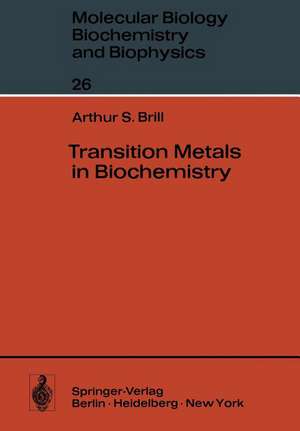
Transition Metals in Biochemistry: Molecular Biology, Biochemistry and Biophysics Molekularbiologie, Biochemie und Biophysik, cartea 26
Autor A. S. Brillen Limba Engleză Paperback – 27 dec 2011
Din seria Molecular Biology, Biochemistry and Biophysics Molekularbiologie, Biochemie und Biophysik
- 15%
 Preț: 603.74 lei
 - 15%
 Preț: 610.96 lei
 -
 Preț: 385.79 lei
 - 5%
 Preț: 709.94 lei
 - 5%
 Preț: 716.26 lei
 - 15%
 Preț: 623.70 lei
 - 15%
 Preț: 619.75 lei
 - 15%
 Preț: 609.53 lei
 - 15%
 Preț: 616.95 lei
 - 15%
 Preț: 613.00 lei
 - 15%
 Preț: 619.91 lei
 - 15%
 Preț: 653.43 lei
 - 15%
 Preț: 611.43 lei
 - 15%
 Preț: 614.73 lei
 - 15%
 Preț: 629.35 lei
 - 15%
 Preț: 625.57 lei
 - 15%
 Preț: 610.33 lei
 - 15%
 Preț: 615.52 lei
 - 15%
 Preț: 611.27 lei
 - 15%
 Preț: 624.33 lei
 - 15%
 Preț: 610.96 lei
Preț: 612.55 lei
Preț vechi: 720.65 lei
-15%
Puncte Express: 919
Carte tipărită la comandă
Livrare economică 05-19 decembrie
Livrare prin curier în România Termenul estimat este afișat lângă disponibilitate.
Transport gratuit pentru acest produs Plată online sau ramburs, în funcție de opțiunile comenzii.
Retur gratuit în 14 zile Comandă securizată și suport în română.
Specificații
ISBN-13: 9783642811500
ISBN-10: 3642811507
Pagini: 200
Ilustrații: VIII, 186 p. 7 illus.
Dimensiuni: 170 x 244 x 11 mm
Greutate: 0.33 kg
Ediția:Softcover reprint of the original 1st ed. 1977
Editura: Springer Berlin, Heidelberg
Colecția Springer
Seria Molecular Biology, Biochemistry and Biophysics Molekularbiologie, Biochemie und Biophysik
Locul publicării:Berlin, Heidelberg, Germany
ISBN-10: 3642811507
Pagini: 200
Ilustrații: VIII, 186 p. 7 illus.
Dimensiuni: 170 x 244 x 11 mm
Greutate: 0.33 kg
Ediția:Softcover reprint of the original 1st ed. 1977
Editura: Springer Berlin, Heidelberg
Colecția Springer
Seria Molecular Biology, Biochemistry and Biophysics Molekularbiologie, Biochemie und Biophysik
Locul publicării:Berlin, Heidelberg, Germany
V-ar putea interesa
-
 Principles and Practice of Clinical ResearchJohn I. Gallin-24%Preț: 674.01 lei887.05 lei
 -
 A Survival Guide for Health Research MethodsTracy Ross-33%Preț: 150.09 lei222.48 lei
 -
 The Frailty ModelLuc Duchateau-15%Preț: 671.62 lei790.14 lei
 -
 Bioconductor Case StudiesFlorian Hahne-15%Preț: 702.45 lei826.42 lei
 -
 Clinical Research in Complementary and Integrative MedicineClaudia M Witt-5%Preț: 292.81 lei308.21 lei
 -
 Tarascon Pediatric Emergency PocketbookSteven G. Rothrock-5%Preț: 130.94 lei137.83 lei
 -
 The Laboratory ZebrafishClaudia Harper-8%Preț: 459.02 lei498.93 lei
 -
 Bone-Implant Interface in Orthopedic SurgeryTheofilos Karachalios-5%Preț: 1151.17 lei1211.75 lei
 -
 Preț: 361.70 lei
 -
 Nursing Research: A Chinese PerspectiveZenobia C Y Chan-23%Preț: 816.32 lei1061.18 lei
 -
 Pharmacological Basis of Acute CareYoo Kuen Chan-5%Preț: 813.09 lei855.88 lei
 -
 -5%Preț: 848.73 lei893.39 lei
 -
 -5%Preț: 1146.56 lei1206.90 lei
Public țintă
ResearchCuprins
1 The Role of Transition Metal Ions in Biological Oxidation and Related Processes.- 1. Transition Metal Ions.- 2. Prosthetic Groups.- 3. Equilibrium Considerations in Reactions of Transition Metals.- 4. Molecular Functions of Proteins Containing Transition Metal Ion Prosthetic Groups.- 5. The Role Which a Transition Metal Ion Plays in the Function of a Protein.- 6. Experimental Methods.- 7. Some Aspects of the Role of the Polypeptide in the Functioning of Proteins Containing Transition Metal Ions.- 2 Metal Coordination in Proteins.- 1. Ligands.- 2. The Established Coordination in Several Proteins.- 3. Covalency.- 4. Some Aspects of Differences in Heme Binding.- 3 Copper.- 1. Cupric Peptides.- 2. EPR of Cupric Peptides and Related Complexes.- 3. The Blue Proteins.- 4. Magnetic and Optical Properties of Quantum Mechanical Models of the Cupric Ion.- 5. “Nonblue” Coordination in Copper Proteins.- 4 Heme Iron.- 1. Valence and Spin States of Iron.- 2. Magnetic Susceptibility.- 3. Valence State Determination.- 4. Optical Properties.- 5. Spin State Equilibria.- 6. Influences of Symmetry upon the Energy Levels of Low- and High-Spin States.- 7. Ligand Hyperfine Effects in Ferric Hemeproteins.- 8. Iron Hyperfine Effects.- 9. Modified Hemes.- 10. Photodissociation and Recombination.- 5 Nonheme Iron and Molybdenum.- 1. Iron Storage and Transport Proteins.- 2. Iron-Sulfur Proteins.- 3. Molybdenum.- 6 Electronic Structures and Properties.- 1. Atomic Orbitals.- 2. Spin States.- 3. Transition Metal Ions.- 4. Ligands and Molecular Orbitals.- 5. Absorption of Light.- 6. Interaction of Transition-Metal Ions with an Applied Magnetic Field.- 7. Magnetic Interactions of the Metal Electrons with Nuclei in the Coordination Sphere.- 8. Optical Activity.- References.