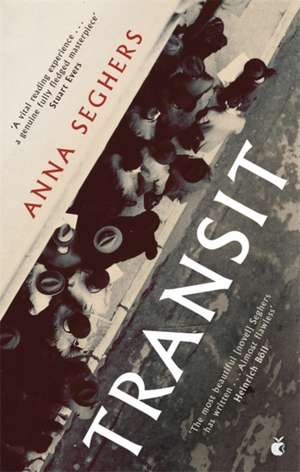
Transit: Virago Modern Classics
Autor Anna Seghers Traducere de Margot Bettauer Dembo Introducere de Stuart Eversen Limba Engleză Paperback – 2 dec 2021
An existential, political, literary thriller first published in 1944, Transit explores the plight of the refugee with extraordinary compassion and insight.
Having escaped from a Nazi concentration camp in Germany and a work camp in Rouen, the nameless narrator finds himself in the dusty seaport of Marseille. Along the way he was asked to deliver a letter to Weidel, a writer in Paris whom he discovered had killed himself as the Nazis entered the city. Now he is in search of the dead man's wife. He carries Weidel's suitcase, which contains an unfinished novel - and a letter securing Weidel a visa to escape France.
Assuming the name Seidler - though the authorities think he is in fact Weidel - he goes from cafe to cafe looking for Marie, who is in turn anxiously searching for her husband. As Seidler converses with refugees over pizza and wine, their stories gradually break down his ennui, bringing him a deeper awareness of the transitory world they inhabit as they wait and wait for that most precious of possessions: transit papers.
'This novel, completed in 1942, is in my opinion the most beautiful Seghers has written . . . almost flawless' - Heinrich Boll
Din seria Virago Modern Classics
-
 Preț: 79.15 lei
 - 26%
 Preț: 58.06 lei
 - 27%
 Preț: 57.10 lei
 - 28%
 Preț: 56.44 lei
 - 28%
 Preț: 66.39 lei
 - 25%
 Preț: 91.91 lei
 - 27%
 Preț: 57.44 lei
 - 25%
 Preț: 60.27 lei
 - 28%
 Preț: 55.77 lei
 - 26%
 Preț: 59.06 lei
 -
 Preț: 63.26 lei
 - 27%
 Preț: 57.58 lei
 - 27%
 Preț: 57.30 lei
 - 27%
 Preț: 56.09 lei
 - 28%
 Preț: 54.79 lei
 - 27%
 Preț: 57.08 lei
 - 26%
 Preț: 59.09 lei
 - 22%
 Preț: 100.04 lei
 - 28%
 Preț: 56.23 lei
 - 26%
 Preț: 91.72 lei
 - 26%
 Preț: 58.16 lei
 - 24%
 Preț: 61.27 lei
 - 27%
 Preț: 56.88 lei
 - 28%
 Preț: 65.48 lei
 - 28%
 Preț: 55.67 lei
 - 25%
 Preț: 60.03 lei
 - 26%
 Preț: 59.09 lei
 - 28%
 Preț: 56.58 lei
 - 27%
 Preț: 56.40 lei
 - 28%
 Preț: 56.48 lei
 - 24%
 Preț: 95.87 lei
 - 28%
 Preț: 64.95 lei
 - 27%
 Preț: 57.22 lei
 - 27%
 Preț: 57.24 lei
 - 26%
 Preț: 89.78 lei
 - 27%
 Preț: 51.24 lei
 - 26%
 Preț: 68.94 lei
 - 26%
 Preț: 52.45 lei
 - 25%
 Preț: 59.72 lei
 - 27%
 Preț: 57.23 lei
 - 28%
 Preț: 55.23 lei
 - 25%
 Preț: 59.57 lei
 - 27%
 Preț: 66.43 lei
 - 27%
 Preț: 56.93 lei
 - 25%
 Preț: 91.99 lei
 - 26%
 Preț: 58.22 lei
 - 27%
 Preț: 57.49 lei
 - 27%
 Preț: 57.51 lei
Preț: 58.87 lei
Preț vechi: 79.39 lei
-26%
Puncte Express: 88
Carte disponibilă
Livrare economică 09-23 noiembrie
Livrare express 23-29 octombrie pentru 41.74 lei
Livrare prin curier în România Termenul estimat este afișat lângă disponibilitate.
Transport gratuit de la 400.00 lei Plată online sau ramburs, în funcție de opțiunile comenzii.
Retur gratuit în 14 zile Comandă securizată și suport în română.
Specificații
ISBN-13: 9780349014708
ISBN-10: 0349014701
Pagini: 288
Dimensiuni: 126 x 196 x 20 mm
Greutate: 0.24 kg
Editura: Little Brown
Colecția Virago
Seria Virago Modern Classics
Locul publicării:London, United Kingdom
ISBN-10: 0349014701
Pagini: 288
Dimensiuni: 126 x 196 x 20 mm
Greutate: 0.24 kg
Editura: Little Brown
Colecția Virago
Seria Virago Modern Classics
Locul publicării:London, United Kingdom
V-ar putea interesa
-
 Last Train to FreedomDeborah SwiftPreț: 71.45 lei
 -
 The EmigrantsW. G. Sebald-19%Preț: 58.33 lei71.82 lei
 -
 AusterlitzW. G. Sebald-25%Preț: 59.56 lei79.50 lei
 -
 -25%Preț: 91.14 lei121.96 lei
 -
 Preț: 115.63 lei
 -
 The Wind Knows My Name: A Richard and Judy Book Club PickIsabel Allende-27%Preț: 41.47 lei56.53 lei
 -
 -24%Preț: 84.08 lei110.52 lei
 -
 What Strange ParadiseOmar El Akkad-35%Preț: 40.05 lei61.68 lei
 -
 False WarCarlos Manuel ÁlvarezPreț: 98.63 lei
 -
 The End and the Beginning: A NovelK. J. Holdom-18%Preț: 59.34 lei72.01 lei
 -
 The Dead Girls' Class TripAnna Seghers-19%Preț: 99.54 lei122.36 lei
 -
 Berlin ShuffleUlrich Alexander BoschwitzPreț: 136.50 lei
 -
 The Good NaziSamir Machado de MachadoPreț: 92.44 lei
 -
 The Café with No NameRobert SeethalerPreț: 105.18 lei
 -
 Lovers of Franz K.Burhan Sonmez-20%Preț: 74.64 lei92.88 lei
 -
 An Infinite SadnessAntonio XerxeneskyPreț: 85.85 lei
 -
 Every Time We Say GoodbyeIvana SajkoPreț: 77.34 lei
Recenzii
INTRODUCED BY STUART EVERS
'They kept streaming into the only port over which the French flag still waved. The masses wanting to leave the continent each week would have manned a giant flotilla. Yet not even one sad little ship was sailing on a weekly basis anymore.'
Having escaped from a Nazi concentration camp in Germany and a work camp in Rouen, the nameless narrator finds himself in the dusty seaport of Marseille. Along the way he was asked to deliver a letter to Weidel, a writer in Paris whom he discovered had killed himself as the Nazis entered the city. Now he is in search of the dead man's wife. He carries Weidel's suitcase, which contains an unfinished novel - and a letter securing Weidel a visa to escape France.
Assuming the name Seidler - though the authorities think he is in fact Weidel - he goes from cafe to cafe looking for Marie, who is in turn anxiously searching for her husband. As Seidler converses with refugees over pizza and wine, their stories gradually break down his ennui, bringing him a deeper awareness of the transitory world they inhabit as they wait and wait for that most precious of possessions: transit papers.
An existential, political and literary thriller first published in 1944, Transit is a multi-layered wartime masterpiece that explores the plight of the refugee with extraordinary compassion and insight.
'Transit belongs to those books that entered my life, and which I continue to engage with in my writing, so much that I have to pick it up every couple years to see what has happened between me and it' Christa Wolf
In political, cultural and artistic terms, Transit offers a vital reading experience: one that is more than just a keen-eyed depiction of a dark and desperate time, but a radical, constantly evolving narrative that delves to the heart of what it is to be human in an inhuman society . . . a genuine, fully fledged masterpiece
Transit belongs to those books that entered my life, and which I continue to engage with in my writing, so much so that I have to pick it up every couple of years to see what has happened between me and it
This novel, completed in 1942, is in my opinion the most beautiful Seghers has written . . . I doubt that our post-1933 literature can point to many books that have been written with such somnambulistic sureness and are almost flawless
No reader will question the author's sincerity as she strives to anatomize the refugee mind
One the most respected and important German authors of the 20th century . . . an important untold story of the refugee situation in Second World War-era Europe . . . A masterpiece
What makes Seghers's story so convincing is the human authenticity of her characters, and the masterly panorama of Vichy Marseille, that 'tiny spigot through which the world flood of Europe's fleeing thousands sought to pour.' Often as that heart-choking picture has been drawn before, both in factual reports and fiction, Seghers's presentation will stir the reader's imagination to its depth
Transit is an eerily poignant read some eighty years after it was first published . . . It is a thriller, yes, but it is a strange one. It might also be called a tragicomedy. Its brilliance has to with this unpindownable-ness. It has to do with the contrast between the genre elements of the novel and the stark, autobiographical realism grounding the narrative. With the way that Seghers artfully renders her characters - comically, tenderly, at times unsympathetically. In big and small ways, the novel resonates
'They kept streaming into the only port over which the French flag still waved. The masses wanting to leave the continent each week would have manned a giant flotilla. Yet not even one sad little ship was sailing on a weekly basis anymore.'
Having escaped from a Nazi concentration camp in Germany and a work camp in Rouen, the nameless narrator finds himself in the dusty seaport of Marseille. Along the way he was asked to deliver a letter to Weidel, a writer in Paris whom he discovered had killed himself as the Nazis entered the city. Now he is in search of the dead man's wife. He carries Weidel's suitcase, which contains an unfinished novel - and a letter securing Weidel a visa to escape France.
Assuming the name Seidler - though the authorities think he is in fact Weidel - he goes from cafe to cafe looking for Marie, who is in turn anxiously searching for her husband. As Seidler converses with refugees over pizza and wine, their stories gradually break down his ennui, bringing him a deeper awareness of the transitory world they inhabit as they wait and wait for that most precious of possessions: transit papers.
An existential, political and literary thriller first published in 1944, Transit is a multi-layered wartime masterpiece that explores the plight of the refugee with extraordinary compassion and insight.
'Transit belongs to those books that entered my life, and which I continue to engage with in my writing, so much that I have to pick it up every couple years to see what has happened between me and it' Christa Wolf
In political, cultural and artistic terms, Transit offers a vital reading experience: one that is more than just a keen-eyed depiction of a dark and desperate time, but a radical, constantly evolving narrative that delves to the heart of what it is to be human in an inhuman society . . . a genuine, fully fledged masterpiece
Transit belongs to those books that entered my life, and which I continue to engage with in my writing, so much so that I have to pick it up every couple of years to see what has happened between me and it
This novel, completed in 1942, is in my opinion the most beautiful Seghers has written . . . I doubt that our post-1933 literature can point to many books that have been written with such somnambulistic sureness and are almost flawless
No reader will question the author's sincerity as she strives to anatomize the refugee mind
One the most respected and important German authors of the 20th century . . . an important untold story of the refugee situation in Second World War-era Europe . . . A masterpiece
What makes Seghers's story so convincing is the human authenticity of her characters, and the masterly panorama of Vichy Marseille, that 'tiny spigot through which the world flood of Europe's fleeing thousands sought to pour.' Often as that heart-choking picture has been drawn before, both in factual reports and fiction, Seghers's presentation will stir the reader's imagination to its depth
Transit is an eerily poignant read some eighty years after it was first published . . . It is a thriller, yes, but it is a strange one. It might also be called a tragicomedy. Its brilliance has to with this unpindownable-ness. It has to do with the contrast between the genre elements of the novel and the stark, autobiographical realism grounding the narrative. With the way that Seghers artfully renders her characters - comically, tenderly, at times unsympathetically. In big and small ways, the novel resonates