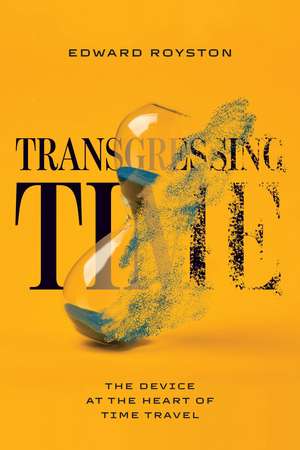
Transgressing Time: The Device at the Heart of Time Travel
Autor Edward Roystonen Limba Engleză Paperback – 27 apr 2026
The first systemic analysis of time travel as narrative device, Edward Royston’s Transgressing Time argues that as a fictional conceit, time travel can most fruitfully be understood from a narratological perspective that sidesteps questions of its plausibility. In service of this goal, Royston identifies the precise narrative device, “anachronic metalepsis,” that powers time travel. Existing at the confluence of narrative’s power to manipulate temporality and fiction’s power to transgress and displace across ontological boundaries, anachronic metalepsis demonstrates that the power of narrative itself is what enables time travel.
Royston bolsters this concept through readings of classics such as Back to the Future and Octavia E. Butler’s Kindred, contemporary works such as the video game Outer Wilds and Scott Alexander Howard’s The Other Valley, and lesser-known works such as the nineteenth-century Spanish novel El Anacronópete. These readings demonstrate how time travel functions across different mediums and genres and spotlights the ways authors and creators have used anachronic metalepsis to contend with themes of exile, freedom and consequences, the powers and pitfalls of nostalgia, the nature of history and our relationship to it, and the nature of time itself.
Royston bolsters this concept through readings of classics such as Back to the Future and Octavia E. Butler’s Kindred, contemporary works such as the video game Outer Wilds and Scott Alexander Howard’s The Other Valley, and lesser-known works such as the nineteenth-century Spanish novel El Anacronópete. These readings demonstrate how time travel functions across different mediums and genres and spotlights the ways authors and creators have used anachronic metalepsis to contend with themes of exile, freedom and consequences, the powers and pitfalls of nostalgia, the nature of history and our relationship to it, and the nature of time itself.
| Toate formatele și edițiile | Preț | Express |
|---|---|---|
| Paperback (1) | 253.89 lei Precomandă | |
| Ohio State University Press – 27 apr 2026 | 253.89 lei Precomandă | |
| Hardback (1) | 692.41 lei Precomandă | |
| Ohio State University Press – 27 apr 2026 | 692.41 lei Precomandă |
Preț: 253.89 lei
Precomandă
Puncte Express: 381
Preț estimativ în valută:
44.93€ • 52.68$ • 39.46£
44.93€ • 52.68$ • 39.46£
Carte nepublicată încă
Doresc să fiu notificat când acest titlu va fi disponibil:
Se trimite...
Preluare comenzi: 021 569.72.76
Specificații
ISBN-13: 9780814259825
ISBN-10: 0814259820
Pagini: 208
Ilustrații: 4 b&w images, 6 tables
Dimensiuni: 152 x 229 mm
Greutate: 0.45 kg
Editura: Ohio State University Press
Colecția Ohio State University Press
ISBN-10: 0814259820
Pagini: 208
Ilustrații: 4 b&w images, 6 tables
Dimensiuni: 152 x 229 mm
Greutate: 0.45 kg
Editura: Ohio State University Press
Colecția Ohio State University Press
Recenzii
“Unpretentious and highly readable, Transgressing Time reaches beyond literary scholars to science fiction fans more broadly.” —Marie-Laure Ryan, author of A New Anatomy of Storyworlds: What Is, What If, As If
“Transgressing Time offers both structural rigor and the playfulness inherent in the wide range of speculative literature it examines. Royston’s intersectional analyses don’t shy from critiquing the material. Where most analyses would stop at the unfortunate racial implications of time travel’s portrayal in narratives like Back to the Future, for example, Royston takes this further, showing how these instances are fundamental to how the narrative uses time travel structurally.” —Bogi Takács, Hugo Award–winning author, editor, and critic
Notă biografică
Edward Royston is Associate Professor of English at Pfeiffer University. His research lies at the intersection of narratology and science fiction studies. Transgressing Time is his first book.
Extras
Time travel remains one of the most perennially popular topics of fiction. Each year sees the release of more time travel narratives across many different media. Since the popularization of science fiction in the middle 20th century, there have been countless time travel stories, shows, novels, and films. Many, such as Robert Heinlein’s “By His Bootstraps” (1941) and “All You Zombies” (1959), NBC’s Quantum Leap (1989–93), Octavia E. Butler’s Kindred (1979), and Robert Zemeckis’s Back to the Future (1985), are considered landmark works of the genre. These works and many others have spawned adaptations, remakes, and sequels. Even in science fiction properties where time travel is not a central conceit, it still comes to play significant roles. Consider the many Star Trek series and films. Some of the most beloved episodes, such as the original series’ “The City on the Edge of Forever” and Next Generation’s “Yesterday’s Enterprise,” feature time travel adventures. And three of its thirteen feature-length films, including the 2009 reboot directed by J. J. Abrams, make use of the device. Time travel plays an important role in many narratives outside of science fiction as well. The romance novel Outlander by Diana Gabaldon and its sequels and television adaptation features time travel as one of their central conceits. Some of the most consequential adventures in the Dragonlance and Harry Potter fantasy series only happen thanks to time travel devices. Superhero comics, like the landmark X-Men storyline “The Days of Future Past,” and video games, like Chrono Trigger (1995), rely on time travel mechanics. Time travel appears across nearly all fictional genres and media.
While time travel is an often theorized topic in philosophy and science disciplines and a firmly established fictional device, it has received scant attention by scholars of fiction and literature. The number of published monographs on the subject can be counted on one hand, and this is not because time travel has only recently received scholarly attention. The earliest of these monographs, Bud Foote’s The Connecticut Yankee in the Twentieth Century: Travel to the Past in Science Fiction, was published in 1991. The latest, Charles M. Tung’s Modernism and Time Machines, was released in 2019. Moreover, these works are fairly narrow in their focus. As the titles of their works indicate, Foote is interested in Twain’s novel’s influence on time travel narratives, and Tung is interested in how time travel reflects the anxieties and challenges presented by modernity. Other monographs on the topic of time travel are more broadly focused. Paul J. Nahin’s Time Machines: Time Travel in Physics, Metaphysics, and Science Fiction (1993) explores the many paradoxes and particulars of fictional time travel from a scientific perspective. David Wittenberg’s Time Travel: The Popular Philosophy of Narrative (2013) considers time travel as a “narratological laboratory” and how it reflects popular science and philosophy and the structure of narratives. James Gleick’s Time Travel: A History (2016) examines how time travel has grown in popularity alongside developments in society and technology. Of these works, only Wittenberg’s touches on how time travel functions in and forms narratives.
Therein lies the gap this text aims to fill. What follows is an extensive and intensive exploration of time travel as a narrative device. I use that term very specifically. Time travel is not limited to a single plot device (a time machine or gate or portal), and its inclusion in a work of fiction can have profound effects on how that work is structured and presented to audiences. Time travel is not incidental to a work of fiction. Time travel is alien and unnatural to our lived experiences. It is employed deliberately by authors and creators toward narrative and rhetorical ends. Those narrative and rhetorical ends are many and varied, reflective of the many and varied ways in which time travel appears in fiction. This work aims to explore time travel as a narrative device and touch on its many appearances and many rhetorical and narrative ends.
While time travel is an often theorized topic in philosophy and science disciplines and a firmly established fictional device, it has received scant attention by scholars of fiction and literature. The number of published monographs on the subject can be counted on one hand, and this is not because time travel has only recently received scholarly attention. The earliest of these monographs, Bud Foote’s The Connecticut Yankee in the Twentieth Century: Travel to the Past in Science Fiction, was published in 1991. The latest, Charles M. Tung’s Modernism and Time Machines, was released in 2019. Moreover, these works are fairly narrow in their focus. As the titles of their works indicate, Foote is interested in Twain’s novel’s influence on time travel narratives, and Tung is interested in how time travel reflects the anxieties and challenges presented by modernity. Other monographs on the topic of time travel are more broadly focused. Paul J. Nahin’s Time Machines: Time Travel in Physics, Metaphysics, and Science Fiction (1993) explores the many paradoxes and particulars of fictional time travel from a scientific perspective. David Wittenberg’s Time Travel: The Popular Philosophy of Narrative (2013) considers time travel as a “narratological laboratory” and how it reflects popular science and philosophy and the structure of narratives. James Gleick’s Time Travel: A History (2016) examines how time travel has grown in popularity alongside developments in society and technology. Of these works, only Wittenberg’s touches on how time travel functions in and forms narratives.
Therein lies the gap this text aims to fill. What follows is an extensive and intensive exploration of time travel as a narrative device. I use that term very specifically. Time travel is not limited to a single plot device (a time machine or gate or portal), and its inclusion in a work of fiction can have profound effects on how that work is structured and presented to audiences. Time travel is not incidental to a work of fiction. Time travel is alien and unnatural to our lived experiences. It is employed deliberately by authors and creators toward narrative and rhetorical ends. Those narrative and rhetorical ends are many and varied, reflective of the many and varied ways in which time travel appears in fiction. This work aims to explore time travel as a narrative device and touch on its many appearances and many rhetorical and narrative ends.
Cuprins
Introduction Toward a Rhetoric of Time Travel
Chapter 1 This Only Happens in Fiction
Chapter 2 The Anachronic Metalepsis
Chapter 3 Characteristics of the Anachronic Metalepsis
Chapter 4 Dilation and Relativity: The Anachronic Metalepsis and the Speed of Light
Chapter 5 Autochthony and Recursion: The Anachronic Metalepsis and Causal and Temporal Loops
Chapter 6 Celebrating and Interrogating Nostalgia: The Anachronic Metalepsis and Historical Revision
Chapter 7 Traveling to Other Times: The Anachronic Metalepsis and Alternate Histories
Chapter 8 Spatializing Time: The Anachronic Metalepsis and Space
Conclusion Closing the Loop
Chapter 1 This Only Happens in Fiction
Chapter 2 The Anachronic Metalepsis
Chapter 3 Characteristics of the Anachronic Metalepsis
Chapter 4 Dilation and Relativity: The Anachronic Metalepsis and the Speed of Light
Chapter 5 Autochthony and Recursion: The Anachronic Metalepsis and Causal and Temporal Loops
Chapter 6 Celebrating and Interrogating Nostalgia: The Anachronic Metalepsis and Historical Revision
Chapter 7 Traveling to Other Times: The Anachronic Metalepsis and Alternate Histories
Chapter 8 Spatializing Time: The Anachronic Metalepsis and Space
Conclusion Closing the Loop
Descriere
The first systemic analysis of time travel as a narrative device in literature and pop culture, drawing on readings of Octavia E. Butler, Scott Alexander Howard, Jack Finney, and others.